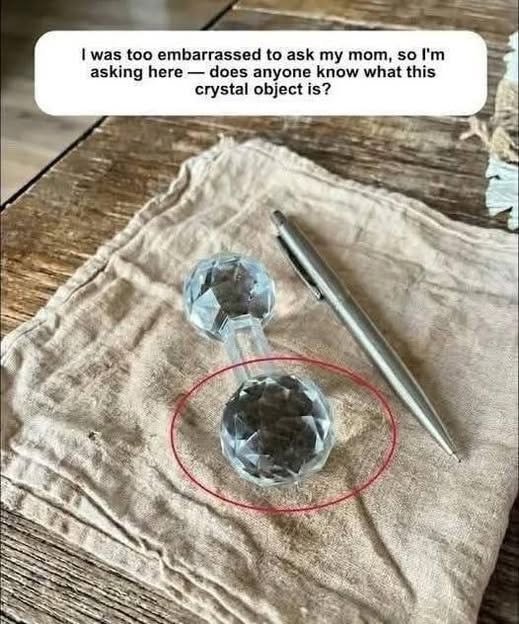
The Mystery of the Crystal Glass Dumbbell Hiding in Your Grandmother’s China Cabinet
Clearing out a family home often uncovers items that seem entirely out of place among fine porcelain, heirloom silver, and crystal wine goblets. Tucked behind the teacups or resting on a velvet-lined shelf, a heavy, clear glass cylinder shaped precisely like a miniature dumbbell frequently leaves family members scratching their heads.
What Is a Crystal Glass Dumbbell?
Often mistaken for a bizarre paperweight or a whimsical child’s toy, a crystal glass dumbbell is actually a vintage knife rest (or couteau). Popularized during the Victorian and Edwardian eras and lasting through the mid-20th century, these items served a very specific purpose in formal dining etiquette. Before the widespread use of paper napkins or casual table settings, hosts expected guests to keep their silverware clean between courses.
Placing a dirty knife flat on a pristine linen tablecloth was a major social faux pas. Instead, diners rested the blade of their knife across the raised ends of the crystal or glass dumbbell, keeping grease and food residue off the fabric. The dumbbell shape was specifically engineered with two raised ends and a recessed center to prevent the knife from rolling off onto the table or floor.
Why Were They Made of Glass or Crystal?
Victorian dining tables were theatrical productions designed to reflect candlelight from polished mahogany surfaces, silver candelabras, and cut crystal glassware. Glass knife rests acted as miniature prisms, catching and refracting light around individual place settings. Wealthier households used heavy lead crystal with intricate diamond-cut facets, while more modest families used pressed glass variants.
How to Identify and Evaluate Your Find
Uncovering one of these rare table accessories in a family collection requires evaluating a few physical characteristics:
-
Check for Maker’s Marks: Look closely at the recessed center or the flat ends for faint acid-etched signatures, trademark stamps, or mold numbers. European glassmakers like Baccarat, Waterford, and Lalique frequently produced high-end knife rests.
-
Assess the Weight and Clarity: High-quality lead crystal will feel surprisingly heavy for its compact size, cool to the touch, and emit a clear, resonant chime when gently tapped.
-
Inspect for Wear: Authentic antique knife rests often show microscopic surface scratches on the high points of the glass where heavy silver knives rested decades ago.
Are They Worth Anything Today?
While individual glass dumbbells are rarely worth a small fortune, they are highly sought after by collectors of antique barware, Victorian dining accessories, and mid-century table settings. Depending on the manufacturer, clarity, and whether you have a matching set of four to six, they can range anywhere from twenty dollars to several hundred dollars on the vintage market.
Ultimately, finding a crystal dumbbell in your grandmother’s china cabinet is a direct link to a more formal era of dining, serving as a reminder of the intricate etiquette and exquisite attention to detail that once defined family gatherings.