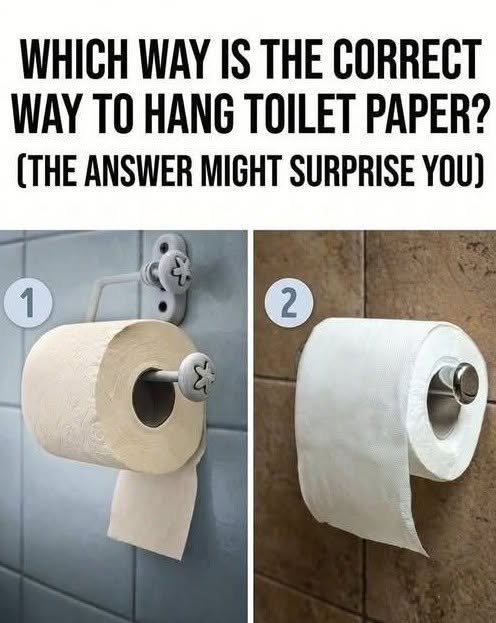
The Toilet Paper Debate That Has Divided Families for Generations!
Over or under? Dive into the hilarious psychology, historical patent proof, and domestic warfare behind the ultimate bathroom debate.
Picture this: You visit a friend’s house, use the guest bathroom, and absentmindedly reach for the toilet paper roll. As you pull, you realize something is deeply, profoundly wrong. The paper is cascading down the back side of the roll, pressed flat against the wall.
You freeze. A cold sweat breaks out. How do monsters live like this?
If this scenario makes your eye twitch, congratulations: you are an active participant in the longest-running, most fiercely contested domestic war in human history. The “Over vs. Under” toilet paper debate has severed friendships, caused late-night marital arguments, and divided households for over a century.
Why do we care so intensely about which way a cardboard cylinder faces? Let’s investigate the psychology, the engineering, and the definitive proof behind the ultimate bathroom debate.
The Historical Proof: What the Original Patent Says
Before we dive into personal preferences, let’s look at the smoking gun: history itself.
The standard perforated toilet paper roll was patented in 1891 by Seth Wheeler of Albany, New York. If you look at Wheeler’s original patent drawings—which are preserved in the United States Patent and Trademark Office archives—the illustration shows the toilet paper clearly unrolling from the front (over).
For patent purists and history buffs, this settles the argument immediately. The inventor literally designed it to flow over the top. Placing it under is, by definition, a rebellion against the creator’s vision.
The Argument for “Over” (The Logical Choice)
Advocates of the “Over” orientation—which consistently wins global polls by roughly a 70% to 30% margin—argue that their method is backed by pure common sense, hygiene, and convenience.
-
Easier Access: When the paper hangs over the front, it is effortless to grab the loose end with a single swipe without scraping your knuckles against a dusty, germ-laden bathroom wall.
-
Reduced Bacterial Transfer: In the “under” position, your hand or fingers are much more likely to brush against the bathroom wall or wallpaper while trying to unroll the sheets, transferring germs back and forth.
-
Aesthetic Appeal: Folding the final sheet into a neat little triangle (the classic hotel fold) is only physically and visually possible when the paper hangs over the front.
The Argument for “Under” (The Secret Motivations)
While the “Over” faction might hold the majority, the defenders of the “Under” orientation are fiercely loyal. When pressed for their reasoning, they usually cite a few specific lifestyle factors:
-
The Pet and Toddler Defense: If you have a mischievous cat who loves to bat at hanging things or a curious toddler who treats a toilet paper roll like a high-speed racing spool, hanging it “under” makes it much harder for them to unspool the entire roll across the hallway floor in three seconds flat.
-
The Neater Visual Profile: Proponents of the under method argue that keeping the paper tucked tightly against the wall looks cleaner and less obtrusive in cramped powder rooms.
(Secret truth: Most “Under” advocates usually admit that they simply don’t care which way the roll goes on the holder, which infuriates the “Over” crowd even more!)
What Your Preference Says About You
Believe it or not, researchers have actually studied the psychology behind this bathroom preference.
In a well-known study conducted by relationship expert Dr. Gilda Carle, participants were surveyed about their toilet paper habits and their dominance in relationships. The results were startlingly correlated:
-
The “Over” Crowd: Scored significantly higher on assertiveness, organization, and a desire to be in control of their environments.
-
The “Under” Crowd: Showed a more laid-back, go-with-the-flow personality, though they were also more prone to conflict avoidance.
Whether or not bathroom ergonomics dictate your entire psychological profile is up for debate, but it certainly explains why people take this argument so seriously.
Frequently Asked Questions
1. Is there an official global consensus on over vs. under?
Yes. Interior designers, hotel chains, and public restroom standards universally mandate the “Over” position because it is cleaner, easier to grab, and looks more professional.
2. Why do people put the roll on backwards?
Usually by accident! When people sleepily or absentmindedly replace an empty roll, they tend to drop the new roll onto the holder in whatever orientation is closest to hand without checking which way it feeds.
3. Can this issue actually cause friction in relationships?
Absolutely. Many couples report that differing toilet paper philosophies are among their earliest and most persistent domestic disagreements.
Action Checklist
-
What to Do:
-
Take a gentle inventory of your home’s bathrooms and ensure your rolls are hanging proudly in the “Over” position.
-
Laugh about the absurdity of caring so much about a cardboard tube.
-
-
What to Avoid:
-
Don’t let a misaligned toilet paper roll ruin a peaceful morning with your family!
-
Conclusion
At the end of the day, whether your toilet paper cascades gracefully over the front or tucks shyly against the wall underneath, the important thing is that it’s there when you need it. But let’s be honest—hanging it over is the correct choice.
History, patents, and basic hygiene all point to the “Over” method as the undisputed champion of the great bathroom debate.
Which side of the great toilet paper divide are you on? Are you team “Over” or team “Under”? Let us know in the comments below!