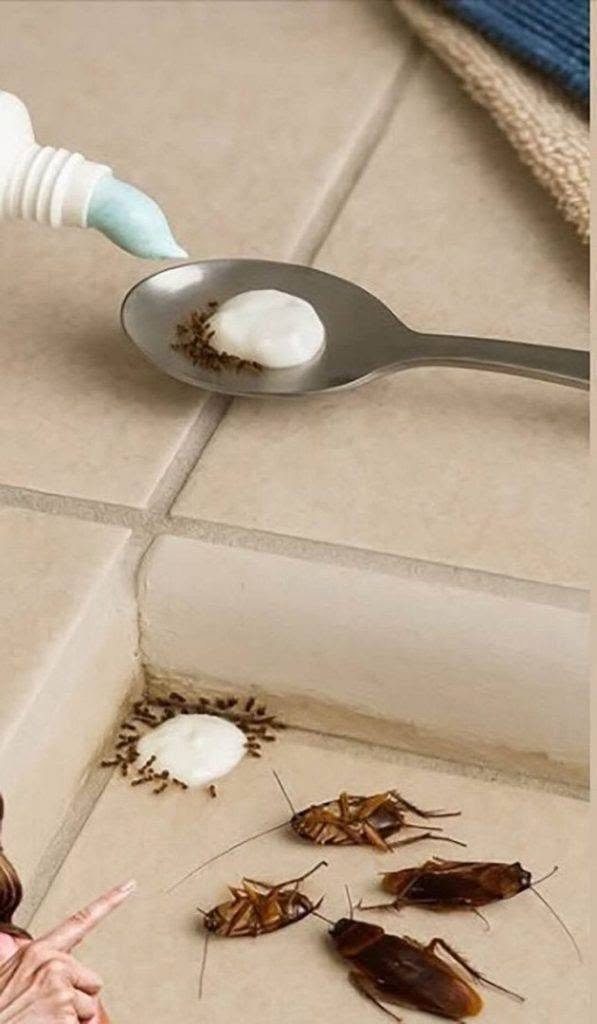
Place This Homemade Mixture in Your Kitchen for an Hour—and Cockroaches May Start Disappearing
A simple homemade cockroach bait can help target roaches, but it won’t magically eliminate every pest. Learn what works, what doesn’t, and how to use it safely.
You see one cockroach disappear behind the refrigerator.
Then another appears near the sink.
A few days later, you spot one in the kitchen at night and start wondering how many are hiding where you can’t see them.
That’s when viral home remedies become tempting.
One popular claim says you can put a simple homemade mixture in your home and, within an hour, flies, mosquitoes, and cockroaches will supposedly disappear forever.
There is a problem with that promise.
No homemade mixture can reliably guarantee that every fly, mosquito, and cockroach will vanish forever after one hour.
But there is a useful idea behind some of these recipes: cockroach baits can work by attracting roaches to a food source containing an insecticidal ingredient. Boric acid, for example, is an established cockroach-control ingredient, and EPA-registered products use it for this purpose.
So instead of repeating a sensational claim, let’s look at what actually makes a homemade-style cockroach bait useful, why it can take days rather than an hour to work, and what you should do if you also have flies or mosquitoes.
The Simple Mixture People Often Talk About
One commonly discussed homemade approach combines a food attractant with boric acid.
The logic is straightforward:
- The food component attracts cockroaches.
- The boric acid acts as the toxic ingredient.
- The cockroach encounters or consumes the bait.
- Repeated exposure can reduce the population.
Boric-acid formulations have been studied against German cockroaches, and EPA-registered cockroach products containing boric acid are available for indoor use.
But there is an important distinction between a homemade mixture and a registered cockroach bait.
A registered product has labeling that specifies where and how it can be used, along with safety precautions. EPA advises consumers to follow pesticide labels exactly and to use pesticides only for pests and locations indicated on the label.
For that reason, if you want the most predictable and controlled result, a commercially prepared, EPA-registered cockroach bait is generally preferable to experimenting with household quantities of pesticide ingredients.
Why the “One Hour” Claim Is Misleading
This is where the viral version of the story falls apart.
A cockroach bait isn’t like a spray that immediately knocks down an insect.
The roach first has to encounter the bait.
It may then consume it or contact it.
The active ingredient then has to affect the insect.
And there may be many other cockroaches hiding in cracks, cabinets, appliances, walls, or other inaccessible areas.
Research on boric-acid cockroach formulations has found that mortality can take several days rather than minutes. In one study, boric-acid formulations had a median lethal time of approximately 5.5 days under continuous-exposure conditions.
So if you put out a bait and don’t see a dramatic change after an hour, that doesn’t necessarily mean it failed.
Cockroach control is usually a population-management problem, not a one-hour knockout.
Why Cockroach Bait Can Be More Useful Than Spraying the Whole Room
When people see a cockroach, the instinctive reaction is often to grab an aerosol spray and attack it.
That may kill the individual insect you can see.
But it doesn’t necessarily address the insects you cannot see.
EPA recommends integrated pest-management approaches that begin with removing food, water, and shelter and then using targeted control methods when necessary. The agency specifically notes that baits can be an effective first line of chemical defense when used safely and kept away from children and pets.
That makes sense when you think about how cockroaches live.
They don’t need much.
A few crumbs.
A leaking pipe.
Moisture beneath a sink.
A cardboard box.
A dark crack behind an appliance.
Those small resources can be enough to keep a population going.
The Real Secret: Remove What Is Feeding Them
Suppose you put out bait but leave food crumbs under the stove every night.
Or there is a dripping faucet beneath the kitchen sink.
Or pet food remains in a bowl overnight.
Or cardboard boxes are stacked in a warm corner.
You’ve made the cockroach’s environment comfortable.
EPA recommends reducing access to food and water, cleaning up crumbs and spills, storing food in sealed containers, fixing leaks, reducing clutter, and sealing cracks and openings.
This is why pest control works better as a system.
Bait attracts and controls pests. Sanitation removes competing food sources. Exclusion prevents new pests from entering.
Those three strategies reinforce one another.
A Safer Way to Approach a Homemade Cockroach Remedy
If you are considering a boric-acid-based approach, don’t treat boric acid like ordinary baking ingredients.
It is an insecticide.
That means it deserves pesticide-level caution.
EPA materials specifically warn that boric acid products should be kept away from children and pets and used according to the applicable directions.
For households with young children, crawling babies, curious pets, or food-preparation areas, a properly designed and labeled bait station can provide a much more controlled application than loose homemade powder.
Keep these rules in mind
Never place insecticidal bait where children or pets can reach it.
Don’t put pesticide mixtures directly beside exposed food, dishes, or food-preparation surfaces.
Don’t scatter large amounts of powder around a room.
Don’t assume that using more product makes it work faster.
Don’t mix different pesticides together.
Don’t use a product for a pest or location that isn’t listed on its label.
EPA specifically advises consumers not to use more pesticide than directed and warns that pesticides can become dangerous when handled improperly.
What About Baking Soda and Sugar?
You’ve probably seen another popular recipe:
sugar + baking soda.
The theory is that sugar attracts cockroaches while baking soda is supposed to kill them.
This mixture is widely discussed online, but it should not be presented as a proven replacement for registered cockroach bait.
The evidence supporting boric-acid-based cockroach control is considerably stronger.
If you’re dealing with a genuine infestation, relying on a kitchen recipe that has not been adequately tested can waste time while the population continues reproducing.
That’s an important distinction between an internet hack and evidence-based pest management.
What About Flies?
Here’s where the viral headline becomes particularly misleading.
A cockroach bait isn’t automatically a fly killer.
House flies have different feeding behavior, biology, and control strategies.
If flies are appearing indoors, first look for the source.
Check:
- Garbage containers
- Overripe fruit
- Food scraps
- Recycling bins
- Pet waste
- Dirty drains
- Forgotten food beneath appliances
- Open doors and windows
- Damaged screens
Removing the breeding or feeding source is often more useful than placing a random substance in the middle of the room.
A kitchen full of accessible food waste can attract flies regardless of what you place on the counter.
And Mosquitoes Are a Completely Different Problem
Mosquitoes generally aren’t controlled by putting a cockroach bait inside your house.
If mosquitoes are repeatedly entering your home, inspect screens, doors, and other entry points.
But the bigger issue may be outside.
Look for standing water around:
- Plant saucers
- Buckets
- Toys
- Gutters
- Trash containers
- Birdbaths
- Unused equipment
- Other outdoor containers
Mosquitoes can reproduce in surprisingly small amounts of standing water.
So if you eliminate the insects inside but leave their breeding habitat outside, the problem may simply return.
The One-Hour Trick That Actually Makes Sense
There is one thing you can accomplish in about an hour that can make a meaningful difference:
Make your kitchen less attractive to cockroaches.
Start with a concentrated cleanup.
First 10 minutes: Remove food
Put away open packages.
Seal cereal, flour, sugar, snacks, and pet food.
Wipe crumbs from counters.
Clean beneath the toaster and other small appliances.
Next 10 minutes: Remove water
Dry the sink.
Check beneath the kitchen sink for leaks.
Don’t leave wet sponges or standing water around overnight.
EPA identifies food, water, and shelter as the three basic resources pests need, making their removal a central part of pest management.
Next 15 minutes: Remove hiding places
Break down unnecessary cardboard.
Clear clutter around appliances.
Remove paper bags and piles of packaging.
Cockroaches can use clutter and cardboard as shelter, and EPA specifically recommends reducing these hiding places.
Final 25 minutes: Find entry points
Inspect:
- Gaps around pipes
- Cracks around cabinets
- Spaces around baseboards
- Openings beneath doors
- Gaps around windows
- Utility penetrations
Seal appropriate cracks and openings.
This won’t kill an existing infestation by itself.
But it makes your home less hospitable and can reduce opportunities for new insects to enter.
Where Cockroaches Commonly Hide
If you’re trying to understand the problem, stop thinking only about the kitchen floor.
Look around:
- Under the refrigerator
- Behind the stove
- Beneath the kitchen sink
- Around plumbing
- Inside cabinet gaps
- Near garbage areas
- Around appliances
- Inside cardboard storage
- Along wall cracks
- In dark, warm, humid areas
Seeing one cockroach in the middle of a brightly lit room can mean it has been disturbed from a hiding place.
That’s why simply killing the one you see may not solve the underlying issue.
What If You See Cockroaches During the Day?
Cockroaches are commonly associated with nighttime activity.
So repeated daytime sightings can be a useful reason to take the situation seriously, particularly when sightings are frequent.
It doesn’t prove that you have a massive infestation.
But it does mean you shouldn’t assume the problem is limited to one insect.
At that point, inspect food sources, moisture, hiding areas, and entry points—and consider a properly labeled bait product or professional pest-control assessment.
Why Spraying Everywhere Can Backfire
More pesticide isn’t necessarily better.
EPA recommends targeted pesticide applications rather than indiscriminately spraying entire rooms and advises using baits and crack-and-crevice treatments when feasible.
There is another practical issue.
If you spray every visible surface, you may contaminate areas that don’t need treatment while doing little to reach hidden insects.
Foggers and “bug bombs” can also create unnecessary exposure risks.
EPA recommends avoiding unnecessary fogging and emphasizes targeted approaches.
The goal isn’t to make your house smell like insecticide.
The goal is to control the pest while minimizing exposure to people and animals.
A Better Strategy for a Persistent Cockroach Problem
If you’ve cleaned thoroughly and cockroaches continue appearing, move from “home remedy” thinking to integrated pest management.
Step 1: Identify the pest
Different cockroach species behave differently.
A small German cockroach requires a different strategy from a large American cockroach entering from outdoors.
Step 2: Remove food and water
This step is non-negotiable.
Step 3: Reduce hiding places
Remove clutter and unnecessary cardboard.
Step 4: Seal entry points
Pay particular attention to gaps around pipes and doors.
Step 5: Use targeted bait
Choose a product labeled for cockroach control and follow its directions.
EPA notes that baits can be effective while reducing the need for broad pesticide application when used properly.
Step 6: Monitor
Sticky monitoring traps can help reveal where activity is occurring.
Step 7: Escalate when necessary
If the infestation persists, a licensed pest-management professional can identify harborages and develop a targeted treatment plan.
Pros and Cons of Homemade Cockroach Remedies
| Approach | Potential advantage | Major limitation |
|---|---|---|
| Food-based homemade bait | Cheap and simple | Effectiveness can be uncertain |
| Baking soda + sugar | Easy to prepare | Limited evidence for reliable control |
| Boric-acid bait | Established cockroach-control ingredient | Requires careful handling |
| Commercial gel bait | Convenient and targeted | Must be kept away from children and pets |
| Bait stations | Controlled placement | May cost more than homemade options |
| Spraying visible roaches | Immediate effect on exposed insects | May not address hidden population |
| Professional pest control | Comprehensive assessment | Higher cost |
The strongest approach isn’t necessarily the cheapest.
It’s the one that actually addresses the infestation while minimizing unnecessary exposure.
Common Mistakes That Keep Cockroaches Around
Leaving pet food out overnight
Pet food can provide an easy food source.
Better: Store food securely and clean bowls and surrounding areas regularly.
Ignoring leaks
A small plumbing leak can provide a persistent water source.
Better: Repair leaks and keep sinks and surrounding areas dry.
Keeping cardboard everywhere
Boxes provide hiding places.
Better: Recycle unnecessary cardboard promptly.
Spraying every time you see a roach
This may kill the individual but leave the source untouched.
Better: Combine sanitation, exclusion, monitoring, and targeted baiting.
Putting pesticide where pets can reach it
This creates an unnecessary exposure risk.
Better: Follow the product label and use inaccessible or tamper-resistant baiting approaches where appropriate.
Believing “natural” automatically means safe
It doesn’t.
Better: Treat any substance intended to kill insects as something requiring appropriate precautions.
Can One Mixture Eliminate Cockroaches Forever?
No.
That’s the honest answer.
Even an effective bait doesn’t guarantee permanent elimination.
Cockroaches can enter from neighboring apartments, plumbing areas, deliveries, boxes, garages, or other routes.
In multi-unit housing, reinvasion can be particularly difficult to prevent.
That means long-term control requires more than a single treatment.
The environment has to change.
Food availability must be reduced.
Moisture needs to be controlled.
Entry points need to be sealed.
Harborages need to be addressed.
And established infestations may require repeated or professional treatment.
A Simple 7-Day Pest-Control Reset
Day 1: Deep-clean the kitchen
Remove crumbs, grease, food residue, and clutter.
Day 2: Fix moisture sources
Check faucets, pipes, drains, and areas beneath sinks.
Day 3: Remove cardboard
Break down boxes and eliminate unnecessary paper clutter.
Day 4: Inspect entry points
Look around doors, windows, pipes, and cabinets.
Day 5: Deploy monitoring
Place appropriate monitoring traps where you suspect activity.
Day 6: Reassess
Look for droppings, shed skins, egg cases, and new activity.
Day 7: Decide whether you need professional help
If activity remains significant, don’t keep experimenting with increasingly aggressive homemade mixtures.
A professional can identify the species and source and recommend an appropriate treatment.
The Bottom Line
There is no scientifically reliable kitchen mixture that can make flies, mosquitoes, and cockroaches disappear forever within an hour.
That headline sounds attractive because it promises an effortless solution to a frustrating household problem.
Reality is more useful.
For cockroaches, boric acid is a legitimate insect-control ingredient used in registered products, but it doesn’t work like an instant spray and can take days to produce substantial mortality.
If you want lasting results, combine targeted control with the basics: remove food and water, reduce clutter, seal entry points, monitor activity, and use labeled pest-control products responsibly.
And if you have children or pets, be especially careful with any insecticide. EPA recommends keeping pesticides inaccessible to them and following product directions precisely.
Don’t trust the “one-hour miracle” claim. A targeted cockroach bait may help, but lasting pest control comes from combining the right treatment with cleanliness, moisture control, and exclusion.