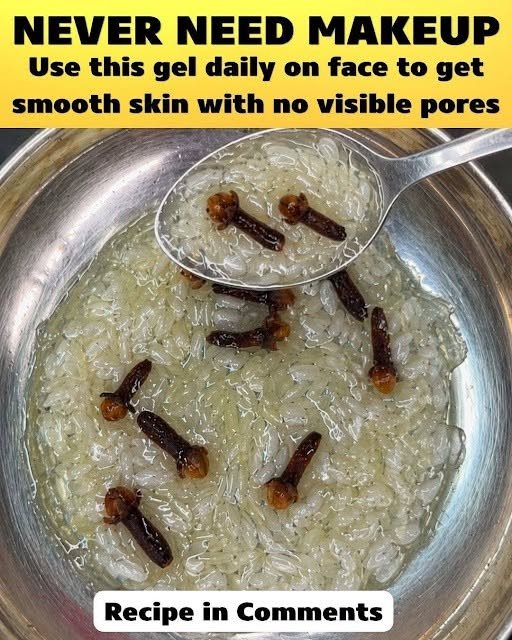
Rice Clove Gel for Tight, Naturally Glowing Skin: Does This Viral DIY Trick Actually Work?
Can rice and clove gel really tighten skin and make it glow? Learn what the evidence says, what it may do, and the risks of this DIY remedy.
You may have seen the recipe everywhere: cook rice, add cloves, turn the mixture into a gel, and apply it to your face for tighter, smoother, brighter-looking skin.
The promise is appealing.
A kitchen remedy. Cheap ingredients. No expensive serum. And supposedly, skin that looks firmer almost immediately.
But there’s a question that deserves more attention than the recipe itself:
Does rice-and-clove gel actually tighten skin—or does it simply make the surface temporarily look smoother?
Those are very different things.
Rice-derived ingredients have been studied for potential moisturizing, antioxidant, anti-inflammatory, and other cosmetic benefits. Clove contains aromatic compounds such as eugenol that can affect biological systems, but concentrated clove-derived ingredients can also irritate or sensitize skin. (PubMed)
What we don’t have is strong clinical evidence showing that a homemade rice-and-clove gel can tighten loose facial skin in the way the viral claims suggest.
That doesn’t mean the mixture can never make your skin look better.
It means we need to separate a temporary cosmetic effect from genuine skin tightening.
And once you understand that distinction, the whole trend makes a lot more sense.
The short answer: can rice-clove gel tighten skin?
Probably not in the way most viral claims suggest.
A homemade rice-and-clove gel may leave skin feeling softer, smoother, or temporarily more hydrated. If the mixture forms a film as it dries, it may also create a short-lived sensation of tightness.
But a tight feeling is not the same as tighter skin.
That difference is crucial.
The American Academy of Dermatology explains that skin-firming creams and lotions generally produce subtle results at best. When a product seems to create an immediate improvement, moisturizing can temporarily plump the skin and make fine lines less noticeable. Creams and lotions cannot penetrate deeply enough to physically lift significantly sagging skin. (AAD)
So if your face feels tighter after a homemade mask dries, that doesn’t necessarily mean collagen has increased or loose skin has been lifted.
You may simply be feeling the dried product film.
Why does the rice part seem convincing?
Rice has a surprisingly interesting history in skincare.
Researchers have identified various potentially useful components in rice and rice-derived materials, including phenolic compounds, betaine, squalene, tricin, and other substances. A review of dermatological uses of rice products found evidence suggesting potential moisturizing, anti-inflammatory, antioxidant, photoprotective, and other skin-related properties. (PubMed)
That’s promising.
But there’s a catch.
“Rice contains potentially useful compounds” does not mean “homemade rice gel tightens facial skin.”
Those are two separate claims.
Research may involve:
- A purified rice-derived ingredient
- Rice bran extract
- Fermented rice material
- A standardized cosmetic formulation
- Oral supplementation
- Laboratory or cell studies
A homemade mixture of cooked rice and water is none of those things.
The concentration of active compounds may be unknown. The stability may be unknown. The pH may vary. The preservation is questionable. And the amount reaching your skin may be completely different from the amount used in a research formulation.
This is one of the most common mistakes in DIY skincare.
A study about an ingredient gets transformed online into a claim about a recipe.
Those aren’t interchangeable.
What about studies showing rice can improve skin firmness?
This is where things get especially interesting.
There is clinical research involving rice-derived compounds and skin measurements.
For example, one open-label study involving 50 participants examined oral rice ceramide supplementation, not a homemade rice mask. The researchers reported improvements in measures including skin hydration, firmness, elasticity, and wrinkle severity. (PubMed)
That finding should not be interpreted as proof that putting cooked rice on your face produces the same effect.
Why?
Because the participants consumed a standardized supplement.
The viral recipe involves topical application of a homemade mixture.
The route of administration is different.
The formulation is different.
The ingredients are different.
The dosage is different.
The research question is different.
This is exactly why reading beyond a study’s headline matters.
A study involving rice-derived ceramides may tell us something interesting about those compounds.
It doesn’t validate every rice-based skincare recipe on social media.
And then there’s the clove
Clove is where I would be considerably more cautious.
Cloves contain eugenol, one of the compounds responsible for their characteristic aroma.
Eugenol has biological activity and is used in several medical and dental contexts. But “biologically active” isn’t synonymous with “ideal for your face.”
Some people can develop sensitivity to fragrance-related substances, and research has documented skin sensitization concerns involving eugenol and related compounds. (PubMed)
That doesn’t mean everyone will react to clove.
It does mean you shouldn’t assume that because something is edible, it is automatically suitable as a facial treatment.
Your digestive system and your skin are different environments.
And facial skin—particularly around the eyes, nose, and mouth—can be surprisingly reactive.
Why clove might make your skin feel “tight”
This is another place where the sensation can be misleading.
Suppose you apply a homemade rice-and-clove mixture.
After several minutes, your skin begins to feel tight.
You look in the mirror.
Your face appears smoother.
It is tempting to conclude:
“The gel tightened my skin.”
But there are several alternative explanations.
The mixture may have dried into a film
As water evaporates, the remaining material can contract slightly and create a tightening sensation.
Your skin may temporarily appear more hydrated
Moisturization can make fine lines less noticeable and give skin a plumper appearance. The AAD specifically notes that moisturizers can temporarily make fine lines look less noticeable. (AAD)
The surface may simply look smoother
A thin layer over the skin can temporarily change how light reflects from the surface.
That can create a “glow.”
The skin may be mildly irritated
This is the one you don’t want.
If a strongly aromatic ingredient makes your skin tingle, sting, burn, or become red, that isn’t evidence that it’s working harder.
The AAD advises stopping products that sting or burn unless they are being used under appropriate medical guidance. Irritation can actually make signs of aging more noticeable. (AAD)
Tight skin vs. temporarily tightened-looking skin
Think about a wrinkled shirt.
If you lightly dampen it and smooth it with your hands, it can look better.
But you haven’t permanently changed the fabric.
Skin isn’t a shirt, of course, but the analogy illustrates an important distinction.
Surface appearance can change faster than underlying structure.
True skin laxity involves deeper structures and changes associated with aging, collagen, elastin, genetics, sun exposure, weight changes, and other factors.
A kitchen mask doesn’t suddenly rebuild the deeper support structure of the skin.
That’s why dermatologists set realistic expectations for topical skin-firming products.
The AAD says creams and lotions may produce subtle results, but a cream cannot provide facelift-like lifting because it doesn’t penetrate deeply enough to accomplish that. (AAD)
So when a DIY mask makes your face feel “tight,” ask:
Does it look temporarily tighter, or has the underlying skin actually become firmer?
Those aren’t the same result.
Can rice gel make skin look brighter?
This claim is more plausible—but still needs qualification.
A well-moisturized skin surface can look smoother and more reflective.
That can create the appearance of a healthy glow.
Rice-derived ingredients have also been investigated for potential cosmetic effects, including moisturizing and antioxidant-related properties. (PubMed)
But there’s a difference between:
“My skin looks brighter after applying this.”
and:
“This treatment permanently changes my pigmentation.”
The first could happen through hydration and surface effects.
The second requires much stronger evidence.
And if a DIY recipe promises dramatic brightening in a few days, that’s a reason to lower your expectations—not raise them.
The problem with homemade skincare: you don’t know the formula
Commercial skincare products are formulated with specific concentrations, preservatives, pH ranges, packaging, and stability requirements.
A homemade rice gel doesn’t have those controls.
Imagine making it in your kitchen:
You cook rice.
Add water.
Add cloves.
Blend or mash everything.
Put it in a jar.
Then store it in the refrigerator.
What is the exact concentration of every ingredient?
What is the final pH?
How long is it microbiologically stable?
What organisms could grow in it?
How does its composition change after three days?
You probably don’t know.
And that’s the problem.
A homemade product containing water and food ingredients can become contaminated even when it looks perfectly normal.
“Looks clean” is not the same thing as “microbiologically safe.”
Does refrigeration make homemade rice gel safe?
Refrigeration can slow microbial growth.
It does not make a homemade cosmetic sterile or guarantee a particular shelf life.
And because the recipe has no standardized preservative system, you don’t have the same stability information you would have for a properly formulated cosmetic.
This is particularly relevant when applying something repeatedly to the face.
You’re not just putting food on a plate.
You’re applying it to a sensitive biological surface.
For people with sensitive or eczema-prone skin, the risk of irritation deserves even more attention. The AAD recommends testing new skincare products before applying them broadly and avoiding ingredients that trigger irritation. (AAD)
Is clove safe for facial skin?
It depends heavily on the form and concentration.
A tiny amount of clove used as a culinary spice is not equivalent to concentrated clove oil.
Clove oil can contain a high concentration of eugenol, and eugenol has been associated with skin sensitization concerns. (PubMed)
That’s why I would not recommend experimenting with concentrated clove essential oil on the face simply because a viral recipe uses cloves.
And I would be particularly careful around:
- The eyelids
- Under-eye area
- Lips
- Broken skin
- Active acne lesions
- Eczema
- Rosacea-prone skin
- Recently exfoliated skin
A skincare ingredient doesn’t become safer simply because it came from the pantry.
What if the recipe doesn’t use clove oil?
That’s less concerning than applying concentrated essential oil, but it doesn’t automatically establish effectiveness or safety.
If whole cloves are boiled with rice and water, some compounds from the cloves can enter the liquid.
But you still don’t know the final concentration.
You also don’t know whether that concentration is enough to produce a meaningful cosmetic benefit.
And you don’t know whether it’s irritating for your skin.
So the correct conclusion isn’t:
“Clove is dangerous.”
Nor is it:
“Clove tightens skin.”
The evidence supports something more nuanced:
Clove contains biologically active compounds, but a homemade rice-clove gel has not been established as a reliable skin-tightening treatment.
Could the gel temporarily reduce the appearance of fine lines?
Possibly.
And this is probably where some users get a genuinely noticeable result.
When skin is moisturized, the outer layer can appear smoother and fine lines may become less visible. The AAD notes that moisturizers can produce this kind of temporary plumping effect. (AAD)
A homemade gel that leaves moisture on the skin could therefore create a short-term cosmetic improvement.
But don’t confuse that with collagen remodeling.
The difference is roughly:
Temporary effect: Skin looks smoother and more hydrated.
Structural effect: Deeper skin architecture changes and remains firmer.
The first can happen relatively quickly.
The second is much harder to achieve.
What actually helps skin look firmer?
If your goal is a more youthful, firm-looking complexion, dermatologists have much more confidence in a few fundamentals.
Sun protection
UV exposure accelerates visible skin aging.
The AAD recommends daily broad-spectrum sunscreen with SPF 30 or higher as part of an anti-aging routine. (AAD)
This isn’t as exciting as a viral kitchen recipe.
But prevention is powerful.
Moisturizer
A good moisturizer can temporarily plump the outer layer of skin and reduce the appearance of fine lines. (AAD)
Retinoids
The AAD notes that products containing retinoids such as retinol can help stimulate collagen production and may provide some improvement in skin appearance over time. (AAD)
Professional treatments
For genuine skin laxity, dermatologists can offer procedures such as radiofrequency, ultrasound, and laser treatments. These can provide more meaningful tightening than topical creams, although results, risks, costs, and suitability vary. (AAD)
The important point is not that everyone needs a cosmetic procedure.
It’s that true tightening is a deeper biological problem than a homemade mask can realistically solve.
Rice-clove gel vs. proven skincare basics
| Approach | Likely benefit | Evidence for actual skin tightening |
|---|---|---|
| Rice-clove DIY gel | Temporary smoothness/hydration may occur | Insufficient |
| Basic moisturizer | Hydration and temporary plumping | Not a true lift |
| Daily SPF 30+ | Helps prevent premature photoaging | Strong preventive value |
| Retinoid/retinol | Can improve fine lines and collagen-related skin changes | Better evidence |
| Professional skin-tightening treatment | Can provide modest lifting/tightening depending on treatment | Stronger evidence |
| Surgical facelift | Most dramatic lifting for significant laxity | Strongest lifting effect |
This comparison makes one thing clear:
A DIY gel doesn’t have to be useless to be overstated.
It may make skin feel nice.
That doesn’t make it a skin-tightening treatment.
What about “natural collagen boosting”?
Be skeptical of this phrase.
Collagen is a structural protein produced within the skin.
A product containing plant compounds doesn’t automatically mean those compounds reach the appropriate skin layers, survive formulation, enter cells, and meaningfully increase collagen production.
Some cosmetic ingredients have research supporting effects on collagen-related processes.
But that evidence usually depends on the exact ingredient, concentration, formulation, exposure, and duration.
A homemade recipe doesn’t automatically inherit the evidence of every individual compound found somewhere inside its ingredients.
This is one of the biggest traps in DIY beauty content.
Ingredient science gets converted into recipe science without the missing steps.
A realistic way to think about rice skincare
Instead of asking:
“Does rice tighten skin?”
ask:
“Which rice-derived ingredient has been studied, in what form, at what concentration, and for what outcome?”
That’s a much better question.
Research on rice-derived skincare ingredients is interesting. A review found potential benefits involving moisturization, inflammation, pigmentation, and other dermatological applications. (PubMed)
But that doesn’t validate a specific homemade mask.
If you want to explore rice-based skincare, a professionally formulated product with a clearly identified rice-derived ingredient gives you considerably more information about what you’re applying.
A simple experiment if you want to see what the gel actually does
If you’re determined to try a rice-based mask, don’t judge it by the sensation alone.
Instead, observe the difference between appearance and lasting change.
Before application
Take a clear photo in the same lighting you normally use.
Don’t use a beauty filter.
Apply a small amount
Don’t start by covering your entire face.
The AAD recommends testing skincare products before broader facial use because even products marketed as gentle or hypoallergenic can cause reactions. (AAD)
Observe the immediate effect
Does your skin feel:
- Softer?
- Smoother?
- Tighter?
- Dry?
- Tingly?
- Burning?
- Red?
A tightening sensation by itself doesn’t prove actual tightening.
Check again later
Look at the skin several hours later.
Then again the following day.
If the effect disappears quickly, you’re likely seeing a temporary surface effect rather than structural tightening.
Stop if your skin reacts
Redness, burning, swelling, itching, or persistent irritation aren’t signs that the treatment is “working.”
They’re reasons to stop.
Common mistakes people make with rice-clove gel
Mistake 1: Leaving it on overnight
Longer exposure doesn’t automatically create better results.
It can increase irritation and contamination concerns.
Better approach: If you use any homemade topical mixture, keep exposure conservative and discontinue if irritation occurs.
Mistake 2: Adding more cloves
More clove doesn’t automatically mean more tightening.
It may simply mean more exposure to potentially irritating aromatic compounds.
Better approach: Don’t increase concentration to chase a stronger sensation.
Mistake 3: Scrubbing the gel into the skin
Physical rubbing can irritate the skin.
Better approach: Apply gently without aggressive rubbing.
Mistake 4: Using it every day
Daily application of a homemade mixture isn’t automatically better.
Better approach: Focus on skin tolerance and use evidence-based products for long-term goals.
Mistake 5: Using it on irritated skin
If your skin barrier is already compromised, adding a fragrant DIY ingredient may make things worse.
Better approach: Simplify your routine and prioritize gentle moisturization.
Mistake 6: Believing the tight feeling proves collagen increased
It doesn’t.
Better approach: Separate immediate sensation from long-term biological change.
What if your skin looks amazing after one use?
Enjoy the result—but interpret it correctly.
A temporary glow can be completely real.
Your skin may genuinely look smoother.
Your fine lines may look softer.
Your complexion may appear more reflective.
None of that requires the gel to have permanently tightened your skin.
This is actually good news.
You don’t have to dismiss every visible improvement just because the viral explanation is exaggerated.
You simply need to identify what kind of improvement you’re seeing.
Mini case scenario: Maria’s “tight skin” experiment
Maria is 52 and notices that her skin looks a little less firm than it did a decade ago.
She sees a rice-and-clove gel video and decides to try it.
After 15 minutes, she washes it off.
Her skin feels noticeably tight.
In the mirror, her cheeks look smoother.
Maria assumes the treatment has tightened her skin.
But the next morning, her face looks much like it did before.
What happened?
Most likely, the product changed the surface appearance and hydration of her skin temporarily.
That doesn’t mean the experience was fake.
The interpretation was wrong.
She experienced a cosmetic effect and interpreted it as structural tightening.
That’s exactly the distinction this trend needs.
Could rice-clove gel help with wrinkles?
It might temporarily make fine lines look less prominent if it hydrates and smooths the surface.
But there’s no good evidence that a homemade rice-and-clove gel can significantly reverse established wrinkles or loose skin.
The AAD advises consumers to have realistic expectations with anti-aging products and notes that creams and lotions generally provide modest results. (AAD)
If a social-media recipe promises a dramatic reduction in wrinkles in a few applications, skepticism is appropriate.
Can it replace moisturizer?
Not necessarily.
A properly formulated moisturizer is designed to hydrate and protect the skin barrier.
The AAD recommends moisturizers as one of the most effective basic anti-aging skincare products and notes that ingredients such as glycerin, hyaluronic acid, dimethicone, and petrolatum can help dry skin. (AAD)
A homemade rice gel has no standardized formulation.
It may feel hydrating.
It may also dry on the skin and leave a film.
Those aren’t the same as having a reliable moisturizer.
What about people with sensitive skin?
This is where I would be especially conservative.
If your skin is sensitive, reactive, eczema-prone, or already irritated, a homemade mixture containing a fragrant spice may not be the best experiment.
The AAD recommends fragrance-free products for people dealing with eczema and advises testing new products before broader use. (AAD)
And if a product burns or stings, don’t assume that discomfort means it’s activating collagen.
Irritation is not a skincare achievement.
The 2026 reality of DIY skincare
The internet has made ingredient experimentation incredibly accessible.
That’s both useful and dangerous.
We now have more information about cosmetic ingredients than ever before.
But we also have more opportunities to confuse:
- Laboratory research with home recipes
- Ingredient studies with finished-product studies
- Temporary hydration with structural improvement
- Tingling with effectiveness
- “Natural” with safe
- “Traditional” with clinically proven
The smartest skincare consumers aren’t necessarily the ones with the longest routines.
They’re the ones who know what evidence actually supports the product they’re using.
The future of rice-based skincare
Rice-derived cosmetic ingredients aren’t going away.
And they shouldn’t.
Research into rice-derived compounds is legitimate and potentially valuable. Scientists are investigating ways to isolate, standardize, and formulate useful components rather than simply applying kitchen ingredients directly to the skin. (PubMed)
That is probably where the future lies.
Not necessarily in rubbing cooked rice on your face.
Instead, expect more attention to:
- Standardized rice extracts
- Rice-derived antioxidants
- Fermented rice ingredients
- Rice-derived ceramides
- Barrier-support formulations
- Carefully controlled cosmetic preparations
The important word is standardized.
That’s what turns an interesting ingredient into something researchers and formulators can actually evaluate.
Frequently Asked Questions
Does rice and clove gel really tighten skin?
There is not enough clinical evidence to say that a homemade rice-and-clove gel genuinely tightens loose facial skin. It may create a temporary tightening sensation or smoother appearance as the product dries or hydrates the skin surface.
Why does my skin feel tight after using rice-clove gel?
The mixture may dry into a film, temporarily change the skin’s hydration, or create a surface effect that makes the skin feel tighter. That sensation does not prove that deeper skin tissue has been tightened.
Can rice make your skin glow?
Rice-derived ingredients have shown potential moisturizing and other cosmetic benefits in research, so a rice-based product may contribute to a smoother-looking complexion. But the evidence does not establish that homemade rice gel produces a dramatic or permanent glow. (PubMed)
**Does rice increase collagen?
Some rice-derived compounds have been investigated for skin-related effects, but evidence involving a particular rice-derived ingredient cannot automatically be applied to homemade cooked-rice gel. More research is needed before claiming that the DIY recipe meaningfully increases facial collagen.
Is clove good for your face?
Clove contains biologically active compounds such as eugenol, but those compounds can also be irritating or sensitizing for some people. Concentrated clove oil should not be treated as interchangeable with culinary quantities of whole cloves. (PubMed)
Can rice-clove gel remove wrinkles?
There is no strong evidence that a homemade rice-and-clove gel removes wrinkles. It may temporarily make fine lines less noticeable through hydration or surface smoothing, but that is different from reversing wrinkles.
How long should rice-clove gel stay on the face?
There is no clinically established application time for a homemade rice-clove gel because the recipe itself has not been validated as a skin-tightening treatment. If you experiment with any DIY topical, avoid prolonged exposure and stop immediately if it burns, stings, itches, or causes redness.
Can I use rice-clove gel every day?
Daily use isn’t necessary to achieve a proven skin-tightening effect because no such effect has been established. Repeated exposure to a homemade mixture can also increase the opportunity for irritation.
What works better for firm-looking skin?
Daily sun protection and moisturizer are strong foundations. Retinoids can improve some signs of skin aging, while professional skin-tightening procedures can provide more substantial results for appropriate candidates. (AAD)
Is a tight feeling proof that a skincare treatment works?
No. A tight sensation can come from a drying film or irritation rather than actual structural tightening. Judge skincare by evidence and longer-term outcomes, not by how strongly it tingles or tightens immediately after application.
Your Rice-Clove Skincare Checklist
If you’re curious about the trend
- Keep expectations realistic.
- Remember that a tight sensation isn’t proof of tightening.
- Patch-test unfamiliar topical mixtures.
- Avoid the eye area.
- Don’t use concentrated clove oil as a casual facial ingredient.
- Stop if you experience burning, itching, swelling, or persistent redness.
- Don’t keep homemade water-based mixtures indefinitely.
- Take consistent photos if you’re trying to evaluate a cosmetic change.
For genuinely firmer-looking skin
- Wear broad-spectrum SPF 30 or higher every day.
- Use a moisturizer suited to your skin type.
- Consider evidence-backed anti-aging ingredients such as retinoids when appropriate.
- Give skincare products enough time to work.
- Avoid aggressive scrubbing.
- Protect your skin from unnecessary irritation.
- See a board-certified dermatologist if significant sagging is your main concern.
The AAD specifically recommends sunscreen and moisturizer as core anti-aging measures and emphasizes realistic expectations from topical products. (AAD)
Rice-clove gel is an appealing DIY beauty trick because it produces exactly the kind of result that can be misleading: your skin may feel tighter almost immediately.
But a tight feeling isn’t proof that your skin has actually become firmer.
Rice-derived ingredients have legitimate scientific interest, and some rice components have been studied for moisturizing, antioxidant, barrier-related, and other skin benefits. (PubMed)
Clove also contains biologically active compounds, but those same compounds can create irritation or sensitization concerns, particularly in concentrated forms. (PubMed)
Most importantly, there isn’t strong clinical evidence showing that a homemade rice-and-clove gel can lift sagging skin or produce meaningful long-term tightening.
So if you try it and your face looks smoother afterward, that’s possible.
Just don’t mistake temporary surface improvement for structural skin tightening.
For long-term skin aging, the boring basics remain remarkably difficult to beat: protect your skin from UV exposure, moisturize consistently, use evidence-backed ingredients when appropriate, and get professional advice when genuine laxity is bothering you.
Rice-clove gel may temporarily make skin feel smoother or tighter, but there’s no good evidence that the homemade remedy genuinely tightens loose skin.
This article is for general educational purposes and does not replace individualized dermatological advice. If you have persistent irritation, significant skin changes, or concerns about skin laxity, consult a board-certified dermatologist.
:::