Scabs Behind Your Ears: What They Could Mean and When to See a Doctor
Scabs behind your ears can have many causes, from dry skin and eczema to infection. Learn what may be causing them and when medical care is needed.
Finding scabs behind your ears can be surprisingly concerning. You may notice them while washing your hair, feel a rough patch when you scratch, or discover dried blood on your pillow and wonder what is happening.
The good news is that scabs behind the ears are often caused by common skin problems rather than something serious.
Dry skin, eczema, irritation from hair products, scratching, and minor infections can all create crusting or scabbing. But persistent, painful, spreading, or repeatedly bleeding sores deserve a closer look.
The appearance of the scab—and what the surrounding skin is doing—can provide useful clues.
What Is a Scab?
A scab is part of the body’s normal wound-healing process.
When the skin is damaged, blood and other fluids can dry on the surface and form a protective crust. Underneath that crust, the body works to repair the damaged tissue.
So a scab itself is not a disease.
The more important question is why the skin was damaged in the first place.
Behind the ears, several conditions can cause repeated irritation or broken skin.
1. Dry Skin
Dry skin is one of the simplest explanations.
The skin behind the ears can become dry because of cold weather, low humidity, frequent washing, hot showers, or harsh soaps.
Dryness can cause:
- Flaking
- Tightness
- Itching
- Small cracks
- Redness
- Crusting after scratching
If you notice that the skin is generally dry or flaky elsewhere on your body, dryness becomes a more likely explanation.
Using a gentle, fragrance-free moisturizer may help restore the skin barrier.
2. Eczema
Eczema can affect the skin around and behind the ears.
It may cause redness, itching, dryness, scaling, cracking, and sometimes oozing that eventually dries into a crust.
People with eczema may notice symptoms that come and go, sometimes becoming worse during dry weather, stress, or after exposure to irritating products.
One of the biggest problems is scratching.
An itchy patch leads to scratching. Scratching damages the skin. Damaged skin forms a scab. The scab becomes itchy, and the cycle starts again.
Breaking that cycle is often an important part of improving the skin.
3. Seborrheic Dermatitis
Seborrheic dermatitis is another common cause of flaky or crusty skin around the ears and scalp.
It can produce:
- Flaking
- Greasy or dry scales
- Redness
- Itching
- Crusting
- Irritation around the ears
People with seborrheic dermatitis often have similar symptoms on the scalp, eyebrows, sides of the nose, or beard area.
Dandruff can be a milder form of the same general skin process.
If the area behind your ears is repeatedly flaky while your scalp is also affected, seborrheic dermatitis is worth discussing with a healthcare professional.
4. Contact Dermatitis
Sometimes the problem is not your skin itself.
It is something touching it.
Hair dye, shampoo, conditioner, fragrances, styling products, cosmetics, earrings, eyeglass frames, headphones, or other materials can irritate the skin or trigger an allergic reaction.
This is called contact dermatitis.
A useful clue is timing.
If the irritation started after introducing a new product, changing hair products, getting your hair colored, or wearing new jewelry, consider whether the new exposure could be responsible.
Stopping the suspected irritant may help, although persistent symptoms should still be professionally evaluated.
5. Scratching or Picking
Sometimes the original problem is tiny.
Maybe there was a mildly itchy patch, a small pimple, or a dry area.
You scratched it.
Then you scratched it again.
Eventually the skin breaks and forms a scab.
Repeated picking can prevent the area from healing and may introduce bacteria into the wound.
If you find yourself repeatedly touching the area without realizing it, keeping your fingernails short and avoiding unnecessary scratching can help.
6. Minor Skin Injuries
Small cuts and abrasions can happen without you remembering exactly how.
The skin behind the ear can be rubbed by:
- Glasses
- Masks
- Headphones
- Hat straps
- Hair accessories
- Jewelry
- Shirt collars
A minor injury can bleed slightly and form a small crust.
If the area heals normally and does not return, there may be little cause for concern.
7. Piercing Irritation
If you have an ear piercing, irritation can sometimes extend toward nearby skin.
Jewelry may cause friction or an allergic reaction, particularly when it contains nickel or another material that your skin does not tolerate well.
Watch for redness, swelling, tenderness, discharge, or persistent crusting around the piercing.
If the piercing appears infected, medical advice may be appropriate.
8. A Skin Infection
Bacteria can enter broken skin and cause an infection.
An infected area may become:
- Increasingly red
- Warm
- Swollen
- Painful
- Tender
- Oozing
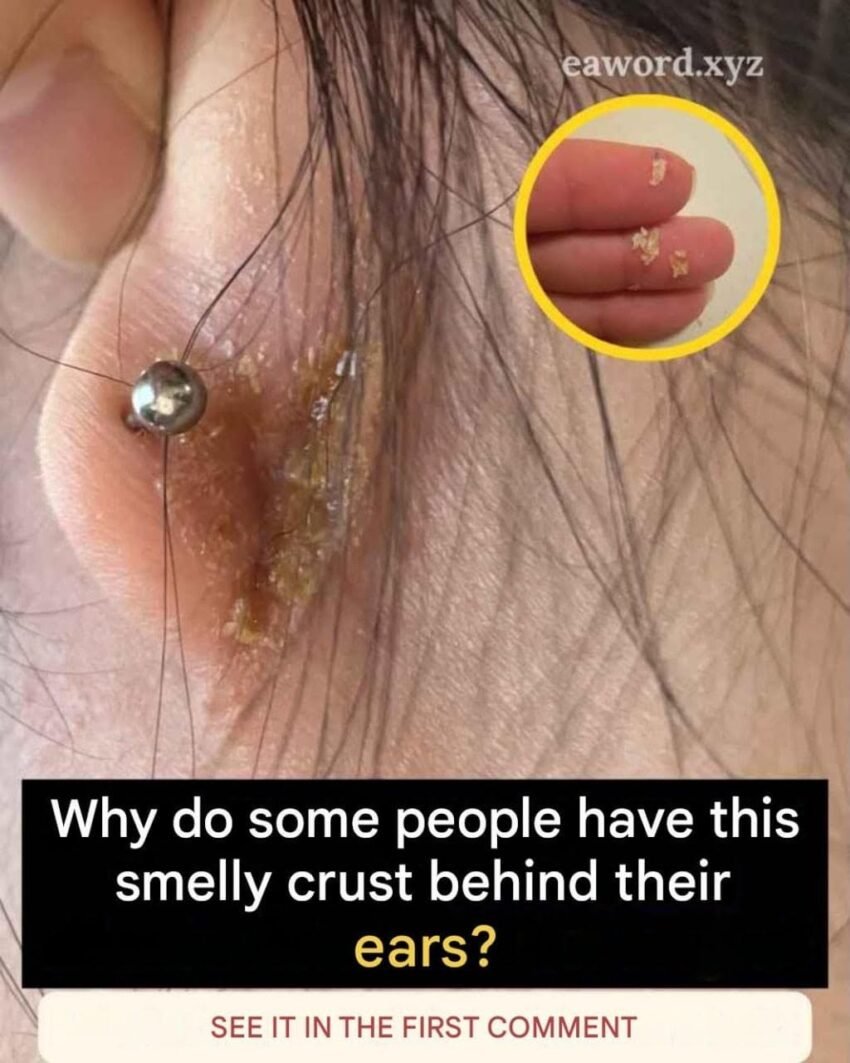
- Covered with yellowish or honey-colored crust
A small wound that becomes progressively more painful or swollen is more concerning than a stable dry patch.
Do not repeatedly pick at an infected-looking scab.
9. Fungal Infection
Fungal skin infections can sometimes affect areas around the ears.
They may cause itching, scaling, redness, irritation, or changes in the surrounding skin.
A fungal infection can resemble eczema or other forms of dermatitis, which is why guessing based solely on appearance can be unreliable.
If a rash persists despite ordinary skin-care measures, a clinician can determine whether fungal treatment is appropriate.
10. Psoriasis
Psoriasis is a chronic inflammatory skin condition that can affect the scalp and areas around the ears.
It can produce thicker, well-defined patches covered with scales.
Some people with psoriasis also have lesions elsewhere, including the elbows, knees, scalp, or nails.
Because psoriasis can resemble other skin conditions, a medical examination may be needed for confirmation.
11. Scalp Problems Spreading Toward the Ear
The skin behind the ear is close to the scalp.
A condition affecting your scalp can therefore extend toward the area behind the ears.
If you have significant dandruff, scalp itching, scaling, redness, or crusting, the underlying scalp condition may be contributing to what you see behind the ear.
Treating only the visible scab may not solve the underlying problem.
12. Allergic Reaction
An allergy to a product or material can cause intense itching and inflammation.
Possible triggers include:
- Hair dye
- Fragrance
- Earrings
- Cosmetics
- Shampoo
- Skin-care products
- Adhesives
- Certain metals
The skin may become red and itchy before it cracks or develops crusts.
If the same reaction repeatedly occurs after exposure to a particular product, stop using the suspected trigger and discuss persistent symptoms with a healthcare professional.
What Does the Color of the Scab Mean?
The color can provide clues, but it cannot reliably diagnose the cause.
Clear or light-colored crust
This may occur when irritated skin produces a small amount of clear fluid that dries.
Yellow or honey-colored crust
This can occur with certain bacterial skin infections and deserves attention if accompanied by redness, swelling, warmth, or pain.
Dark brown or black crust
This may simply represent dried blood or an older scab.
However, a persistent dark lesion should not automatically be assumed to be a normal scab.
Red or inflamed skin around the scab
Redness can occur with irritation, inflammation, scratching, or infection.
What matters is whether the redness is improving or spreading.
When Should You See a Doctor?
Most minor scabs heal as the underlying skin recovers.
You should consider medical evaluation if the area:
- Does not heal
- Keeps returning in exactly the same place
- Continues bleeding
- Becomes increasingly painful
- Becomes swollen or warm
- Produces pus or persistent drainage
- Develops spreading redness
- Changes significantly in appearance
- Is accompanied by fever
- Appears without an obvious cause
A sore that repeatedly fails to heal deserves particular attention.
That does not mean it is cancer.
But persistent or changing skin lesions should be examined rather than repeatedly covered up or scratched away.
Could a Scab Behind the Ear Be Skin Cancer?
It is possible for skin cancer to occur behind the ear because that area can receive sun exposure.
However, most scabs are not skin cancer.
Certain skin cancers can appear as a sore that does not heal, a lesion that repeatedly crusts or bleeds, or a spot that changes over time.
Risk is influenced by factors such as cumulative ultraviolet exposure, skin type, previous skin cancers, age, and other individual factors.
If you have a persistent lesion that repeatedly forms a scab and never seems to completely heal, arrange an examination with a healthcare professional or dermatologist.
The important point is not to panic.
It is to have persistent changes evaluated.
A Simple Way to Track the Problem
If you are unsure whether a scab is improving, take a clear photograph of the area in good lighting.
You can compare it over time.
Pay attention to:
Size: Is it getting larger?
Color: Is it changing?
Texture: Is the surface becoming thicker or more irregular?
Bleeding: Does it bleed without being scratched?
Healing: Does it actually disappear?
Recurrence: Does the same spot repeatedly develop a scab?
These observations can be useful when speaking with a clinician.
What You Can Do at Home
For a small, uncomplicated scab, gentle care is usually better than aggressive treatment.
Keep the area clean.
Avoid picking or scratching.
Do not repeatedly peel off the scab.
Avoid harsh soaps, fragrances, and irritating products around the affected skin.
If the skin is simply dry, a gentle fragrance-free moisturizer may help.
Do not apply prescription-strength creams, antibiotics, antifungals, or steroid products without appropriate guidance, particularly when you do not know what caused the lesion.
Common Mistakes That Can Make It Worse
Picking the scab
Removing the crust repeatedly can reopen the wound and delay healing.
Using too many products
Applying several creams, oils, antiseptics, and home remedies at once can irritate already damaged skin and make it harder to determine the original cause.
Scrubbing the area
A scab does not need aggressive scrubbing to become clean.
Gentle cleansing is usually preferable.
Ignoring repeated bleeding
If the same spot repeatedly bleeds and reforms a crust, it deserves evaluation.
Assuming every crust is an infection
Not every scab needs antibiotics.
Eczema, dryness, dermatitis, psoriasis, and mechanical irritation can all produce crusting.
When Is It More Urgent?
Seek prompt medical care if the area becomes rapidly swollen, extremely painful, increasingly warm, or surrounded by redness that is spreading.
Fever or feeling significantly unwell along with a worsening skin infection is another reason to seek medical attention.
If swelling develops around the ear or you experience significant hearing changes, severe pain, or other concerning symptoms, do not rely solely on home treatment.
Frequently Asked Questions
Are scabs behind the ears normal?
They can occur from common problems such as dryness, eczema, scratching, irritation, or minor injuries. A scab that repeatedly returns or does not heal should be evaluated.
Why do I keep getting scabs behind my ears?
Repeated scabbing may indicate an ongoing source of irritation, eczema, seborrheic dermatitis, psoriasis, an allergic reaction, infection, or repeated scratching. Identifying the underlying cause is more useful than repeatedly removing the scab.
Can dandruff cause scabs behind the ears?
Yes. Conditions such as seborrheic dermatitis can affect both the scalp and the skin around or behind the ears, producing flakes, irritation, and crusting.
Are yellow scabs behind the ears a sign of infection?
Yellow or honey-colored crust can occur with some bacterial skin infections, particularly when accompanied by redness, warmth, swelling, pain, or drainage. It is not possible to diagnose an infection from color alone.
Can eczema cause crusting behind the ears?
Yes. Eczema can cause itching, inflammation, cracking, oozing, and crusting. Scratching can make the problem significantly worse.
Could a scab behind my ear be cancer?
Most scabs are not cancer. However, a skin lesion that repeatedly crusts, bleeds, changes, or fails to heal should be examined by a healthcare professional.
Should I remove a scab behind my ear?
Generally, avoid picking or deliberately removing it. The scab can protect the healing skin underneath, and repeatedly removing it can reopen the wound.
How long should a scab take to heal?
Healing time varies depending on the cause and depth of the skin injury. A simple minor injury should generally improve over time. If a lesion remains unchanged, repeatedly reopens, or continually forms a new scab, seek medical advice.
When should I see a dermatologist?
Consider seeing a dermatologist for a persistent, recurring, changing, painful, bleeding, or unexplained lesion, particularly if ordinary gentle skin care does not improve it.
Quick Checklist
Check the area for:
- ☐ Redness
- ☐ Swelling
- ☐ Warmth
- ☐ Pain
- ☐ Itching
- ☐ Drainage or pus
- ☐ Repeated bleeding
- ☐ Changes in size or color
- ☐ A sore that does not heal
- ☐ Repeated scabbing in the same location
Avoid:
- ☐ Picking the scab
- ☐ Scratching
- ☐ Harsh scrubbing
- ☐ Unnecessary antibiotics
- ☐ Randomly mixing multiple creams
- ☐ Ignoring a lesion that repeatedly returns
Scabs behind your ears are usually caused by something relatively common, such as dry skin, eczema, seborrheic dermatitis, irritation, scratching, or a minor injury.
But the pattern matters.
A small scab that heals and disappears is very different from a lesion that keeps returning, bleeding, growing, or refusing to heal.
Pay attention to what your skin is doing. Keep the area gently cared for, avoid picking, and seek professional advice when the problem persists or looks unusual.
A scab is a sign that the skin has been injured—not a diagnosis. The real question is what caused the injury and whether the skin is actually healing.
Medical disclaimer: This article is for general educational purposes and does not replace an examination or personalized medical advice. If you have a persistent, painful, infected-looking, bleeding, or changing skin lesion, consult a qualified healthcare professional.