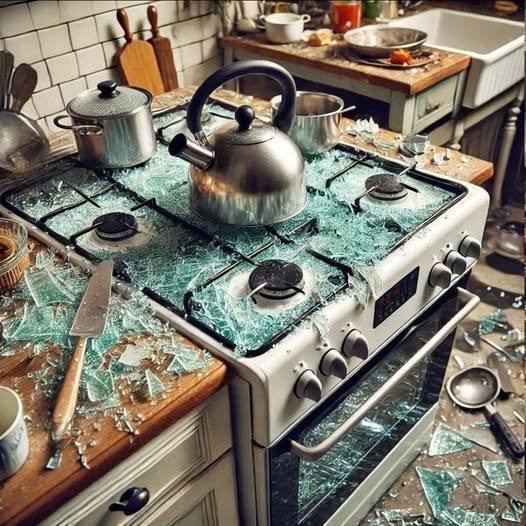
12 Dangerous Glass Stovetop Habits You Didn’t Know Were Damaging Your Cooktop
A glass stovetop looks almost indestructible.
It’s smooth, modern, easy to wipe clean, and—unlike traditional burners—doesn’t have all those grates and coils that collect crumbs.
But that sleek surface has a weakness many people discover only after something goes wrong.
Glass cooktops are durable, but they are not scratch-proof, crack-proof, or immune to thermal damage.
A heavy pan dropped in the wrong place, a rough-bottomed skillet dragged across the surface, a sugary spill left behind, or even cleaning the wrong way can leave permanent damage.
And some habits that seem completely harmless can shorten the life of your cooktop—or create a genuine safety problem.
Whether you have a radiant electric glass cooktop or a smooth induction model, the safest rule is simple:
Treat the surface as a precision appliance, not as a countertop.
Here are the everyday habits worth changing.
Safety note: Always follow the owner’s manual for your specific cooktop. Radiant electric and induction models can have different cookware and cleaning requirements. If the glass is cracked, stop using the affected appliance and follow the manufacturer’s service instructions.
1. Sliding Heavy Pots Across the Glass
This is probably one of the most common mistakes.
You’re cooking pasta.
The pot is heavy.
You want to move it from one burner to another.
So you slide it.
It seems harmless.
It isn’t.
Manufacturers such as GE and Samsung specifically warn against sliding cookware across smooth glass or ceramic cooktops because it can scratch or damage the surface.
The problem isn’t limited to cast iron.
Even cookware that is technically compatible with the cooktop can contain tiny rough areas, particles, or residue underneath.
Once those get trapped between the pan and the glass, sliding the pan turns them into something like sandpaper.
The better habit
Lift. Move. Place.
Don’t drag.
If the pan is too heavy to lift safely, don’t improvise. Turn off the heat and use a safer method appropriate for your appliance and cookware.
2. Using Rough or Damaged Pan Bottoms
Turn your cookware over.
Look at the bottom.
Is it smooth?
Is it flat?
Are there burrs, deep scratches, rough spots, or burned-on food?
A pan can look perfectly good from the top while its bottom is quietly damaging your cooktop.
GE recommends smooth, flat-bottom cookware for glass cooktops and warns that rough cookware can scratch the surface.
Older cookware deserves particular attention because repeated use can change the bottom surface over time.
Try this simple inspection
Before putting a frequently used pan on your cooktop, run your fingers carefully around the underside when the pan is cool.
If it feels rough or damaged, don’t assume the glass will tolerate it.
The cooktop may be more fragile than the pan.
3. Dropping Cookware Onto the Surface
This one sounds obvious.
But kitchens are busy places.
You lift a Dutch oven.
Your grip slips.
You set a heavy pan down harder than intended.
That impact can matter.
Glass-ceramic cooktops are engineered to withstand normal cooking, but a concentrated impact can damage them.
And unlike a scratched surface, a crack isn’t merely cosmetic.
Manufacturers warn that a broken or cracked cooktop can create an electrical-shock hazard and should not be operated until appropriately serviced.
The rule
Never drop cookware onto a glass cooktop.
Set it down gently.
This becomes particularly important with heavy cookware such as cast iron.
4. Treating the Cooktop Like a Cutting Board
It looks like a giant flat piece of glass.
So why not chop something on it?
Because the cooktop wasn’t designed for that.
Sharp knives can scratch the surface, and food debris can become trapped between cookware and the glass during later cooking.
GE explicitly warns against using a glass cooktop as a cutting board.
There is another problem:
A cutting board gives you a surface designed for cutting.
A cooktop gives you a heating surface.
Keep those jobs separate.
5. Putting Hot Pans on the Wrong Place
Here’s a habit that can happen without much thought.
You finish cooking.
You remove a hot pan.
Then you place it on an unused area of the cooktop.
After all, that section isn’t glowing.
But on a smooth cooktop, “not glowing” does not necessarily mean “cold.”
Radiant cooktops can retain substantial heat after the element is turned off, and manufacturers use hot-surface indicators to warn users about residual heat.
More importantly, your cooktop is still a heat-sensitive appliance surface.
If you regularly use it as a landing pad for extremely hot cookware, you’re asking the surface to perform a job it wasn’t designed to perform.
Better habit
Use a suitable heat-resistant trivet or designated surface when you need somewhere to place hot cookware.
6. Pouring Cold Liquid Onto a Very Hot Surface
This is one of those moments where cleaning instinct can work against you.
Something spills.
You want to wipe it immediately.
You grab a wet cloth.
The cooktop is still extremely hot.
Stop for a moment.
Manufacturers warn about cleaning hot cooktops with wet materials because the rapid heating of water can create steam and cause burns. GE specifically cautions about steam burns when a wet sponge or cloth is used on a hot surface.
Thermal shock can also be a concern for glass and ceramic materials, depending on the appliance and circumstances.
The safer approach
Follow your manufacturer’s instructions for cleaning spills while the surface is hot or warm.
Don’t improvise with large amounts of cold water.
And never put cookware or glassware on the cooktop assuming sudden temperature changes are harmless.
7. Ignoring a Small Crack
This is the habit to take most seriously.
You notice a tiny crack.
Maybe it isn’t spreading.
Maybe the cooktop still works.
Maybe you think:
“I’ll deal with it later.”
Don’t.
Manufacturers warn that a cracked glass cooktop can present an electrical-shock hazard, particularly because liquids can penetrate damaged areas.
If you see a crack, fracture, or split:
Stop using the appliance and follow the manufacturer’s instructions for service.
Don’t test whether the crack is “serious enough.”
Don’t cover it with tape and continue cooking.
Don’t assume it is merely cosmetic.
A damaged glass surface is a safety issue.
8. Letting Sugary Spills Sit There
Not every spill is equally troublesome.
Sugar deserves special attention.
Think about:
- Jam
- Caramel
- Syrup
- Candy
- Sweet sauces
- Desserts
- Sugary cooking mixtures
When these substances become extremely hot and remain on a glass cooktop, they can cause permanent pitting or damage.
GE’s cleaning guidance specifically warns that sugary spills and melted plastic can damage the glass surface if they aren’t handled correctly.
What should you do?
Don’t automatically wait for every spill to become completely cold.
Instead, follow the cleaning procedure in your appliance’s manual.
For GE cooktops, the manufacturer gives specific instructions for safely moving hot sugary residue with a suitable scraper while wearing an oven mitt.
The exact procedure can vary by manufacturer.
The important lesson is:
Don’t let a sugary spill bake onto the cooktop.
9. Allowing Melted Plastic to Stay on the Surface
This can happen surprisingly quickly.
A plastic bag.
A container.
A utensil.
A lid.
Something gets too close to the hot surface.
Suddenly there’s melted plastic.
Don’t keep cooking as if nothing happened.
Melted plastic can bond to the glass and cause permanent damage. GE warns that hardened plastic may require replacement of the cooktop glass.
If this happens, turn off the appropriate heating elements and follow your manufacturer’s instructions for safe removal.
And don’t attack the surface with whatever sharp object happens to be in your kitchen drawer.
Use only the tools and methods recommended for your specific cooktop.
10. Using the Wrong Cookware
This is where things get confusing.
There isn’t one universal answer to:
“What cookware can I use on a glass stove?”
The answer depends on the specific appliance.
For example, GE recommends certain cookware materials for radiant smooth glass cooktops and warns against cookware such as rough cast iron, glass, and stoneware in certain configurations.
Samsung similarly gives different cookware recommendations for electric glass and induction cooktops.
That means a pan that’s fine on one appliance isn’t automatically ideal for another.
Your owner’s manual wins
Not a random internet list.
Not what your neighbor uses.
Not what worked on your old stove.
Check the manufacturer’s cookware recommendations for your exact model.
11. Using a Pan That’s Too Small or Too Large
Pan size matters.
If your cookware doesn’t match the heating zone appropriately, you can get inefficient heating and potentially create additional risks.
Whirlpool recommends choosing a flat-bottom pan approximately the same size as the surface unit, while Samsung advises matching cookware size to the burner or cooking zone.
The goal isn’t necessarily perfect mathematical matching.
It’s using cookware that is appropriate for the cooking zone according to your manufacturer’s instructions.
And pay attention to handles.
Handles sticking out over neighboring hot areas can increase the chance of accidental contact, spills, or burns.
12. Leaving a Burner on High and Walking Away
A glass cooktop can look calm even when it’s extremely hot.
That’s part of what makes it deceptive.
You don’t see a flame.
But the heating element can still become extremely hot.
Whirlpool’s safety instructions warn against leaving surface units unattended at high heat because boilovers can create smoke or greasy spills that may ignite.
High heat also gives you less room for error.
A pan can go from controlled cooking to scorched food surprisingly quickly.
A safer habit
Stay nearby when cooking at high temperatures.
If you need to leave the kitchen, reduce the heat or turn the appliance off when appropriate.
13. Putting Flammable Objects on the Cooktop
Here’s another habit that doesn’t always look dangerous.
You turn off the cooktop.
Then you put something on it because you need counter space.
A paper towel.
A plastic container.
A grocery bag.
A cookbook.
A dish towel.
The problem?
The surface may remain hot.
GE warns against storing items that can melt or catch fire on the glass cooktop, even when it isn’t actively being used.
The surface can retain heat after cooking.
Better rule
If something can melt or burn, keep it away from the cooktop until you’re certain the surface has cooled.
14. Cleaning With Abrasive Materials
A glass cooktop doesn’t need aggressive scrubbing.
In fact, aggressive cleaning can make things worse.
Avoid assuming that steel wool, rough scouring pads, abrasive powders, or improvised scraping tools are appropriate.
GE notes that glass cooktops are scratch-resistant but not scratch-proof and recommends following the manufacturer’s cleaning instructions.
Samsung likewise recommends appropriate cleaning products and soft cloths for its electric and induction cooktops.
Think gentle, not aggressive
Remove residue using products and tools specifically recommended for your appliance.
A few extra minutes of proper cleaning are better than a permanent scratch.
15. Cleaning While the Surface Is Still Too Hot
This habit deserves special attention because it combines two risks.
You can damage the surface.
And you can burn yourself.
A hot cooktop can retain heat even after the cooking element is switched off. GE specifically recommends caution when cleaning and advises avoiding certain cleaning products on hot surfaces.
Don’t assume:
“The red light is off, so it’s safe.”
Instead, use the appliance’s hot-surface indicator and manufacturer’s instructions.
And remember that the indicator is a safety aid—not permission to touch the surface immediately.
16. Dragging a Pan Because “It’s Only a Little Scratch”
One tiny scratch doesn’t mean your cooktop is ruined.
But scratches can accumulate.
A surface that looked flawless a year ago can gradually develop a web of marks from repeated dragging, rough cookware, food particles, and improper cleaning.
GE notes that deep scratches aren’t removable and recommends avoiding cookware with rough bottoms and avoiding sliding cookware.
So don’t wait until the damage becomes obvious.
Change the habit now.
Lift instead of slide.
It costs nothing.
17. Cooking With Debris Trapped Under the Pan
This is one of the easiest mistakes to prevent.
A grain of salt.
A bit of dried food.
A tiny piece of spice.
A fragment of packaging.
It doesn’t look important.
But place a heavy pan over it and move that pan around, and the debris can become an abrasive layer between cookware and glass.
GE specifically warns that coarse particles such as salt and ground pepper can become trapped under cookware and cause scratches.
Before cooking
Take one second.
Look at the surface.
If there’s debris, remove it appropriately.
That one-second habit can save you from unnecessary wear.
18. Using Cast Iron Without Checking Your Manufacturer’s Guidance
Cast iron is a complicated subject.
Some people use it successfully on glass cooktops.
Others are told not to use it.
Both experiences can be real because cookware and cooktop designs vary.
GE says traditional cast iron is not recommended for some radiant smooth glass cooktops because rough surfaces can scratch the glass and because cast iron retains substantial heat.
Whirlpool provides guidance for using cast iron on certain glass cooktops, emphasizing careful lifting rather than sliding and keeping the pan bottom clean and dry.
So don’t rely on a blanket rule.
Check three things
- Your cooktop manufacturer’s instructions
- Your cookware manufacturer’s instructions
- The condition of the pan’s bottom
If the manufacturer’s guidance says not to use it, don’t.
19. Using Aluminum Foil on a Radiant Glass Burner
Aluminum foil seems harmless.
It’s lightweight.
It doesn’t look dangerous.
But GE warns against using aluminum foil on or near radiant cooktop burners because the heat can fuse the foil to the glass surface.
That can leave you with a damaged cooktop and a much bigger problem than the mess you were trying to avoid.
If you’re tempted to cover the surface to “make cleanup easier,” check your owner’s manual first.
There are safer ways to protect and clean the appliance.
20. Forgetting That the Surface Can Stay Hot After Cooking
This may be the most important habit for households with children, grandchildren, older adults, or anyone who moves quickly through the kitchen.
A glass cooktop doesn’t always look hot.
There may be no flame.
There may be no obvious visual signal.
Yet the surface can remain hot after the burner is switched off. GE specifically explains that radiant cooktops retain heat and use hot-surface indicators to communicate residual heat.
Make this a household rule
When the cooktop is on—or has recently been used—treat the surface as hot until the appliance indicates that it has cooled sufficiently.
Don’t rest your hand on it to check.
Don’t place objects on it.
Don’t let children treat it as an extension of the countertop.
The 5 Habits That Cause the Most Trouble
If you don’t remember everything in this article, remember these five:
1. Never use a cracked cooktop.
A crack can create an electrical safety hazard.
2. Don’t slide cookware.
Lift and place it.
3. Don’t use rough-bottomed cookware.
Inspect the bottom of your pans.
4. Don’t treat the surface like a countertop.
No cutting, storage, or random objects.
5. Follow your specific owner’s manual.
Cooktop designs and cookware recommendations vary.
What About Cleaning a Glass Cooktop?
A simple cleaning routine can prevent a lot of unnecessary damage.
First, remove loose food debris appropriately.
Then use the cleaning product recommended for your model.
Use a soft cloth or manufacturer-approved cleaning pad.
For stubborn residue, use only the scraper or cleaning method specified by the manufacturer.
Don’t assume that more pressure equals better cleaning.
And don’t use a cleaning product simply because it works on ordinary glass.
A cooktop is a specialized glass-ceramic surface, not a household window.
Samsung recommends cleaning its electric cooktops with appropriate products and soft cloths, while GE provides specific guidance for removing residue and baked-on material.
A Simple Before-and-After Cooking Routine
You don’t need a complicated maintenance schedule.
Before cooking
- Check that the surface is clean.
- Check the bottom of your pan.
- Make sure the pan is dry.
- Confirm that the cookware is appropriate for your cooktop.
- Match the pan to the cooking zone.
- Keep towels, paper, plastic, and other flammable items away.
While cooking
- Don’t leave high heat unattended.
- Don’t slide cookware.
- Keep handles positioned safely.
- Watch for boilovers.
- Clean spills according to your manufacturer’s instructions.
After cooking
- Turn the controls off.
- Remember that the surface may remain hot.
- Remove residue appropriately.
- Don’t put plastic or other heat-sensitive objects on the surface.
- Allow the cooktop to cool according to the manufacturer’s guidance.
This routine takes very little time.
But it can prevent a surprising amount of damage.
What to Do If You Accidentally Scratch the Cooktop
First, don’t panic.
A scratch doesn’t automatically mean the appliance is unsafe.
However, don’t try to “polish away” a deep scratch with an aggressive abrasive.
GE notes that deep scratches generally cannot be removed, while some marks that resemble scratches may actually be removable residue.
Clean the surface according to the manufacturer’s instructions and inspect it.
If you see a crack, fracture, or split, that’s different.
Stop using the appliance and contact the manufacturer or a qualified service professional.
What If You Break a Glass Cooktop?
Don’t try to repair the glass yourself.
Don’t continue using it because “only one burner is affected.”
Don’t cover the crack and hope for the best.
Manufacturers warn that a broken cooktop can create an electrical-shock hazard.
The safest approach is to stop using the appliance and follow the manufacturer’s service instructions.
A replacement glass surface may be possible depending on the model.
A Realistic Kitchen Scenario
Imagine you’re making a large pot of soup.
The burner is hot.
You decide to move the pot.
Instead of lifting it, you slide it to the next burner.
A tiny piece of dried food is underneath.
You don’t notice.
A few weeks later, you see a long scratch.
Then you clean it aggressively with a rough pad because the scratch looks dirty.
Now the surface has more marks.
Nothing dramatic happened.
There was no explosion.
No loud warning.
Just a series of small habits.
That’s how many appliance problems begin.
Not with one outrageous mistake.
With ordinary actions repeated hundreds of times.
Why Glass Cooktop Damage Can Be Expensive
A scratched pan is annoying.
A damaged cooktop can be much more expensive.
And some damage isn’t simply cosmetic.
Deep scratches, cracks, pitting, and fused materials can require professional service or replacement of the glass surface.
That means a few seconds of prevention can be worth far more than the cost of the cleaning product or proper cookware you might have avoided buying.
The cheapest cooktop repair is often the one you never need.
The Glass Stovetop Safety Checklist
Before you finish reading, save this list.
DO
- ✔ Lift cookware instead of sliding it
- ✔ Use smooth, flat-bottom cookware appropriate for your model
- ✔ Keep the surface free of food debris
- ✔ Match pan size to the cooking zone
- ✔ Keep handles positioned safely
- ✔ Follow your owner’s manual
- ✔ Clean spills using the manufacturer’s recommended method
- ✔ Treat the surface as hot until it has cooled
- ✔ Remove melted plastic and sugary spills according to manufacturer instructions
- ✔ Inspect cookware bottoms regularly
DON’T
- ✘ Drop heavy cookware
- ✘ Drag cast iron or rough pans across the glass
- ✘ Use the cooktop as a cutting board
- ✘ Store plastic or flammable items on the surface
- ✘ Use abrasive cleaning materials unless specifically approved
- ✘ Pour cold water onto an extremely hot surface
- ✘ Ignore cracks
- ✘ Use cookware your manufacturer says is unsuitable
- ✘ Leave high-heat cooking unattended
- ✘ Assume a turned-off burner means a cool surface
- ✘ Use aluminum foil on radiant burners unless your manual specifically permits it
A glass stovetop doesn’t need to be treated like a fragile piece of decoration.
But it does need to be treated with respect.
The biggest problems usually come from habits that feel harmless: sliding pans, using rough cookware, dropping heavy pots, ignoring spills, cleaning too aggressively, storing objects on the surface, or continuing to use a cooktop after the glass has cracked.
The good news?
Most of these mistakes are incredibly easy to prevent.
Lift instead of slide.
Use the right cookware.
Keep the surface clean.
Respect residual heat.
Handle sugary spills and melted plastic promptly according to the manufacturer’s instructions.
And if the glass ever cracks, don’t gamble with it—stop using the appliance and get it properly assessed.
Your glass cooktop was designed to make cooking easier.
With a few better habits, you can help keep it working safely, looking good, and serving your kitchen for years to come.