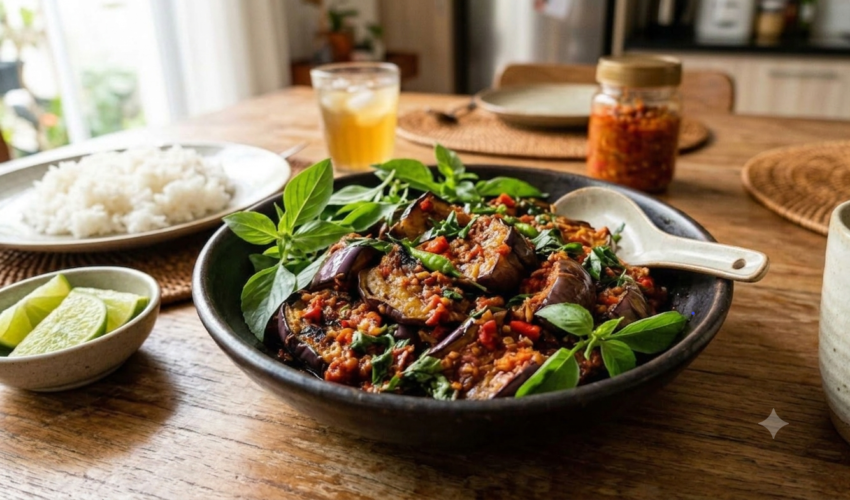
Spicy Eggplant Sambal – Terong Balado
The eggplant starts sizzling the moment it hits the hot oil.
Its edges turn golden and slightly crisp while the soft center becomes almost silky. Then comes the sambal—the unmistakable aroma of chilies, garlic, shallots, and tomatoes filling the kitchen.
One spoonful and you get everything at once: heat, sweetness, tang, savoriness, and that wonderfully soft eggplant texture that practically melts into the sauce.
This is Terong Balado, a beloved Indonesian-style spicy eggplant dish that turns a few humble ingredients into something incredibly flavorful.
If you love food with a little fire, this recipe is going to earn a permanent place in your kitchen.
The word balado refers to a spicy chili-based preparation associated especially with West Sumatra and Minangkabau cooking. It is often made with ingredients such as red chilies, shallots, garlic, and tomatoes, creating a sambal that is bright, punchy, and deeply aromatic.
Eggplant is a perfect partner for it.
It absorbs the sambal like a sponge, so every bite is coated in that vibrant red sauce.
And although traditional versions can be quite spicy, you can easily adjust the chili level to suit your table.
Meta description: Make spicy Indonesian Eggplant Sambal, or Terong Balado, with tender eggplant and fragrant chili, tomato, shallot, and garlic sambal. An easy, bold side dish packed with authentic flavor.
Why You’ll Love Terong Balado
- Big flavor: Spicy, savory, tangy, slightly sweet, and deeply aromatic.
- Simple ingredients: Most are easy to find at a regular grocery store.
- Beginner-friendly: The technique is straightforward.
- Naturally vegan: No meat, dairy, or eggs are needed.
- Naturally vegetarian: A flavorful vegetable dish that does not feel boring.
- Budget-friendly: Eggplant is inexpensive and the sambal uses pantry-friendly ingredients.
- Customizable heat: Make it gentle or fiery.
- Perfect with rice: The sambal begs to be spooned over steaming rice.
- Great for meal prep: The flavors develop beautifully after resting.
- Comfort food: Soft eggplant and spicy sambal make an incredibly satisfying combination.
What Is Terong Balado?
Terong Balado translates roughly to eggplant prepared with balado-style chili sauce.
It is part of Indonesia’s rich sambal tradition.
The sambal typically combines red chilies with shallots, garlic, and tomatoes. Depending on the cook and region, additional ingredients such as lime, sugar, shrimp paste, or other aromatics may be used.
This recipe keeps the main flavor profile simple and accessible while staying true to the spirit of the dish.
The eggplant can be fried, grilled, roasted, or pan-seared.
Frying gives the eggplant especially rich flavor and a silky interior, but roasting or air-frying can make the dish lighter.
Ingredients
This recipe makes approximately 4 servings.
For the Eggplant
- 600 g (1.3 lb) Asian or globe eggplant
- 1 teaspoon fine salt
- 120–180 ml (½–¾ cup) neutral cooking oil, for shallow-frying
- 1 tablespoon water, if needed while cooking
For the Balado Sambal
- 100 g (about ¾ cup) fresh red chilies, roughly chopped
- 2–4 red bird’s-eye chilies, optional for extra heat
- 100 g (about ¾ cup) shallots, peeled
- 4 cloves garlic
- 150 g (about 1 cup) ripe tomatoes, chopped
- 1 tablespoon neutral cooking oil
- 1 teaspoon salt, or to taste
- 1 teaspoon granulated sugar
- 1 tablespoon fresh lime juice
- 2 tablespoons water, as needed
Optional Authentic-Style Addition
- 1 teaspoon shrimp paste (terasi), toasted
For a fully vegan dish, omit the shrimp paste.
Ingredient Notes
Eggplant
Long Asian eggplants work beautifully because they cook quickly and become wonderfully tender.
Globe eggplant is also excellent.
Choose eggplants that feel firm, have smooth skin, and feel heavy for their size.
Red Chilies
Fresh red chilies give the sambal its beautiful color and fruity heat.
For a milder version, remove the seeds and membranes.
Bird’s-Eye Chilies
These small chilies bring serious heat.
Use them only if you enjoy spicy food.
Shallots
Shallots provide sweetness and depth.
Do not skip them if possible—they help create the characteristic sambal flavor.
Tomatoes
Tomatoes add acidity, moisture, and natural sweetness.
They also help create a spoonable sambal rather than a dry chili paste.
Lime Juice
Fresh lime juice brightens the finished dish.
Add it toward the end rather than cooking it for a long time.
Shrimp Paste
Shrimp paste adds a powerful savory depth in traditional preparations.
A small amount goes a long way.
PRO TIP: If using shrimp paste, toast it briefly in a dry pan before adding it. This reduces its raw aroma and develops a deeper savory flavor.
Nutritional Information
Approximate nutrition per serving, based on four servings and assuming most of the frying oil is not consumed:
- Calories: 280
- Protein: 5 g
- Carbohydrates: 24 g
- Fat: 20 g
- Fiber: 8 g
- Sugar: 12 g
Actual values vary depending on eggplant size and how much oil the eggplant absorbs.
Is Terong Balado Vegan?
Yes, if you omit shrimp paste and use a plant-based cooking oil.
Is It Vegetarian?
Yes, when made without shrimp paste.
Is It Gluten-Free?
The basic recipe is naturally gluten-free.
Check packaged sambal ingredients and shrimp paste labels if cross-contact is important.
Is It Dairy-Free?
Yes.
Is It Keto?
Eggplant is relatively low in carbohydrates, but the tomatoes and sugar contribute some carbs. For a stricter low-carb version, reduce or omit the sugar and serve it without rice.
Is It Weight-Loss Friendly?
Eggplant itself is nutrient-rich and relatively low in calories, but traditional frying increases the overall calorie content.
For a lighter version, roast or air-fry the eggplant.
Kitchen Tools Needed
Basic Tools
- Large skillet or wok
- Cutting board
- Sharp knife
- Food processor or mortar and pestle
- Slotted spoon
- Mixing bowl
- Paper towels or a wire rack
Optional
- Air fryer
- Blender
- Mortar and pestle
- Splatter screen
No food processor? Use a mortar and pestle for a more traditional coarse sambal texture.
A knife also works if you finely mince everything.
How to Make Terong Balado
1. Prepare the eggplant
Wash and dry the eggplant.
Trim the ends.
Cut into approximately 5–7 cm (2–3 inch) pieces.
For thick globe eggplant, cut each piece lengthwise into halves or quarters.
Sprinkle lightly with 1 teaspoon salt.
Let the eggplant sit for approximately 10–15 minutes.
This seasons the flesh and can help draw out some excess moisture.
Pat dry before frying.
PRO TIP: Do not soak eggplant for a long time in salted water. You want it seasoned, not waterlogged.
2. Prepare the sambal ingredients
Roughly chop:
- Red chilies
- Bird’s-eye chilies
- Shallots
- Garlic
- Tomatoes
Keep the pieces relatively small so they process easily.
3. Make the chili paste
Place the chilies, shallots, garlic, and tomatoes into a food processor.
Pulse until you have a coarse paste.
Do not blend until completely smooth.
A slightly textured sambal gives the finished dish more character.
For a traditional approach, pound the ingredients in a mortar and pestle.
WHAT SHOULD NOT HAPPEN: Do not turn the mixture into a completely watery puree. A coarse, spoonable paste works better.
4. Fry the eggplant
Heat 120–180 ml oil in a large skillet over medium-high heat.
When the oil is hot, add the eggplant in batches.
Do not overcrowd the pan.
Cook for approximately 3–5 minutes per side, depending on the size of the pieces.
You want:
- Golden-brown edges
- Soft, tender centers
- Slightly collapsed flesh
Transfer the cooked eggplant to a wire rack or paper towels.
Repeat with the remaining eggplant.
PRO TIP: Eggplant absorbs oil quickly. Make sure the oil is properly hot before adding the pieces. If the oil is too cool, the eggplant can become greasy rather than beautifully browned.
5. Cook the sambal
Carefully remove excess oil from the skillet, leaving approximately 1 tablespoon.
Place the skillet over medium heat.
Add the chili mixture.
Cook for approximately 8–12 minutes, stirring regularly.
The sambal will initially smell sharp and raw.
As it cooks, the aroma should become deeper, sweeter, and more rounded.
The color should become a rich, vibrant red.
6. Season the sambal
Add:
- 1 teaspoon salt
- 1 teaspoon sugar
- 2 tablespoons water, if needed
Stir well.
Cook for another 2–3 minutes.
Taste.
You are looking for a balance of:
spicy + salty + slightly sweet + tangy.
If it tastes too sharp, cook it a little longer.
If it needs brightness, add a small amount of lime juice.
7. Add optional shrimp paste
If using shrimp paste, add approximately 1 teaspoon toasted terasi.
Stir thoroughly.
Cook for another 1–2 minutes.
The aroma will become more savory and complex.
8. Add the eggplant
Gently add the fried eggplant to the sambal.
Use a spatula to turn the pieces rather than aggressively stirring.
You want the sambal to coat every piece without completely breaking down the eggplant.
Cook for approximately 2–3 minutes.
9. Finish with lime juice
Turn off the heat.
Add 1 tablespoon fresh lime juice.
Taste once more.
Add more salt, sugar, or lime juice if necessary.
The final sambal should be bold enough to stand up to the soft eggplant.
10. Rest before serving
Let the Terong Balado sit for 5 minutes before serving.
This gives the sambal time to cling to the eggplant and allows the flavors to settle.
Chef-Level Tips for the Best Terong Balado
Toast the chilies lightly
If you have time, lightly char or roast the chilies before blending.
This can add a subtle smoky flavor.
Do not burn them.
Use ripe tomatoes
Ripe tomatoes give the sambal natural sweetness and a richer red color.
Balance the sambal
A good sambal should not taste like pure heat.
You want several layers:
- Chili heat
- Shallot sweetness
- Tomato acidity
- Saltiness
- Slight sweetness
- Lime freshness
Keep the sambal textured
A completely smooth sauce can feel more like a puree.
A coarse sambal gives you little bursts of flavor.
Do not overcook the eggplant
The eggplant should be tender but still recognizable as pieces.
If cooked too long in the sambal, it can collapse completely.
CHEF’S TIP: Taste the sambal after it has cooked before adding the eggplant. It should already taste delicious on its own. The eggplant will soften and absorb that flavor, so weak sambal will produce a weak final dish.
Common Mistakes to Avoid
Mistake 1: Using cold oil
The eggplant can absorb too much oil.
Make sure the oil is hot before frying.
Mistake 2: Crowding the skillet
Too many pieces lower the oil temperature.
Cook in batches.
Mistake 3: Not cooking the sambal enough
Raw chili and shallot flavors can be harsh.
Cook until the mixture smells fragrant and the oil begins to separate slightly.
Mistake 4: Making it painfully spicy
More chili does not automatically mean better sambal.
Use bird’s-eye chilies carefully.
Mistake 5: Adding too much lime juice
Lime should brighten the dish, not dominate it.
Start with a small amount and adjust.
Mistake 6: Overcooking the eggplant in the sambal
A few minutes is enough.
You want tender pieces, not eggplant puree.
How to Control the Spice Level
Mild
Use sweet red chilies or red bell peppers for most of the chili quantity.
Remove all seeds and membranes.
Medium
Use regular red chilies and one bird’s-eye chili.
Hot
Use several bird’s-eye chilies.
Very Hot
Keep the seeds and add additional bird’s-eye chilies.
Serve with plenty of rice and a cooling side dish.
SAFETY TIP: Avoid touching your eyes or face after handling hot chilies. Wash your hands thoroughly with soap and water.
Variations and Customizations
Air-Fried Terong Balado
Cut the eggplant into pieces.
Toss with approximately 1–2 tablespoons oil.
Air-fry at 200°C (400°F) for about 12–18 minutes, turning halfway.
Cook until golden and tender.
Toss with the prepared sambal.
This is lighter than deep or shallow frying.
Roasted Terong Balado
Toss the eggplant with oil.
Roast at 220°C (425°F) for approximately 20–25 minutes.
Turn halfway.
The edges should become browned and caramelized.
Extra-Garlicky Version
Add two additional garlic cloves to the sambal.
This creates a deeper savory flavor.
Sweet-Spicy Version
Add another teaspoon of brown sugar.
This is especially good if you are using very hot chilies.
Smoky Terong Balado
Char the chilies and tomatoes briefly in a dry skillet before blending.
The smoky flavor works beautifully with eggplant.
Balado Eggs
Replace some or all of the eggplant with hard-boiled eggs.
Fry the boiled eggs until lightly golden, then coat them in the sambal.
Tempeh Balado
Add crispy fried tempeh to the sambal for a more protein-rich vegan meal.
Potato Balado
Fried or roasted potatoes are another excellent match for the spicy sauce.
Did You Know?
The word sambal is commonly used for chili-based sauces and condiments across Indonesia, but sambals can vary enormously in texture, ingredients, and preparation.
Some are raw.
Some are cooked.
Some are smoky.
Some are fermented.
Some are intensely spicy.
That variety is part of what makes Indonesian cuisine so exciting.
Balado is particularly associated with West Sumatran and Minangkabau cuisine, where bold chili-based preparations are an important part of the culinary tradition.
Storage and Reheating
Refrigerator
Allow the dish to cool.
Place it in an airtight container.
Refrigerate for up to 3–4 days.
Freezer
Terong Balado can be frozen, although the eggplant will become softer after thawing.
For best quality, freeze for up to 1 month.
Reheating on the Stove
Place the eggplant and sambal in a skillet over medium-low heat.
Add a tablespoon of water if needed.
Cover and heat for approximately 5–7 minutes.
Stir gently.
Microwave
Microwave in a covered microwave-safe container in 30–60 second intervals until hot.
Be careful when opening the container because steam will escape.
Best Texture
Freshly made Terong Balado has the best contrast between tender eggplant and vibrant sambal.
However, the flavor often becomes even deeper after resting overnight.
What to Serve With Terong Balado
The classic partner is simple:
Steaming hot rice.
The rice softens the heat and gives you something to soak up every drop of sambal.
For a complete Indonesian-inspired meal, serve it with:
- Steamed jasmine rice
- Coconut rice
- Nasi kuning
- Cucumber slices
- Fresh herbs
- Fried tofu
- Tempeh
- Indonesian-style vegetable dishes
- Hard-boiled or fried eggs
Cooling Sides
If your sambal is very spicy, serve something refreshing alongside it:
- Sliced cucumber
- Fresh tomatoes
- Plain coconut yogurt
- Simple green salad
- Fresh herbs
Plating Tips
For a beautiful presentation, spoon a little sambal onto a wide serving plate.
Arrange the eggplant pieces on top.
Add another spoonful of sambal across the center.
Finish with:
- Fresh cilantro
- Thinly sliced red chilies
- Fried shallots
- Lime wedges
Serve with a bowl of steaming rice on the side.
The bright red sambal against the golden-purple eggplant makes this dish naturally photogenic.
Frequently Asked Questions
What does Terong Balado mean?
Terong means eggplant, while balado refers to a spicy chili-based style of preparation associated especially with West Sumatran and Minangkabau cuisine.
Is Terong Balado very spicy?
It can be, but the heat is easy to adjust. Remove chili seeds and reduce bird’s-eye chilies for a milder version.
Can I make Terong Balado without shrimp paste?
Absolutely. Simply leave it out. The dish remains flavorful and becomes completely vegan when prepared with plant-based ingredients.
Can I bake the eggplant instead of frying it?
Yes. Roast it at approximately 220°C (425°F) until browned and tender, then coat it with the cooked sambal.
Why does eggplant absorb so much oil?
Eggplant has a porous structure that readily absorbs oil, especially when the oil is not hot enough. Properly heated oil and cooking in batches help reduce excessive absorption.
Can I make Terong Balado ahead of time?
Yes. It can be made several hours ahead or the day before. Store it covered in the refrigerator and reheat gently.
What should I serve with Terong Balado?
Steamed rice is the simplest and best pairing. You can also serve it with tofu, tempeh, eggs, cucumber, and other Indonesian-inspired side dishes.
Final Thoughts
Terong Balado is proof that you do not need a long ingredient list to make something unforgettable.
You start with humble eggplant.
You fry or roast it until tender.
Then you cover it in a bright, fiery sambal made from chilies, tomatoes, shallots, garlic, and lime.
The result is bold, comforting, and incredibly satisfying.
And while the traditional flavors are powerful, the recipe is flexible enough for your kitchen. Make it mild for the family. Turn up the heat when you want something fiery. Air-fry the eggplant for a lighter meal. Add tempeh for protein. Serve it with rice and a few cooling sides.
However you make it, do not rush the sambal.
Let the chilies, shallots, garlic, and tomatoes cook until their raw edges disappear and their flavors become rich and fragrant.
That is where the magic happens.
If you try this Spicy Eggplant Sambal, leave a comment and tell me how spicy you made yours. Did you fry, roast, or air-fry the eggplant? Share this recipe with someone who loves Indonesian food, save it for your next spicy-food craving, and bring a little Indonesian-inspired warmth to your kitchen.
Grab some eggplant, turn up the heat, and get ready for a plate of tender, fiery, flavor-packed Terong Balado.