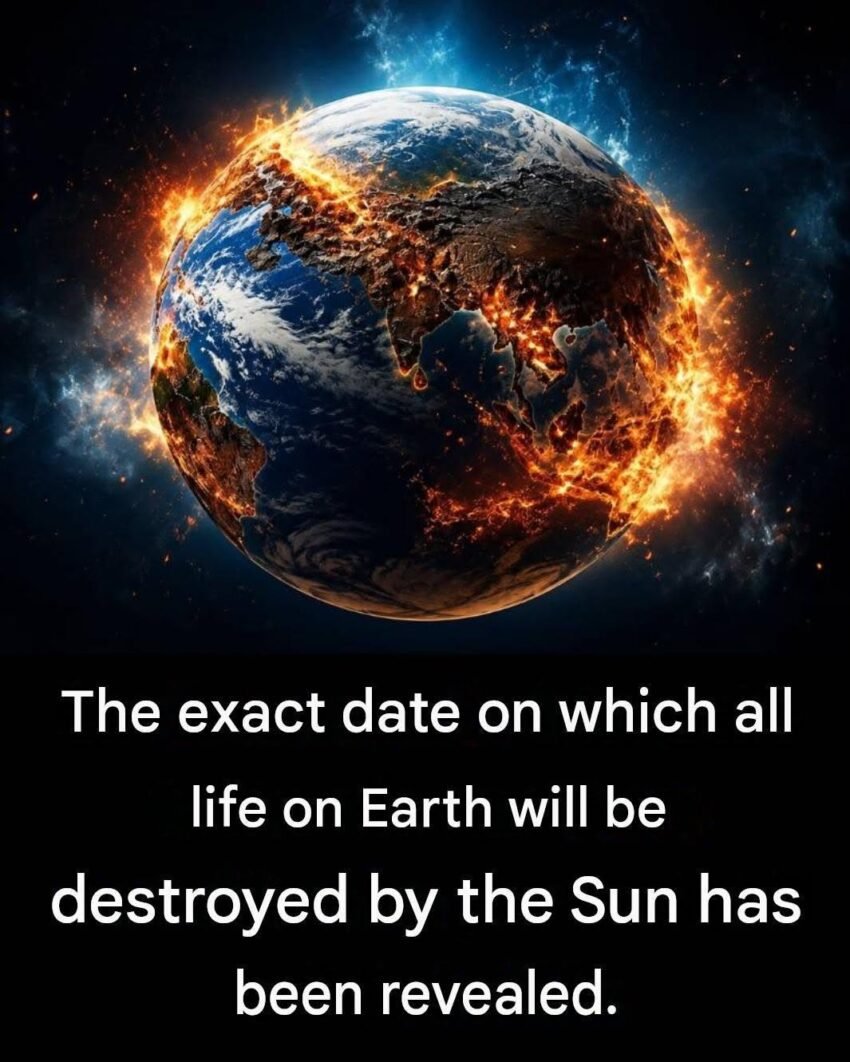
The Clock is Ticking: What Science Actually Reveals About the End of Life on Earth
Hollywood has spent decades trying to scare us with the apocalypse. We watch blockbusters featuring rogue asteroids, global super-volcanoes, catastrophic nuclear winters, or sudden, violent alien invasions wiping out civilization in a chaotic afternoon.
We are culturally obsessed with the idea that Earth’s final chapter will look like a high-budget disaster movie—loud, fiery, and instantaneous.
Yet, when astrophysicists, climatologists, and astrobiologists finally put hard numbers on the planet’s expiration date, the reality they uncovered is far more chilling. There will be no cinematic explosions or dramatic final broadcasts. Instead, science reveals that the end of life on Earth will be a remarkably slow, agonizingly quiet fade—a planetary sunset stretching across billions of years.
Recent advanced climate modeling has given us a clearer picture of when and how the biosphere will collapse. The truth about Earth’s final days forces us to rethink everything we know about our planet’s resilience.
The Real Culprit: Our Aging, Brighter Sun
To understand why Earth has a shelf life, we have to look up. Our Sun is a main-sequence star, steadily fusing hydrogen into helium in its core. As it consumes its nuclear fuel over billions of years, its internal structure slowly contracts and heats up, causing it to brighten and expand.
For decades, scientists understood that a brightening sun would eventually bake the planet dry. However, older models predicted a much more aggressive timeline, suggesting that rising solar radiation and the steady decline of atmospheric carbon dioxide (absorbed by silicate rocks over geological epochs) would choke out photosynthetic plant life in a mere 100 million years.
A comprehensive study published in JGR Atmospheres flipped that timeline on its head. Using sophisticated three-dimensional climate models that account for dynamic variables like cloud formation, rainfall patterns, ocean circulation, and atmospheric transport, researchers simulated Earth’s trajectory over the next two billion years.
The findings? Plant life—the foundational pillar of almost every terrestrial and marine food chain—is far more stubborn than we thought. Even under significantly reduced carbon dioxide levels and steadily escalating temperatures, resilient, drought-adapted flora (similar to modern cacti and specialized extremophile vegetation) could endure. Scientists now estimate that Earth’s plant-based biosphere could survive for approximately 1.8 billion more years before conditions become completely untenable.
The Slow Unraveling: How the End Will Actually Unfold
When the biosphere finally begins its terminal decline, it will not happen overnight. The breakdown of Earth’s life-support systems will occur in distinct, geological phases.
-
Phase 1: The Carbon Starvation (Hundreds of Millions of Years Away): As the Sun grows hotter, chemical weathering accelerates, sucking carbon dioxide out of the air at a faster rate. Trees and standard plants relying on standard C3 photosynthesis will struggle as CO2 levels drop past critical thresholds, leading to a massive contraction of global forests and green spaces.
-
Phase 2: The Moist Greenhouse and Ocean Evaporation (Around 1 Billion Years Away): Solar luminosity will increase by roughly 10%, pushing global temperatures to a tipping point. Oceans will begin a runaway evaporation cycle, flooding the atmosphere with water vapor—a potent greenhouse gas. Plate tectonics and the planetary carbon cycle will grind to a permanent halt.
-
Phase 3: The Sterilization of the Biosphere (Around 1.8 Billion Years Away): As surface water vanishes completely, the last remaining microbial and extremophile plant life will face an unyielding, hyper-arid wasteland. The planet will officially cross the threshold from a living world into a sterile, baked rock.
Why This Matters: The Paradox of Planetary Fragility and Resilience
There is a profound psychological paradox hidden in these geological projections. On one hand, knowing that our planet has an absolute expiration date humbles our species. It reminds us that Earth is not an eternal, static museum piece; it is a dynamic, evolving environment operating on a cosmic timeline that cares nothing for human ambition.
On the other hand, the data reveals astonishing biological grit. Life on Earth has already survived mass extinctions, global ice ages, and atmospheric transformations. The fact that plants and microorganisms can adapt to squeeze out another 1.8 billion years under an increasingly hostile sun proves that life is a stubbornly persistent force of nature.
Long before the sun boils away the oceans, human history will have risen, peaked, and vanished into deep time. The monuments, cities, and digital archives we spend so much energy building will erode into dust, leaving behind quiet landscapes long before the planet itself begins to bake.
Step-by-Step Guide: How Science Maps Deep-Time Planetary Futures
If you want to understand how researchers peer billions of years into the future without a crystal ball, you have to look at the interdisciplinary mechanics of astrobiology and climatology.
-
Stellar Evolution Tracking: Astronomers study stars of varying masses across the galaxy to map out the exact life cycle, luminosity changes, and heating rates of G-type main-sequence stars like our Sun.
-
Geochemical Modeling: Scientists calculate how silicate-carbonate weathering rates shift as planetary temperatures rise, tracking how fast atmospheric carbon dioxide is stripped from the air over eons.
-
Three-Dimensional Climate Simulation: Advanced supercomputers simulate planetary fluid dynamics—mapping how shifting oceans, cloud covers, and wind currents distribute heat across a changing globe.
-
Photosynthetic Threshold Analysis: Biologists test the physiological limits of modern resilient plants to determine the absolute minimum water and carbon dioxide concentrations required to sustain cellular energy production.
Comparative Analysis: Sci-Fi Apocalypse vs. Scientific Reality
| Metric | Hollywood / Doomsday Fiction | Scientific Reality (JGR Atmospheres Study) |
| Timeline | Sudden (Days, years, or centuries) | Gradual (1.8 billion years of slow decline) |
| Primary Catalyst | Asteroids, nuclear war, alien invasion | Solar evolution and stellar brightening |
| Nature of End | Catastrophic explosion or freezing chaos | Slow drying, carbon starvation, and heat stress |
| Survivors | A handful of human heroes hiding in bunkers | Resilient extremophile plants and deep-earth microbes |
Common Misconceptions and How Science Corrects Them
-
Misconception 1: Global warming caused by humans is the end of the Earth. While anthropogenic climate change poses an existential threat to modern human civilization and current biodiversity, it is a micro-crisis on a geological scale. Earth’s climate has massive self-correcting mechanisms that operate over millions of years, though human action dictates whether we survive to see them.
-
Misconception 2: The Sun will swallow the Earth tomorrow. Popular culture often collapses timelines. While the Sun will eventually enter its red giant phase roughly 5 billion years from now, Earth’s surface will become completely uninhabitable for complex life billions of years before that happens due to simple solar brightening.
-
Misconception 3: Life ends all at once. People imagine a sudden day where every living cell dies simultaneously. Science shows a cascading regression—complex animals go first, followed by forests, leaving hardy microbes and resilient desert flora clinging to existence until the bitter end.
Expert-Level Insights: The Search for Earth 2.0
Astrophysicists studying Earth’s distant future aren’t just morbidly curious about our home planet’s death; they are building frameworks to find habitable worlds elsewhere. By understanding the exact tipping points where a planet transitions from a “moist greenhouse” to a sterile wasteland, space agencies can better scan exoplanets for signs of atmospheric degradation. When we look at distant stars through space telescopes, we aren’t just looking for life as it is today—we are looking for worlds sitting safely in the middle of their own long, stable biological windows.
Frequently Asked Questions
Will humans still be around when the end of life on Earth happens?
Almost certainly not. Modern humans have only existed for a few hundred thousand years. The geological timescales being discussed—hundreds of millions to billions of years—mean that humanity will either have evolved into something unrecognizable, gone extinct due to natural or self-inflicted causes, or migrated to other star systems long before the Sun bakes the planet.
Does this new study mean we have more time than we thought?
Yes. Previous models suggested that the countdown for plant life was closer to 100 million years due to plummeting carbon dioxide levels. The updated 3D climate models prove that plants are more resilient than previously credited, pushing the biological expiration date out to roughly 1.8 billion years.
What will be the very last living thing on Earth?
When conditions become too harsh for plants and animals, the final survivors will almost certainly be extremophile microorganisms—chemoautotrophic bacteria living deep underground or in isolated subterranean hydrothermal pockets, completely independent of the surface sun.
What happens to the oceans when the end finally arrives?
Roughly one billion years from now, increased solar heat will cause a runaway greenhouse effect. The oceans will gradually evaporate, filling the atmosphere with dense water vapor before the liquid water is entirely lost to space through hydrogen escape.
Can human technology prevent this planetary end?
Over a timescale of 1.8 billion years, geo-engineering projects—such as orbital sunshades, atmospheric manipulation, or moving Earth’s orbit via gravitational assists—are theoretically possible for an advanced space-faring civilization. However, on a practical level, migrating to stable star systems is a far more viable solution.
Why is carbon dioxide dropping over time instead of rising?
Over millions of years, rain reacts with atmospheric CO2 to weather silicate rocks, washing the carbon into the oceans where it locks away into limestone. Without active volcanic replenishment balancing this cycle, tectonic slowing over billions of years will starve the air of carbon dioxide.
Is the Sun getting brighter right now?
Yes. The Sun’s luminosity increases by roughly 10% every billion years. This process is entirely natural and imperceptible on a human lifespan, but it dictates the long-term destiny of our solar system.
Does this research change how we look at climate change today?
It separates two entirely different problems. Human-induced climate change is an urgent, immediate crisis threatening our current global infrastructure and ecosystems. The solar lifecycle is a deep-time cosmological certainty that unfolds over millions of generations. Both matter, but they operate on completely different clocks.
Earth’s story will not end with a sudden, fiery catastrophe, but with a quiet, billion-year transition. Understanding our planet’s distant future doesn’t invite despair—it highlights the incredible, improbable miracle of the green, breathing world we get to inhabit right now.