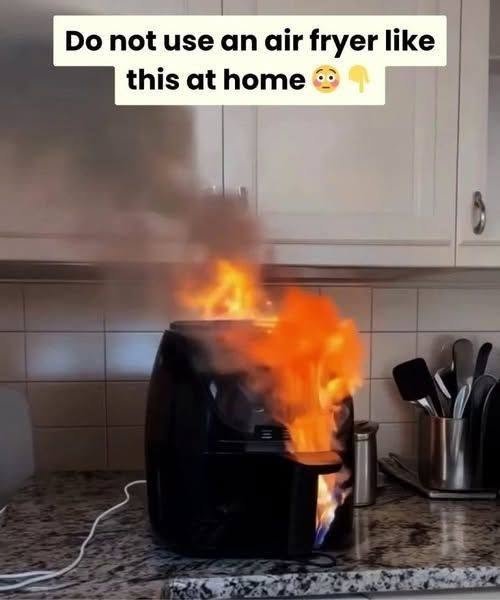
5 Places You Should Never Use Your Air Fryer Indoors
Air fryers have completely revolutionized home cooking, offering a fast, energy-efficient way to achieve a crispy crunch without deep-frying in vats of oil. Because they are compact and countertop-friendly, many people assume they can be plugged in and operated virtually anywhere in the kitchen.
However, air fryers are essentially mini convection ovens that draw massive amounts of electrical power (typically 1,200 to 1,800 watts) and expel intense heat and steam through high-pressure exhaust vents. Where you place yours matters immensely for home safety.
Avoiding these five hazardous spots in your indoor kitchen prevents property damage, appliance failure, and fire risks.
1. Directly Against a Kitchen Wall
-
The Hazard: Pushing the back of your air fryer flush against a wall or right in front of a power socket.
-
Why It’s Dangerous: Air fryers vent hot air and high-temperature steam out of their rear or side ports. If the unit is pressed against a wall, heat has nowhere to escape. Over time, trapped heat can scorch paint, warp drywall, discolor tiles, melt plastic outlets, and cause the appliance to dangerously overheat. Always leave at least 4 to 6 inches of clearance behind the unit.
2. Tucked Directly Under Low Hanging Cabinets
-
The Hazard: Operating the appliance on a counter underneath overhead upper cabinetry.
-
Why It’s Dangerous: The powerful plume of hot steam shooting upward during cooking can quickly warp wood finishes, peel laminate counter trim, and trap moisture against the underside of your cabinets. This localized heat concentration creates a silent, long-term fire and structural hazard. Pull your air fryer out into the open workspace before turning it on.
3. Inside a Closed Cupboard, Pantry, or Appliance Garage
-
The Hazard: Leaving the air fryer tucked away inside a closed wooden cabinet or drawer while it runs to keep countertops clutter-free.
-
Why It’s Dangerous: Enclosed spaces trap heat rapidly and choke off the oxygen circulation required for safe appliance operation. This can lead to complete electrical failure, melted internal components, or a severe cabinet fire. Always take your air fryer out and place it on an open counter space.
4. Right Next to the Kitchen Sink
-
The Hazard: Setting up your air fryer directly beside the sink or water tap for convenience.
-
Why It’s Dangerous: Water and high-voltage electricity are a volatile mix. Splashing water from the sink can easily enter the appliance’s housing or electrical base, triggering an immediate short circuit, severe electrical shock, or permanent damage to the heating elements. Keep appliances at least a few feet away from water sources.
5. On Top of Plastic Mats, Vinyl Countertops, or Clutter
-
The Hazard: Placing the unit on a flammable surface, a protective plastic mat, or a wobbly, cluttered stack of items.
-
Why It’s Dangerous: Air fryer bases get intensely hot during prolonged cooking cycles. Placing the unit on a non-heat-resistant surface like vinyl or cheap laminate can melt the counter material or cause toxic fumes. Furthermore, an unstable or cluttered surface increases the risk of the heavy machine tipping over and spilling boiling grease.
Step-by-Step Guide: Setting Up a Safe Air Fryer Station
-
Clear the Perimeter: Find an open section of your countertop with at least 5 inches of free space on all sides, especially behind the exhaust vents.
-
Verify the Surface: Ensure your countertop is made of a heat-resistant material like granite, marble, quartz, or solid, stable butcher block.
-
Plug Directly Into the Wall: Never use an extension cord or power strip with an air fryer; they draw too much current and can overheat household wiring. Plug the unit directly into a grounded wall outlet.
-
Pull Forward to Cook: If your counter sits under a cabinet overhang, simply slide the air fryer forward into the open room before pressing start.
Comparative Analysis: Safe vs. Unsafe Air Fryer Locations
Frequently Asked Questions
Can an air fryer start a kitchen fire? Yes. While rare, fires can occur if grease buildup inside the basket ignites, if the unit overheats due to blocked ventilation, or if it is placed too close to flammable materials like paper towels or curtains.
How much space does an air fryer need around it? Most manufacturers recommend leaving at least 4 to 6 inches (10 to 15 cm) of clear space around the back, sides, and top of the appliance to ensure proper airflow and heat dissipation.
Is it safe to plug an air fryer into an extension cord? No. Air fryers pull a high electrical load (frequently 1,500+ watts). Plugging them into an extension cord or power strip can overheat the wiring, trip breakers, or spark an electrical fire.
Your air fryer is a brilliant kitchen tool, but it demands proper ventilation and respect for heat. Give it space to breathe on an open, heat-safe countertop, keep it away from water and cabinets, and you’ll enjoy safe, crispy meals for years to come.