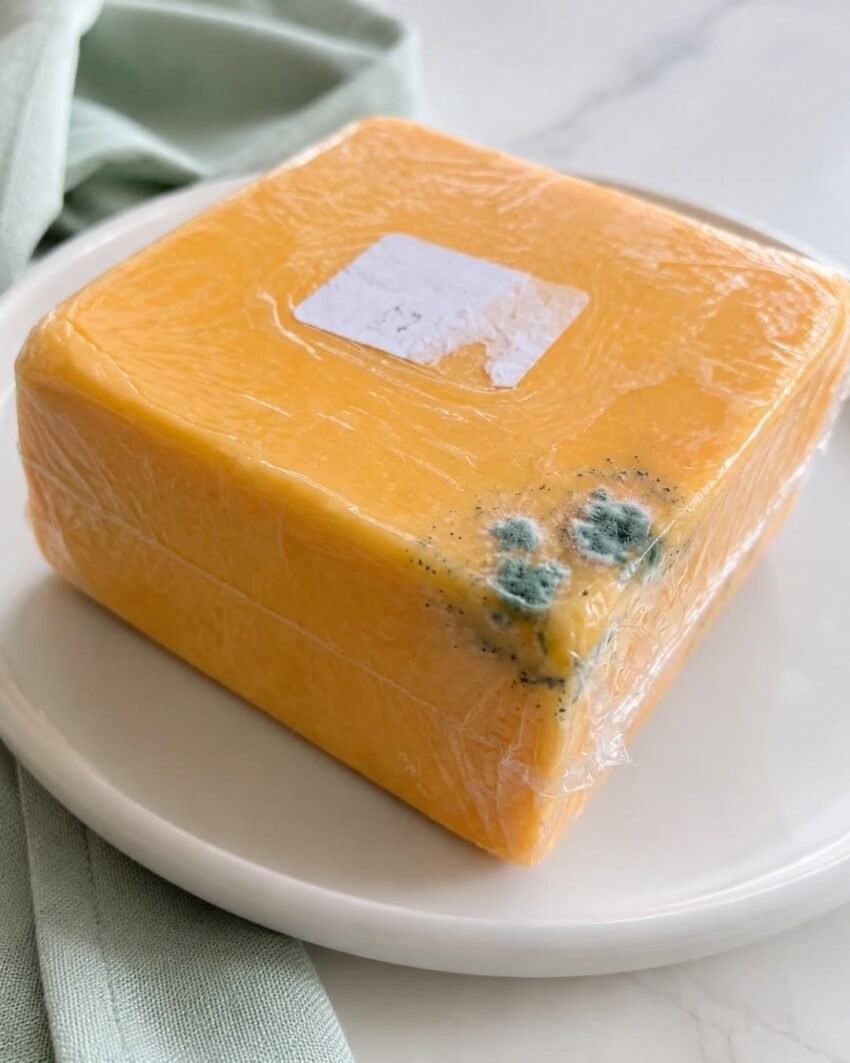
The Moldy Cheddar Dilemma: Can You Salvage It or Should It Go in the Trash?
Opening a block of aged cheddar only to find a fuzzy patch of green or blue mold is a universally frustrating kitchen moment. Your immediate instinct might be to toss the entire package into the trash, or perhaps to grab a knife and carve away the offending spot.
When it comes to food safety and dairy, the rules aren’t always intuitive. Treating soft cheese the same way as hard cheese can lead to food poisoning, while throwing out a high-quality block of cheddar just because of a surface blemish wastes both food and money.
The Science of Cheese Mold: Hard Versus Soft
To understand whether cheddar is salvageable, you have to look at its density and moisture content. The United States Department of Agriculture (USDA) and food safety experts divide cheeses into distinct categories based on how easily mold can penetrate their structure.
-
Soft Cheeses (Ricotta, Cottage Cheese, Cream Cheese, Brie): These have high moisture levels and a porous texture. If you spot mold on a soft cheese, the microscopic roots (mycelium) have almost certainly spread throughout the entire block, even if you can’t see them. Verdict: Throw it out.
-
Hard and Semi-Hard Cheeses (Cheddar, Parmesan, Swiss): These cheeses are dense, low in moisture, and tightly packed. Mold struggles to penetrate deep beneath the surface of a hard block. Verdict: Salvageable in most cases.
Because traditional cheddar is a hard-to-semi-hard cheese, its low moisture content acts as a natural barrier against deep mold penetration.
A Step-by-Step Practical Guide to Salvaging Cheddar
When you discover green mold on a block of cheddar, you don’t automatically need to waste the whole package. Follow this safe, industry-standard protocol to rescue your cheese:
-
Inspect the Extent of the Mold: Check how much of the block is affected. If it’s a small, localized spot, you can proceed. If the entire block is covered, slimy, or discolored deep within, discard it.
-
Use a Clean Knife: Grab a sharp, clean knife. Do not let the knife touch the moldy patch directly before cutting into clean cheese, as this can cross-contaminate the rest of the block.
-
Cut Generously: Slice off at least 1 inch (2.5 centimeters) all around and below the moldy spot. Ensure your knife goes deep into clean, unblemished cheese.
-
Avoid Touching the Mold: Keep the knife blade away from the mold during the process. Wash the knife thoroughly before making any further cuts.
-
Re-wrap Properly: Wrap the remaining healthy cheddar tightly in fresh parchment paper, wax paper, or specialized cheese paper to prevent exposure to air and future moisture accumulation. Avoid wrapping hard cheese directly in tight plastic wrap, which can trap condensation and encourage new mold growth.
When You Absolutely Must Throw It Out
While cheddar is resilient, certain conditions mean the entire block is compromised and unsafe for consumption.
-
Shredded, Sliced, or Crumbled Cheddar: If pre-shredded or sliced cheddar develops mold, throw it out immediately. Because the surface area is completely exposed and fragmented, mold spreads rapidly throughout the entire bag.
-
Unusual Odors or Slimy Texture: If the cheese smells sour, ammonia-like, or feels slimy to the touch alongside the mold, it has spoiled due to bacterial degradation rather than just surface mold.
-
Compromised Immune Systems: If the food is meant for pregnant women, infants, the elderly, or anyone with a compromised immune system, it is always safer to discard moldy cheese entirely rather than risk exposure to harmful mycotoxins or accompanying bacteria like Listeria.
Real-World Scenarios: Two Common Kitchen Mishaps
Consider Jessica, who unwrapped a gourmet 2-year-aged sharp cheddar bought at a local market and found a quarter-sized spot of green mold near the corner after it sat in the back of her fridge for three weeks. Because it was a dense, aged block, she sliced off a 1-inch border around the spot, inspected the interior (which looked and smelled completely normal), and used the rest to bake a batch of cheddar biscuits.
On the flip side, Marcus found a bag of pre-shredded sharp cheddar with a dusting of green mold near the seal. Following the urge to save money, he tried picking out the moldy handfuls and using the rest for tacos. Within hours, he experienced severe gastrointestinal distress. Pre-shredded cheeses lack the density of a solid block, allowing mold and bacteria to permeate every strand effortlessly.
Comparison of Cheese Types and Mold Safety
| Cheese Type | Moisture Level | Mold Penetration Risk | Action to Take |
| Hard Cheddar (Block) | Low | Low (surface only) | Cut off at least 1 inch around the mold and eat the rest. |
| Shredded Cheddar | Moderate | High (spreads throughout) | Throw away the entire package. |
| Soft Cheeses (Brie, Goat) | High | High (deep root system) | Throw away the entire package. |
| Processed Cheese Slices | Moderate-High | High | Throw away the entire package. |
Common Mistakes When Dealing with Moldy Cheese
-
Sniff-testing for safety: Assuming that if a cheese smells fine, it is safe to eat. Mold can produce invisible toxins or off-flavors that aren’t immediately detectable by smell.
-
Simply scraping off the surface: Using a butter knife to scrape away just the fuzzy green fuzz without cutting deep into the underlying cheese.
-
Storing cheese in airtight plastic bags: Trapping residual moisture against the cheese surface, which accelerates both mold growth and spoilage.
Expert Insights: Understanding Food Waste vs. Food Safety
Food safety authorities like the USDA emphasize that while cutting mold off hard cheese is generally safe, prevention is always better than cure. Modern food science notes that mold on cheese is often a harmless penicillium strain, but it can occasionally be accompanied by harmful bacteria or molds that produce mycotoxins. The 1-inch rule is designed as a safety buffer to ensure you bypass any microscopic root systems. Proper refrigeration (keeping your fridge at or below 40°F / 4°C) and changing wrapping materials frequently will dramatically reduce how often you encounter mold in the first place.
Frequently Asked Questions
What kind of mold grows on cheddar cheese?
It is usually a harmless strain of penicillium or ambient mold spores from the refrigerator environment, though spoilage molds can also appear if moisture is high.
Does toasting or melting moldy cheddar kill the toxins?
No. While heat will kill live mold spores and bacteria, it does not destroy potential mycotoxins or metabolic byproducts left behind by certain molds.
Why does hard cheese resist mold better than soft cheese?
Hard cheeses have low moisture content and high salt levels, both of which inhibit the growth and spread of fungal root systems.
Can I eat the cheese if the mold is white instead of green?
Sometimes white powdery mold on aged cheeses like cheddar is a natural part of the aging process (like natural rind development), but if it appears patchy, fuzzy, or grew during storage, treat it the same as green mold and cut it away.
How can I prevent cheddar from getting moldy in the fridge?
Store it wrapped in porous paper (like parchment or cheese paper) rather than plastic wrap, and keep it in the cheese drawer where humidity is regulated.
Is it safe to feed trimmed cheddar to pets?
No. Pets can be sensitive to mycotoxins and dairy spoilage products just like humans, so it is best to avoid feeding them trimmed moldy cheese.
Action Checklist for Moldy Cheddar
-
Do: Check if the cheddar is a solid block before attempting to salvage it.
-
Do: Cut at least 1 inch deep around and below the moldy spot using a clean knife.
-
Do: Re-wrap the remaining cheese in fresh paper to prevent further moisture buildup.
-
Avoid: Salvaging pre-shredded, sliced, or soft cheeses that show any signs of mold.
-
Avoid: Touching the moldy spot with your knife blade while cutting away the bad section.
Finding a spot of green on your cheddar isn’t a death sentence for the whole block—as long as it’s a solid, hard cheese and you trim away a generous margin, you can safely enjoy the rest.
For solid blocks of cheddar, mold is usually just a surface visitor; trim away a 1-inch border with a clean knife, and the rest of the block remains safe to eat.