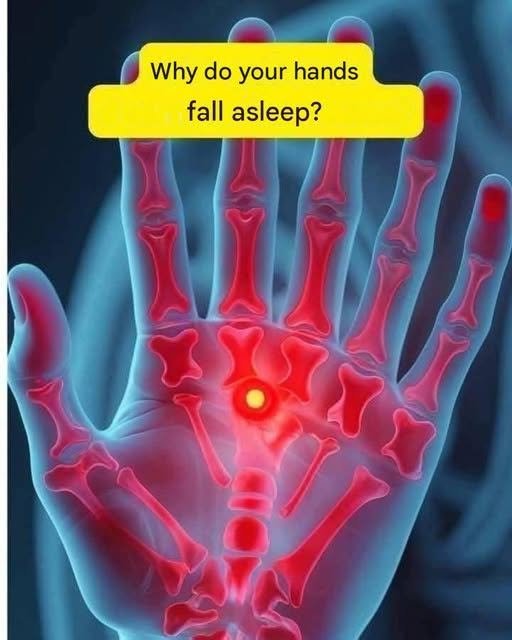
The Tingle Trap: Demystifying Why Your Hands Fall Asleep (and Why It’s Rarely What Internet Myths Say)
We’ve all experienced it: you wake up in the middle of the night, or you stand up from your desk, and your hand feels completely dead, heavy, and buzzing with an uncomfortable sensation of pins and needles. A rush of panic sometimes sets in, especially if you’ve recently scrolled past sensationalized clickbait claims suggesting that tingling hands are a “clear, definitive sign of cancer.”
Before jumping to terrifying conclusions, it helps to separate medical reality from internet myth. While persistent numbness can occasionally point to underlying health concerns, waking up with a numb hand is overwhelmingly a benign mechanical issue rather than a sinister diagnosis.
The Anatomy of a “Sleeping” Hand
When your hand falls asleep, the medical term is paresthesia. It happens when sustained, direct pressure is placed on a peripheral nerve or when blood flow to the area is temporarily restricted.
Think of a garden hose: if you step on the hose, the water flow stops or stutters, and the pressure builds up behind the blockage. The moment you step off, the water rushes back through, creating a turbulent, sputtering surge. Similarly, when you shift your sleeping position or uncross your legs, the trapped nerve is released, sending a cascade of nerve signals back to the brain that registers as tingling, buzzing, or prickling.
Common (and Far More Likely) Causes of Hand Numbness
If your hands frequently fall asleep, you can almost always trace the culprit back to common, treatable structural or lifestyle factors rather than oncology:
-
Carpal Tunnel Syndrome: Compression of the median nerve as it passes through the narrow carpal tunnel in your wrist, often aggravated by repetitive typing, sleeping with wrists curled, or fluid retention.
-
Cervical Spine Compression: A pinched nerve in the neck (cervical radiculopathy) caused by poor posture, a disc bulge, or age-related wear and tear on the vertebrae.
-
Sleeping Posture: Simply sleeping directly on your arm or wrist, cutting off circulation or compressing the ulnar or radial nerves for hours.
-
Nutritional Deficiencies: Low levels of essential vitamins—particularly Vitamin B12, which is vital for maintaining the protective myelin sheath around your nerves.
-
Peripheral Neuropathy from Diabetes: Chronic high blood sugar can damage peripheral nerves over time, leading to regular numbness or burning in the hands and feet.
Debunking the Cancer Myth
Where does the terrifying rumor linking hand numbness to cancer come from? In very rare instances, certain systemic conditions, paraneoplastic syndromes, or tumors affecting the central nervous system (brain or spinal cord) can cause neurological symptoms. However, these presentations are exceptionally uncommon, and they are almost always accompanied by a cluster of severe, progressive neurological red flags—such as profound muscle weakness, loss of balance, severe coordination issues, or sudden cognitive changes—rather than just a casual morning tingle from a bad sleeping position.
Attributing every instance of temporary hand paresthesia to a catastrophic illness creates unnecessary health anxiety and distracts people from investigating real, easily manageable mechanical causes like ergonomics and vitamin levels.
A Step-by-Step Practical Framework for Relief
If hand numbness is becoming a frequent nuisance in your daily life, take a structured, logical approach to addressing it:
-
Audit Your Sleep Ergonomics: Try wearing a straight wrist brace (night splint) to keep your wrists neutral while you sleep, preventing the median nerve from getting pinched.
-
Evaluate Your Workstation Setup: Ensure your computer keyboard and mouse placement allow your wrists to stay straight rather than bent upward or pressed sharply against a hard desk edge.
-
Check Your Nutrient Levels: Ask your doctor to run a simple blood panel checking your Vitamin B12, folate, and metabolic markers.
-
Incorporate Gentle Stretches: Perform regular nerve-gliding and wrist-stretching exercises throughout the day to relieve tension in your forearms and neck.
Real-World Scenarios: Finding the Real Root Cause
Consider David, a software developer who woke up every morning with both hands completely numb and buzzing. Terrified by a random article he read online linking numbness to severe neurological illness, he spiraled into intense health anxiety. When he finally consulted a neurologist, he learned he simply had mild bilateral carpal tunnel syndrome caused by sleeping with his wrists curled tightly beneath his pillow. A simple set of night splints completely resolved the issue within two weeks.
Conversely, ignoring chronic, worsening numbness that travels up the entire arm and is accompanied by burning pain or grip weakness warrants a professional evaluation to check for nerve entrapment or cervical spine issues.
Comparison of Numbness Triggers
| Cause | Typical Onset | Accompanying Symptoms | Action Required |
| Poor Sleep Posture | Upon waking up | Resolves within minutes of movement and shaking out the hand | None (adjust sleeping position) |
| Carpal Tunnel Syndrome | Gradual, repetitive | Nighttime waking, thumb/index finger numbness, dropping items | Ergonomic changes, wrist splints, doctor visit |
| Cervical Nerve Pinch | Linked to neck movement | Neck stiffness, pain radiating down the shoulder and arm | Physical therapy, medical evaluation |
| Vitamin B12 Deficiency | Slow and progressive | Brain fog, fatigue, balance issues, symmetrical tingling | Dietary adjustments, B12 supplementation |
Common Mistakes When Interpreting Hand Numbness
-
Relying on catastrophic internet searches: Assuming the worst-case scenario (like cancer or rare diseases) based on generic symptom checker lists instead of looking at common mechanical issues.
-
Ignoring persistent symptoms: Waiting until permanent nerve damage occurs before addressing chronic carpal tunnel or pinched nerves.
-
Self-diagnosing without testing: Guessing at vitamin deficiencies or nerve entrapments without consulting a primary care physician or specialist for proper diagnostics.
Expert Insights: The Neurological Perspective
Neurologists and orthopedic specialists emphasize that while listening to your body is crucial, understanding basic anatomy prevents panic. Temporary paresthesia is a normal physiological response to pressure on a nerve. When numbness becomes chronic, painful, or starts interfering with your daily grip strength, it is a clear signal to evaluate your ergonomics, posture, and systemic health—not a sign of an impending oncological crisis.
Frequently Asked Questions
Why do my hands fall asleep every night?
The most common reasons are sleeping positions that compress the wrists (carpal tunnel) or elbows (cubital tunnel), or resting directly on your arms, cutting off temporary nerve signaling.
When should I worry about hand numbness?
Seek medical attention if the numbness is constant, progressive, affects your balance, is accompanied by sudden muscle weakness, or does not resolve after changing position.
Can anxiety make your hands tingle?
Yes. Hyperventilation or acute anxiety triggers shifts in blood chemistry and adrenaline release, frequently causing paresthesia in the hands, fingers, and face.
How do doctors test for carpal tunnel syndrome?
Doctors typically perform physical examination maneuvers (like Tinel’s or Phalen’s tests) and may order an electromyography (EMG) or nerve conduction study to measure electrical activity in the nerves.
Are B-complex vitamins helpful for tingling hands?
If the numbness is due to a B12 or B6 deficiency, supplementing under medical guidance can significantly improve nerve function and reduce symptoms.
Can dehydration cause your hands to fall asleep?
While dehydration affects overall circulation and muscle function, localized hand numbness is primarily a neurological compression issue rather than a direct result of thirst.
Action Checklist for Hand Health
-
Do: Pay attention to whether your numbness is temporary (positional) or persistent (neurological).
-
Do: Use wrist splints at night if you suspect carpal tunnel compression.
-
Do: Consult a healthcare professional for persistent numbness, weakness, or pain.
-
Avoid: Jumping to catastrophic conclusions based on sensationalized online myths.
-
Avoid: Ignoring chronic grip weakness or spreading numbness down your arms.
Understanding how your nerves work turns a terrifying mystery into a manageable physical puzzle, keeping your peace of mind intact while you take care of your body.
Waking up with your hands falling asleep is a normal, benign mechanical reaction to temporary nerve compression—not a sign of cancer—and is almost always easily resolved by adjusting your sleep posture or addressing common issues like carpal tunnel syndrome.