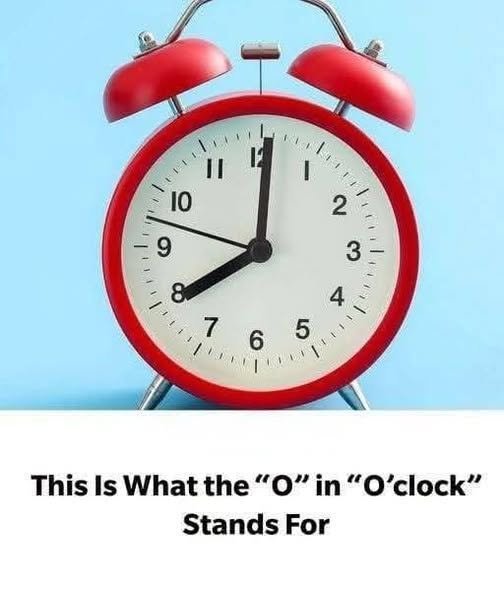
The Fascinating History Behind “O’Clock”—The Everyday Word We Never Think Twice About
Discover the surprising linguistic evolution, the shift from sun dials to mechanical timepieces, and how a sixteenth-century contraction permanently changed how humanity tracks the hours.
Look at your smartphone screen, glance at your microwave, or check the corner of your computer monitor. Throughout any given day, you will likely use the phrase “o’clock” a dozen times or more without a second thought. We tell our children it is eight o’clock, we confirm meetings for two o’clock, and we count down the minutes until five o’clock. It is linguistic wallpaper—so completely woven into the fabric of daily English that its odd structure never triggers our curiosity.
Yet, if you pause for just a moment to look at the phrase letter by letter, a strange mystery emerges. What on earth is that lonely apostrophe doing there? What is an “o”? And how did a fragment of a religious phrase transform into the universal marker of sixty-minute intervals?
The history of “o’clock” is a time capsule spanning centuries of technological disruption, linguistic shorthand, and the human race’s relentless obsession with synchronizing its schedules. This deep-dive exploration uncovers the surprising etymology, the mechanical revolution that forced the word into existence, and why this tiny phrase remains a linguistic masterpiece.
The Clockwork Revolution: Why Humanity Suddenly Needed a New Phrase
To understand why we say “o’clock,” you have to travel back to a time when telling time was entirely fluid, unreliable, and tied completely to the physical sky.
For thousands of years, ancient civilizations divided daylight into twelve hours and nighttime into twelve hours, regardless of the season. This meant that a “summer hour” was significantly longer than a “winter hour.” Clocks were crude water clocks (clepsydras), sundials that depended entirely on clear skies, or candle clocks that burned down at roughly steady rates. In this era, precise clock-time as we know it today simply did not exist. Most people woke with the sun, worked until dusk, and didn’t need to coordinate appointments down to the minute.
Everything changed in late-medieval Europe with the invention of the mechanical weight-driven clock around the late thirteenth and fourteenth centuries. Erected in high town squares and cathedral towers, these massive iron mechanisms struck bells to announce the passing of equal, standardized hours to the surrounding townspeople.
Suddenly, a new way of speaking about time was required. People no longer just looked up and guessed; they listened to the bell tower ring out the hour.
The Linguistic Origin: From “Of the Clock” to an Apostrophe
The phrase “o’clock” did not appear out of thin air. It is a classic example of linguistic compression—what etymologists call a contraction born of relentless repetition.
When mechanical tower clocks began announcing the hours, English speakers needed a way to distinguish between counting a duration of hours (e.g., “I waited for three hours”) and pointing to a specific point on the dial (e.g., “It is three [of the clock]”).
Originally, people literally said:
-
“It is three of the clock.”
-
“The meeting is at four of the clock.”
Over decades of everyday conversation, the human tongue naturally tends toward efficiency. Saying “of the clock” rapidly over and over again causes syllables to blur. The unstressed words “of” and “the” began to telescope together.
By the sixteenth century, this phrase had compressed into “o’clock.” The apostrophe is not a possessive mark; it is a structural scar. It stands in direct place of the missing letters f and th from the phrase “of the clock.” It is a visual monument to linguistic laziness—or, more accurately, our brain’s constant drive to make speech faster and smoother.
Comparative Overview: How Different Languages Tell Time
While English settled on a contraction of “of the clock,” other languages approached the mechanical age with entirely different linguistic strategies.
| Language | Phrase Used to State the Hour | Literal Translation / Etymology |
| English | “Eight o’clock“ | Contraction of “of the clock” (marking mechanical time) |
| Spanish | “Son las ocho en punto“ | “They are eight on the point” (referring to the exact strike on the dial) |
| German | “Es ist acht Uhr“ | “It is eight hour/clock” (derived directly from the Latin hora) |
| French | “Il est huit heures“ | “It is eight hours” (focusing on the duration/count of the day) |
| Dutch | “Het is acht uur“ | “It is eight hour” (direct Germanic alignment with time units) |
The Psychological Comfort of Standardized Time
Why did “o’clock” stick so permanently in our vocabulary, surviving the transition from pocket watches to digital displays and atomic clocks? Because humans crave cognitive anchors.
Saying “It is four o’clock” does more than just transmit data; it creates a shared reality. In an era before smartphones, hearing the town clock strike or agreeing to meet “at twelve o’clock” established a social contract of punctuality. It transformed time from an invisible, abstract river into discrete, manageable blocks.
Even today, when our devices show precise digital readouts like 12:00, our speech patterns still lean heavily on the cadence of “o’clock” when hitting the top of the hour. It rolls off the tongue with a satisfying rhythmic punch that digital numbers simply cannot replicate.
Common Misconceptions About Time Phrases
Language evolution is messy, and many people harbor mistaken beliefs about how everyday idioms originated.
Misconception 1: The Apostrophe Indicates Possession
Many assume “o’clock” means “clock’s hour” or belongs to the clock.
-
The Reality: As established, the apostrophe is a contraction marker replacing “f” and “th” from “of the clock,” not a possessive indicator.
Misconception 2: “O’Clock” Has Always Been Spelled This Way
Early English texts spelled out the compression in various ways—such as oclock, o-clock, or a clock—before standard printing presses and dictionaries locked in the apostrophe convention we recognize today.
Misconception 3: Mechanical Clocks Were Invented to Tell Time for Individuals
The earliest mechanical clocks in medieval Europe were built for the church and public governance, not for individual convenience. They were designed to regulate monastic prayer schedules and civic curfews long before personal timekeeping devices existed.
Expert-Level Insights: The Digital Shift and Language Survival
Linguists often study how technological shifts threaten or reshape vocabulary. When digital clocks with glowing LED numbers became ubiquitous in the 1970s and 80s, cultural critics predicted that older idioms tied to mechanical dials would die out.
Yet “o’clock” proved remarkably resilient. Even children learning to read digital clocks are taught to say “eight o’clock” when the minutes read “00.” This proves that idioms outlive the specific technology that birthed them, transforming from functional descriptions into cultural institutions.
Mini Case Scenario: Arthur’s Classroom Discovery
Take the experience of Arthur, a middle school history teacher in Ohio who noticed his students struggling to connect with pre-industrial history. During a lesson on the invention of mechanical clock towers in medieval Europe, a student asked why people didn’t just check their phones.
Instead of a dry lecture, Arthur challenged the class to look closely at the word “o’clock” on the chalkboard. He asked them to say it ten times fast. Together, they tracked the compression of “of the clock” down into a single syllable.
By showing his students the linguistic scar left by the apostrophe, Arthur turned a mundane vocabulary word into a living bridge to the past. The students suddenly realized that every time they used the word, they were unknowingly speaking a compressed medieval phrase born the moment humanity decided to synchronize its hours.
Frequently Asked Questions
What does the “o” actually stand for in “o’clock”?
The “o” is not a word by itself; it is a remnant of the preposition “of” that was fused together with “the clock” over centuries of rapid speech.
When was the word “o’clock” first recorded in English?
Written variations of the phrase began appearing in English literature during the late fourteenth and early fifteenth centuries as mechanical clocks became more widespread across Europe.
Why don’t we use “o’clock” when stating minutes?
“O’clock” is specifically reserved for the exact top of the hour (when the minute hand points to 12). For other times, we state the hours and minutes directly, such as “eight-fifteen” or “ten-forty.”
Are there other common contractions built the same way?
Yes! English is full of contractions that drop letters and replace them with apostrophes for speech efficiency, such as don’t (do not), won’t (will not), and it’s (it is).
Did sailors and navigators influence how we tell time?
Indirectly, yes. The standardization of timekeeping became vital for maritime navigation (calculating longitude at sea), which accelerated the reliance on precise mechanical clocks and standardized hourly terminology.
Why do some languages use the word “hour” instead of “clock”?
Languages like French (heure) and German (Uhr) root their timekeeping vocabulary in the Latin word hora, focusing on the unit of time itself, whereas English uniquely anchored its phrase to the physical machine (the clock) that measured it.
Is it grammatically correct to write “8 o’clock” or “eight o’clock”?
Both are acceptable depending on context. In formal publishing, traditional style guides often recommend spelling out numbers under ten (“eight o’clock”) while using numerals for specific times in journalistic or technical formats (“8:00 o’clock” is redundant; use either “8:00” or “eight o’clock”).
How has the digital age affected how we speak about time?
While digital clocks display exact numbers, spoken language remains deeply tied to traditional phrasing. People still say “quarter past” or “half past” alongside “o’clock,” proving that cultural speech habits change much slower than hardware technology.
Action Checklist
-
Notice Your Speech: Pay attention to how often you naturally drop the formal “of the clock” in favor of the snappy modern contraction.
-
Share the History: Use the origin of the apostrophe as an engaging conversation starter at your next family gathering.
-
Examine Your Devices: Contrast the ultra-modern digital screens around your home with the ancient linguistic roots of the words you use to describe them.
-
Appreciate Language Evolution: Recognize how human speech naturally compresses over time to maximize communicative efficiency.
Language is living history. A tiny, everyday phrase like “o’clock” carries the echoes of medieval tower bells, scribal shorthand, and human ingenuity. The next time you check your watch and tell a friend it is three o’clock, remember that you are speaking fluent sixteenth-century shorthand—a testament to how deeply our tools shape the words we use every single day.
What is your favorite everyday word or idiom with a surprising hidden history? Share your thoughts in the comments below!