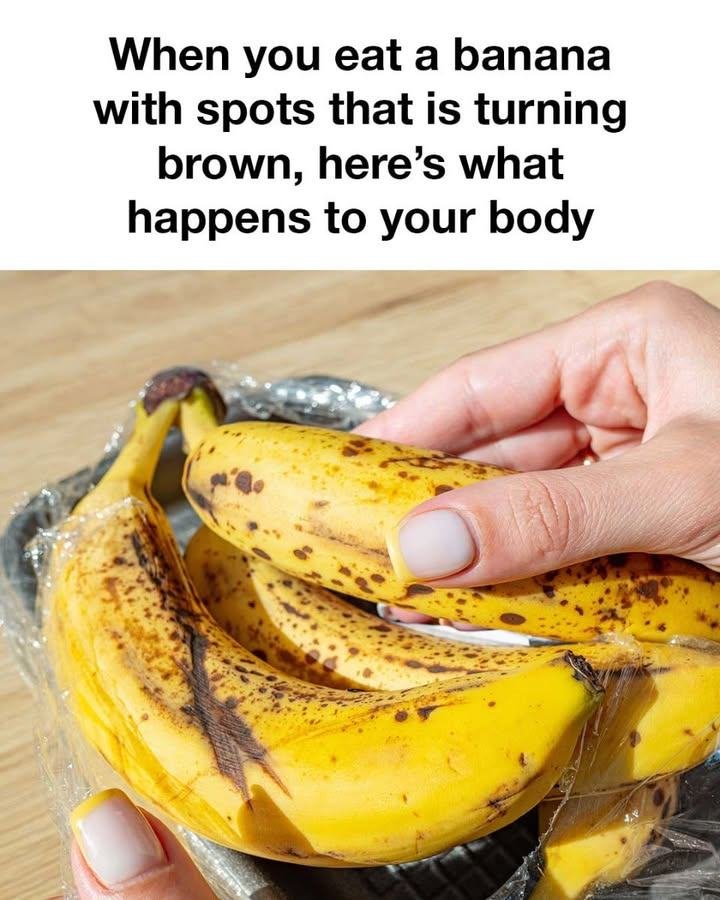
What Happens to Your Body When You Eat a Banana with Brown Spots
Eating a spotted banana isn’t just safe—it can be surprisingly healthy. Learn what happens in your body when you eat bananas that are turning brown.
Introduction
You peel a banana and notice brown spots starting to appear on the peel.
Some people toss it, thinking it’s “overripe” or “bad.” Others eat it anyway.
Here’s the truth: bananas with brown spots are actually packed with benefits—and your body reacts in interesting ways when you eat them.
In this article, we’ll explore:
-
How the ripeness affects nutrition
-
What happens in your digestive system
-
How blood sugar is influenced
-
Surprising health benefits
Why Brown Spots Appear on Bananas
Bananas turn brown because:
-
Starch converts to sugar: As bananas ripen, complex carbohydrates break down into simpler sugars.
-
Polyphenol oxidase activity: This natural enzyme reacts with oxygen, causing brown spots.
-
Ethylene production: This plant hormone accelerates ripening.
The browner the banana, the sweeter and softer it becomes.
What Happens in Your Body
1. Faster Energy Release
-
Brown spots indicate higher sugar content (glucose, fructose, sucrose).
-
Your body digests and absorbs these sugars faster than starch.
-
This gives a quick energy boost—perfect for post-workout or a midday pick-me-up.
Tip: If you need sustained energy, pair it with protein or fiber.
2. Easier Digestion
-
Starch in green bananas is resistant, which can be harder to digest.
-
As bananas ripen, starch converts to simple sugars, which are gentler on the stomach.
-
Brown-spotted bananas are ideal for people with digestive sensitivities.
3. Higher Antioxidant Activity
-
Studies show that as bananas ripen, antioxidant levels increase.
-
These antioxidants help neutralize free radicals in the body.
-
Brown spots are a visual sign that polyphenols are at work.
4. Blood Sugar Considerations
-
Brown bananas have a higher glycemic index than yellow ones.
-
For most healthy people, this is fine.
-
People with diabetes should monitor portion size and pair with fiber, protein, or healthy fats to avoid spikes.
5. Immune and Gut Benefits
-
Ripe bananas are easier for gut bacteria to ferment.
-
They act as a prebiotic, feeding healthy gut bacteria.
-
Some studies suggest ripened bananas may enhance immune function due to antioxidant compounds.
Health Benefits of Eating Spotted Bananas
| Benefit | Why It Happens |
|---|---|
| Quick energy | Simple sugars are readily absorbed |
| Antioxidant boost | Brown spots indicate increased polyphenols |
| Better digestion | Less resistant starch, gentler on stomach |
| Gut support | Prebiotic effect feeds healthy bacteria |
| Reduced food waste | Ripe bananas often discarded unnecessarily |
Myths About Brown Bananas
-
Myth: They’re bad for you.
Fact: Safe to eat and more antioxidant-rich. -
Myth: They cause rapid weight gain.
Fact: Like any fruit, moderation matters; they are nutrient-dense. -
Myth: They spoil quickly.
Fact: If peeled and stored in the fridge, they can last 1–2 more days.
Tips for Eating Ripe Bananas
-
Use in smoothies: Adds natural sweetness without added sugar.
-
Top oatmeal or yogurt: Boosts antioxidants and flavor.
-
Freeze for later: Perfect for banana bread or desserts.
-
Pair with protein: Peanut butter, yogurt, or nuts balance blood sugar.
Frequently Asked Questions
1. Are brown-spotted bananas safe?
Yes, they are safe unless mold develops or there is an unusual odor.
2. Are they sweeter than yellow bananas?
Yes, starch converts to sugar as bananas ripen.
3. Can they spike blood sugar?
Potentially, due to higher sugar content. Combine with protein or fiber to moderate.
4. Do they help with digestion?
Yes, the lower starch content makes them easier to digest.
5. Do brown bananas have more nutrients?
Yes, especially antioxidants like polyphenols.
6. Can kids eat them?
Absolutely. Soft texture and sweet flavor are ideal for children.
7. Can I freeze them?
Yes, perfect for smoothies, baking, or as a natural ice cream base.
Eating a banana with brown spots is not only safe—it can be more nutritious than yellow bananas.
-
Provides quick energy
-
Supports gut health
-
Boosts antioxidants
-
Easier to digest
So the next time you see a brown-spotted banana, don’t toss it. Eat it, freeze it, or blend it. Your body will thank you.