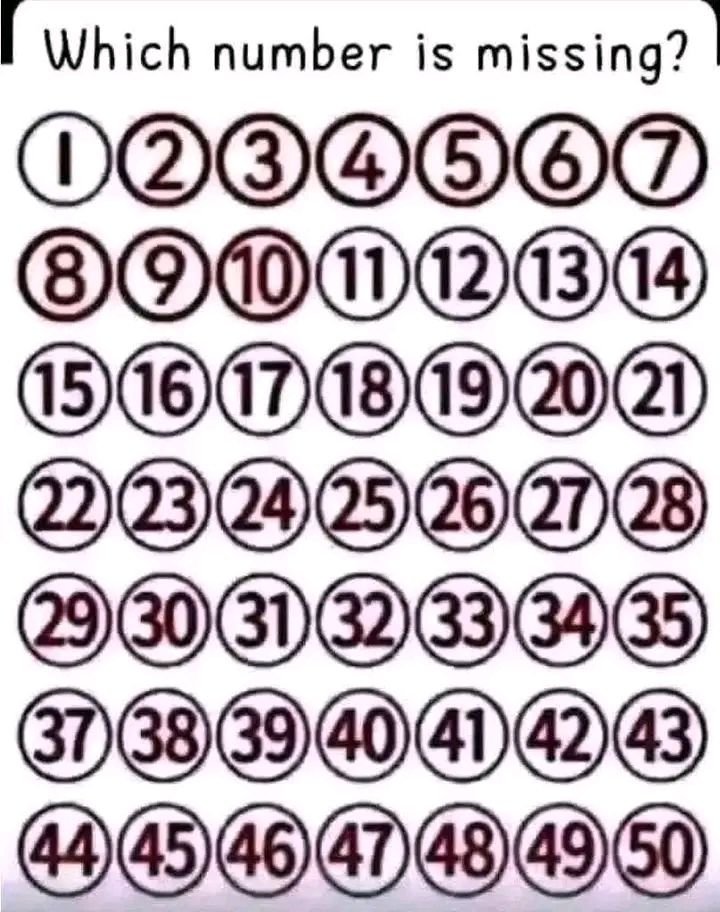
Which Number Is Missing in Them? How to Solve Number Puzzles Like a Pro
Learn how to find missing numbers in sequences, patterns, and puzzles. Step-by-step methods, tips, and real-life examples to sharpen your brain.
Introduction: The Puzzle Everyone Loves
You’ve probably seen puzzles like this:
2, 4, 6, ?, 10
Or more complex versions in tests, IQ challenges, or brain teasers.
The question always comes down to one thing:
“Which number is missing?”
Finding it isn’t just fun—it’s a way to exercise your brain, improve problem-solving skills, and even sharpen logic for daily life.
In this guide, you’ll learn:
-
How to recognize number patterns
-
Step-by-step strategies for missing-number puzzles
-
Common mistakes to avoid
-
Real-world applications of these skills
Step 1: Understand the Type of Sequence
Most missing-number puzzles fall into several types:
-
Arithmetic Sequences
-
Numbers increase or decrease by a constant amount.
-
Example: 3, 6, 9, ?, 15 → The difference is 3 → missing number = 12
-
-
Geometric Sequences
-
Numbers multiply or divide by a constant factor.
-
Example: 2, 4, 8, ?, 32 → Multiply by 2 → missing number = 16
-
-
Squares and Cubes
-
Numbers are perfect squares or cubes.
-
Example: 1, 4, 9, ?, 25 → 1², 2², 3², 4², 5² → missing number = 16
-
-
Fibonacci-Type Sequences
-
Each number is the sum of the previous numbers.
-
Example: 1, 1, 2, 3, ?, 8 → missing number = 5
-
-
Mixed or Pattern-Based Sequences
-
Alternating additions/subtractions, or a hidden rule.
-
Example: 2, 4, 8, 16, ? → Multiply by 2 → missing number = 32
-
Step 2: Identify the Pattern
Tips to Spot Patterns Quickly
-
Check differences between consecutive numbers.
-
Look for multiplication or division sequences.
-
Check squares or cubes if numbers increase rapidly.
-
Consider alternating patterns (e.g., add 2, subtract 1).
-
Don’t assume simplicity—some sequences have creative or hidden rules.
Step 3: Use Logical Reasoning
Sometimes sequences require reasoning beyond math:
-
Odd vs. Even Patterns
Example: 2, 4, 6, ?, 10 → odd/even pattern → missing = 8 -
Position-Based Rules
Example: 2, 4, 8, 16, ? → the nth term = 2^n → missing = 32 -
Combination Patterns
Example: 1, 2, 4, 7, 11, ? → +1, +2, +3, +4 → missing = 16
Step 4: Double-Check Your Work
-
Ensure the rule applies to all numbers, not just part of the sequence.
-
Look for alternative interpretations—some puzzles allow multiple answers.
-
Always verify your missing number fits the overall pattern.
Common Mistakes People Make
-
Rushing Without Analyzing
Guessing the missing number often leads to mistakes. -
Ignoring Complex Patterns
Some puzzles involve more than one operation. -
Overcomplicating Simple Sequences
Sometimes the pattern is straightforward—don’t overthink. -
Skipping Verification
Always check the sequence logic after inserting your answer.
Real-Life Applications of Missing-Number Skills
-
Standardized Tests and IQ Exams
-
Many test questions rely on missing-number patterns.
-
-
Budgeting and Accounting
-
Detecting missing or inconsistent figures in spreadsheets.
-
-
Data Analysis
-
Recognizing trends and predicting missing data points.
-
-
Problem-Solving Skills
-
Daily life decisions often involve identifying patterns or gaps.
-
Quick Tricks to Solve Number Puzzles Faster
-
Write down differences between consecutive numbers.
-
Check for multiplication/division first if numbers grow quickly.
-
Look for alternating sequences.
-
Use small scratch work instead of mental calculations.
-
Use trial and error with logic—sometimes guessing helps spot the rule.
Frequently Asked Questions
1. Can a sequence have multiple correct missing numbers?
Yes. Some puzzles are open-ended, but most test sequences follow one consistent rule.
2. What if I can’t find a pattern?
Check for more complex operations or position-based rules.
3. How can I improve at spotting patterns?
Practice with puzzles, brain teasers, and logic games daily.
4. Are missing-number puzzles only for kids?
No, they are excellent for adults to exercise cognitive skills and improve logic.
5. Can software or apps help?
Yes. Apps like Lumosity, BrainBashers, and daily puzzle apps improve pattern recognition.
6. How long should I spend on one puzzle?
Typically 1–3 minutes. If stuck, move on and return later with fresh eyes.
7. Can these skills help in math classes?
Absolutely. Recognizing patterns is the foundation of algebra and higher math.
8. What’s the easiest way to start learning patterns?
Start with simple arithmetic sequences, then progress to geometric and mixed patterns.
The Bigger Picture: Why Missing-Number Puzzles Matter
These puzzles are more than fun—they train your brain to:
-
Detect patterns
-
Reason logically
-
Think critically
-
Solve real-life problems efficiently
Even if you never take an IQ test, these skills are valuable for work, finance, and daily problem-solving.
Final Thoughts: Master the Art of Spotting the Missing Number
Finding the missing number isn’t just about memorizing formulas—it’s about:
-
Observing patterns carefully
-
Reasoning logically
-
Practicing consistently
Next time you see a sequence, pause, analyze, and ask:
“Which number is missing?”
Your brain will thank you—and you’ll impress friends with your quick, clever answers.
Your Turn
Challenge yourself:
-
5, 10, 20, ?, 80
Can you spot the missing number?
Share your answer in the comments and try creating your own sequence to challenge friends.
Hint: Look for a multiplication pattern.