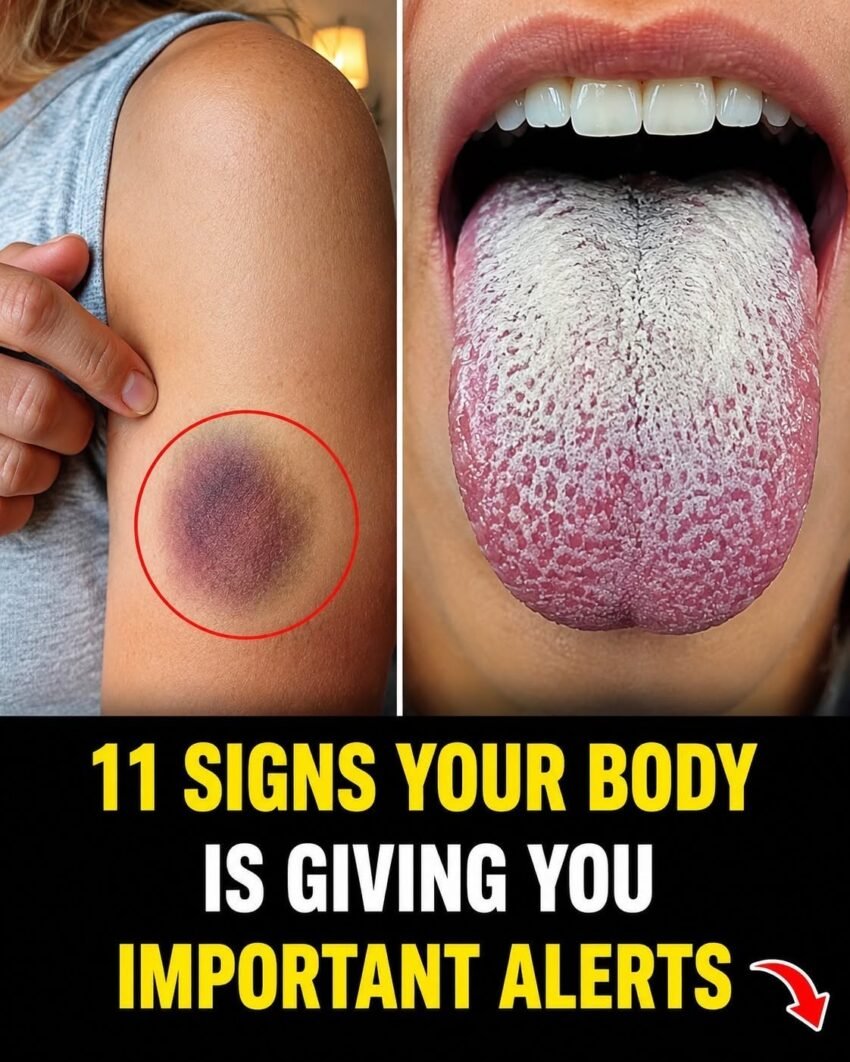
11 Signs Your Body Is Giving You Important Alerts You Shouldn’t Ignore
Your body rarely sends a notification that says, “Something needs attention.”
Instead, it often starts with small changes.
You feel unusually tired. Your mouth stays dry. Your digestion suddenly changes. You wake up with headaches. A wound seems to take longer than expected to heal.
Most of these symptoms have ordinary explanations. A poor night’s sleep, stress, dehydration, a new medication, or a temporary illness can make you feel different.
But sometimes a persistent or unusual change is your body’s way of telling you to slow down and pay attention.
The goal isn’t to become frightened by every symptom. It’s to become better at recognizing patterns.
Here are 11 everyday warning signs worth noticing, along with practical tips for deciding when it’s time to talk with a healthcare professional.
Health note: This article is for general education and isn’t a diagnosis. Many symptoms have multiple possible causes. If a symptom is severe, sudden, worsening, or accompanied by emergency warning signs, seek prompt medical care.
1. You’re Tired Even After Getting Enough Sleep
Everyone gets tired.
A late night, stressful week, demanding job, or poor sleep can leave almost anyone exhausted.
But there’s a difference between ordinary tiredness and persistent fatigue that doesn’t improve with adequate rest.
If you’re regularly sleeping enough but still feel drained, it’s worth paying attention.
Possible causes can range from stress and poor sleep quality to anemia, thyroid problems, medication effects, depression, sleep disorders, or other medical conditions.
Simple tip
Keep track of your sleep and energy for a week or two.
Ask yourself:
- How many hours am I sleeping?
- Am I waking repeatedly?
- Do I snore heavily?
- Do I wake with headaches?
- Am I sleepy during the day?
- Has my energy changed recently?
If persistent fatigue is interfering with normal activities, make an appointment with your healthcare professional rather than simply pushing through it.
2. You’re Constantly Thirsty
Feeling thirsty after exercise or on a hot day is completely normal.
Constant thirst is different.
If you’re drinking much more than usual and still feel thirsty, especially if you’re also urinating frequently, it’s worth discussing with a healthcare professional.
Increased thirst and urination can occur with high blood glucose, among other causes.
The Centers for Disease Control and Prevention (CDC) lists increased thirst and frequent urination among common symptoms of diabetes. (cdc.gov)
Other possibilities include dehydration, certain medications, and conditions affecting fluid balance.
Simple tip
Don’t simply force yourself to drink enormous amounts of water because you’re unusually thirsty.
Notice the pattern.
If excessive thirst continues for days or is accompanied by frequent urination, unexplained weight loss, fatigue, or blurred vision, talk with a healthcare professional about whether testing is appropriate.
3. Your Bathroom Habits Suddenly Change
Your digestive system isn’t identical every day.
Diet changes, travel, stress, infections, medications, and changes in activity can all affect bowel movements.
But a persistent change from your normal pattern deserves attention.
You might notice:
- New constipation
- Persistent diarrhea
- A significant change in stool appearance
- Unexplained urgency
- Persistent abdominal discomfort
- A feeling that your bowel habits have changed without an obvious reason
One unusual bowel movement usually isn’t a reason to panic.
A lasting change is more meaningful.
Simple tip
Think about what changed before the symptom appeared.
Did you start a new medication?
Change your diet?
Travel?
Eat significantly more or less fiber?
Experience an illness?
If the change persists or is accompanied by blood in the stool, unexplained weight loss, significant pain, or other concerning symptoms, seek medical evaluation.
4. You’re Losing Weight Without Trying
This is one of those symptoms that’s easy to dismiss.
Maybe you’ve simply been busy.
Maybe you’ve been eating a little differently.
But unintentional weight loss can sometimes signal an underlying health problem.
It can occur with digestive disorders, thyroid disease, diabetes, infections, medication effects, mental-health conditions, and some cancers, among other causes.
That doesn’t mean unexplained weight loss automatically means something serious.
It means the reason should be understood.
Simple tip
If you notice your weight steadily falling without intentionally changing your diet or exercise routine, make a note of the trend.
Don’t focus on a single measurement.
Look at the overall pattern.
A healthcare professional can determine whether further evaluation is needed.
5. You Keep Getting Headaches That Feel Different
Headaches are incredibly common.
Most are not caused by something dangerous.
But the pattern matters.
A headache that is new, unusually severe, increasingly frequent, or distinctly different from your usual headaches deserves attention.
Pay particular attention to a sudden, extremely severe headache or a headache accompanied by symptoms such as weakness, confusion, fainting, difficulty speaking, vision changes, fever with a stiff neck, or other neurological symptoms.
Simple tip
Keep a basic headache diary.
Record:
- When it started
- How long it lasted
- Where it hurt
- How severe it was
- What you ate and drank
- How much you slept
- Any other symptoms
Patterns can help your healthcare professional understand what’s happening.
6. Your Skin Suddenly Changes
Your skin can tell you a surprising amount about what’s happening in your body—and sometimes the change is entirely local.
Pay attention to a new or changing mole, persistent sore, unexplained rash, or spot that changes in size, shape, color, or behavior.
The American Academy of Dermatology recommends having suspicious or changing skin spots evaluated by a dermatologist. (aad.org)
You don’t need to memorize every possible skin condition.
Instead, become familiar with your own skin.
Simple tip
When you notice a new spot, take a clear photograph in good lighting.
If it changes, that photograph can help demonstrate what was different before.
And don’t repeatedly scratch, burn, or attempt to remove an unidentified growth at home.
7. You Feel Short of Breath Doing Things That Used to Be Easy
Getting out of breath after running up several flights of stairs can be normal.
Becoming unusually short of breath while doing ordinary activities you’ve handled comfortably before is different.
Maybe you used to walk around the neighborhood without difficulty, but now you need to stop repeatedly.
Maybe climbing a single flight of stairs leaves you unusually winded.
There are many potential explanations, including deconditioning, anemia, asthma, lung conditions, heart conditions, and other causes.
Simple tip
Compare your current ability with your recent normal—not with someone else’s fitness level.
If your exercise tolerance has clearly declined without an obvious explanation, talk with a healthcare professional.
If shortness of breath is sudden or severe, especially with chest pain, fainting, blue or gray lips, or confusion, seek emergency medical care.
8. Your Feet or Ankles Keep Swelling
Swelling can happen after standing for a long time, traveling, eating a very salty meal, or during certain hormonal changes.
But persistent or unexplained swelling deserves attention.
Swelling in both legs can have many possible causes, including medication effects and problems involving the heart, kidneys, liver, veins, or other systems.
Sudden swelling in one leg, especially when accompanied by pain, warmth, or redness, can be more urgent because a blood clot is one possible cause.
Simple tip
Notice when the swelling happens.
Is it worse at night?
Does it disappear by morning?
Is it affecting one side or both?
Did you recently start a medication?
Don’t assume persistent swelling is simply part of getting older.
9. You Have Frequent Heartburn
Occasional heartburn is common.
Large meals, certain foods, alcohol, lying down soon after eating, and other factors can trigger it.
But frequent heartburn shouldn’t simply become something you live with indefinitely.
Persistent reflux symptoms can affect quality of life and may require treatment.
The American College of Gastroenterology recommends medical evaluation in certain circumstances, particularly when symptoms are frequent, troublesome, or accompanied by alarm symptoms. (pubmed.ncbi.nlm.nih.gov)
Simple tip
Notice whether symptoms occur after particular meals or when lying down.
Avoid eating immediately before bed if that triggers symptoms.
If heartburn happens frequently, interferes with sleep, or requires regular medication, discuss it with a healthcare professional.
And remember that chest pain isn’t always heartburn.
If you’re unsure whether chest discomfort is reflux or something more serious, seek medical attention.
10. A Small Wound Takes Longer to Heal
A minor cut or scrape normally progresses through healing.
If you notice that wounds repeatedly seem slow to heal, don’t simply dismiss it.
Delayed healing can occur for several reasons, including poor circulation, infection, certain medications, nutritional problems, and high blood glucose.
Diabetes can also affect the body’s ability to heal wounds, particularly when blood glucose remains elevated. (cdc.gov)
Simple tip
Keep minor wounds clean and follow appropriate wound-care instructions.
Watch for increasing redness, warmth, swelling, drainage, worsening pain, or fever.
If wounds repeatedly heal slowly—or a wound isn’t improving as expected—contact a healthcare professional.
11. Your Mood, Memory, or Concentration Has Changed
Not every mental lapse means something is seriously wrong.
Everyone forgets names.
Everyone occasionally walks into a room and forgets why.
Stress and lack of sleep can make concentration surprisingly difficult.
The more important question is whether there’s a persistent change from your usual functioning.
Perhaps you’re struggling with tasks that used to be routine.
Maybe you’re repeatedly forgetting appointments.
Maybe your family has noticed changes before you have.
Mood changes can also be significant.
Persistent sadness, anxiety, irritability, loss of interest, or major changes in sleep and appetite deserve attention.
Simple tip
Don’t be embarrassed to mention these changes to your doctor.
Brain health is health.
And sometimes a symptom that feels like “just getting older” has a treatable cause.
One Symptom Doesn’t Always Tell the Whole Story
This is perhaps the most important point.
The human body isn’t a collection of isolated parts.
One symptom can have dozens of possible explanations.
For example, fatigue might come from poor sleep.
Or anemia.
Or stress.
Or medication.
Or a thyroid disorder.
Or another health problem.
That’s why searching for one symptom online and immediately deciding you have the worst possible condition can create unnecessary fear.
Instead, look at the pattern.
Ask:
When did it start?
Is it getting worse?
How often does it happen?
What else changed?
Is it interfering with daily life?
Those details are much more useful than a single symptom in isolation.
Your Personal “Normal” Is One of the Best Warning Systems
You don’t need to become an expert in medicine to become more aware of your health.
You simply need to know what is normal for you.
How much energy do you normally have?
How often do you normally use the bathroom?
How far can you comfortably walk?
How much water do you usually drink?
What does your skin normally look like?
How often do you usually get headaches?
How well do you normally sleep?
Once you know your baseline, changes become easier to notice.
That doesn’t mean every change is dangerous.
It means you have useful information to discuss with a healthcare professional if something persists.
A Simple Daily Body-Check Habit
You don’t need to spend an hour analyzing yourself every morning.
Try a quick mental check.
Energy
Do I feel roughly as energetic as usual?
Hydration
Am I unusually thirsty?
Breathing
Can I perform my normal activities comfortably?
Digestion
Has my usual bowel pattern changed?
Pain
Is there new or persistent pain?
Skin
Have I noticed a new or changing spot?
Mood
Do I feel significantly different emotionally?
Weight
Have I noticed unexplained changes?
This isn’t a diagnostic test.
It’s simply a way to notice patterns before they become easy to ignore.
When a Symptom Is an Emergency
Most everyday symptoms aren’t emergencies.
But some combinations require immediate attention.
Seek emergency medical care for symptoms such as:
- Sudden severe chest pain or pressure
- Severe difficulty breathing
- Sudden weakness or numbness, particularly on one side
- Sudden difficulty speaking or understanding speech
- Sudden loss of consciousness
- A sudden severe headache unlike previous headaches
- Severe allergic reactions with breathing difficulty or swelling
- Significant uncontrolled bleeding
Don’t wait for a home remedy to work when symptoms could represent a medical emergency.
Common Mistakes People Make With Body Warning Signs
Mistake 1: Ignoring symptoms because they’re common
A symptom being common doesn’t make persistent symptoms irrelevant.
Better approach: Notice duration, frequency, and change from your normal.
Mistake 2: Assuming everything is aging
Some changes become more common with age, but that doesn’t mean every new symptom should be accepted as inevitable.
Better approach: Mention persistent changes during routine healthcare visits.
Mistake 3: Searching for the scariest diagnosis
Online searches can quickly turn an ordinary symptom into a frightening list of rare diseases.
Better approach: Use reliable health sources and discuss persistent concerns with a professional.
Mistake 4: Treating symptoms without understanding them
Taking medication repeatedly to suppress a symptom may hide a problem that needs evaluation.
Better approach: If a symptom keeps returning, find out why.
Mistake 5: Waiting until something becomes severe
Early evaluation can sometimes make problems easier to manage.
Better approach: Don’t wait indefinitely when a symptom is persistent, progressive, or unusual for you.
A Simple Rule: Notice, Track, Act
When something feels different, use three steps.
NOTICE
Don’t automatically dismiss the change.
TRACK
Write down when it happens, how often, and whether it’s getting better or worse.
ACT
If it persists, worsens, or concerns you, contact a healthcare professional.
This approach is far more useful than either extreme:
ignoring everything or panicking about everything.
Your body doesn’t always send dramatic warnings.
Sometimes the signal is surprisingly ordinary:
You’re more tired than usual.
You’re suddenly thirsty all the time.
Your digestion has changed.
A familiar headache feels different.
Your skin looks different.
You’re getting short of breath doing things that used to be easy.
These signs don’t automatically mean something is wrong.
But persistent or unexplained changes deserve attention.
The goal isn’t to fear every symptom. It’s to recognize when your normal has changed—and know when it’s worth asking why.
Listen to your body without becoming afraid of it.
Notice patterns.
Keep track of meaningful changes.
And when something doesn’t seem right, don’t be afraid to bring it up with a healthcare professional.
Sometimes the most useful health habit isn’t knowing every disease.
It’s simply knowing your own baseline well enough to notice when something has changed.