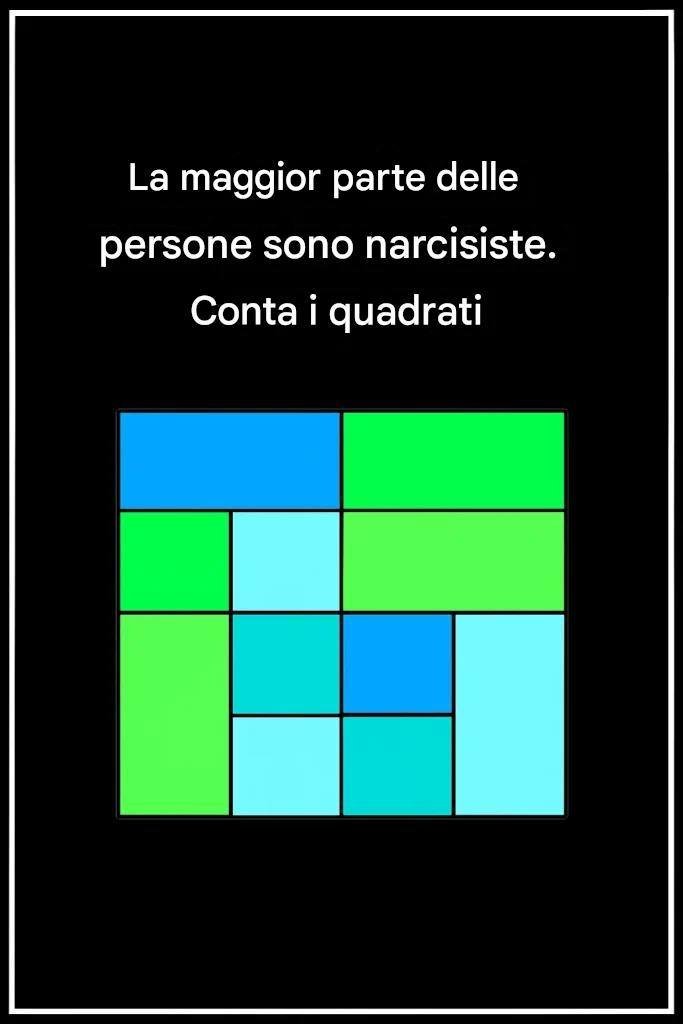
“Most People Are Narcissists, Count the Squares” — What’s Really Going On?
You’ve probably seen this kind of post:
“Most people are narcissists. Count the squares.”
It usually comes with an image — a grid, overlapping boxes, or a tricky visual puzzle — and a bold psychological claim.
Before you jump in, let’s unpack both parts:
-
The narcissist claim
-
The square-counting illusion
Because they’re usually not connected in the way the post suggests.
First: Are Most People Narcissists?
Short answer: No.
True narcissistic personality traits exist on a spectrum. But Narcissistic Personality Disorder (NPD) is relatively uncommon.
According to the American Psychiatric Association, Narcissistic Personality Disorder involves a persistent pattern of:
-
Grandiosity
-
Need for excessive admiration
-
Lack of empathy
-
Exploitative behavior
Large-scale estimates suggest only a small percentage of adults meet clinical criteria.
However…
Modern culture (especially social media) can amplify narcissistic traits like:
-
Self-focus
-
Image management
-
Validation-seeking
That doesn’t mean “most people are narcissists.” It means human psychology includes self-interest — and online environments magnify it.
So why pair this claim with counting squares?
The Square-Counting Illusion Explained
These viral posts usually show:
-
A grid of large squares
-
Smaller squares inside
-
Overlapping lines
-
Hidden shapes
The trick is that most people:
-
Count only the obvious squares
-
Miss the overlapping combinations
-
Underestimate the total
It’s a visual perception test, not a personality diagnosis.
Psychologists often use visual illusions to demonstrate how the brain simplifies patterns. The brain prefers the most obvious shapes first.
That’s not narcissism.
That’s cognitive efficiency.
Why the Post Says “Most People Are Narcissists”
This is usually engagement bait.
Here’s how it works psychologically:
-
It presents a bold accusation (“Most people are narcissists”).
-
It gives you a challenge (“Count the squares”).
-
It implies that missing squares proves something about you.
This taps into:
-
Ego defense
-
Curiosity
-
Competitiveness
-
Fear of being wrong
It’s designed to make you interact.
What Counting Squares Actually Measures
Square-counting illusions test:
-
Visual attention
-
Pattern recognition
-
Cognitive flexibility
-
Patience
They do not test narcissism.
Narcissism involves personality traits, not visual perception accuracy.
There is no scientific basis linking square-counting errors to narcissistic tendencies.
Why People Get Different Answers
When counting squares, people often:
-
Count only the smallest visible ones
-
Forget medium-sized combinations
-
Miss the largest outer square
-
Overlook rotated or overlapping shapes
The total depends entirely on the design of the image.
Without seeing the specific image you’re referring to, I can’t calculate the exact number — because every version is different.
If you’d like, you can describe the layout (for example: “a 4×4 grid with one large outer border”), and I’ll help you count systematically.
How to Count Squares Correctly (Step-by-Step Method)
If you’re looking at a grid-based puzzle, use this method:
Step 1: Count the Smallest Squares
Count each individual unit square.
Step 2: Count 2×2 Combinations
Group squares in blocks of four.
Step 3: Count 3×3 Blocks
Look for larger groupings.
Step 4: Count the Largest Outer Square
Step 5: Check for Overlapping or Hidden Boxes
Most people stop after Step 1 — that’s why answers differ.
The Psychology Behind Viral Brain Teasers
Posts like this spread because they combine:
-
A personality hook
-
A challenge
-
A comparison trigger
Social media thrives on:
-
“If you saw 16, you’re normal.”
-
“If you saw 20, you’re a genius.”
-
“If you saw 12, you’re narcissistic.”
These labels are arbitrary.
They’re designed to provoke reaction — not deliver real psychological insight.
So… Are Most People Narcissists?
No.
Humans are naturally self-focused sometimes. That’s survival wiring.
But clinical narcissism is far more complex than a visual puzzle.
And missing a few squares doesn’t diagnose anything.
Why These Posts Feel So Convincing
They exploit three things:
-
Authority tone — bold psychological claims
-
Ambiguity — no clear right answer shown
-
Social comparison — “What did you get?”
Your brain wants resolution.
That’s why you paused.
If You Want, Let’s Actually Count
If you describe the image (for example: number of rows and columns, overlapping boxes, or special markings), I’ll:
-
Break it down clearly
-
Show you the counting formula
-
Explain how others likely miscounted
No psychology traps involved.
Final Thoughts
The phrase “Most people are narcissists” is attention-grabbing — but not scientifically grounded in this context.
Counting squares measures visual processing.
Narcissism involves personality traits.
They’re not related.
But if you’ve got the image in front of you, let’s solve it properly.