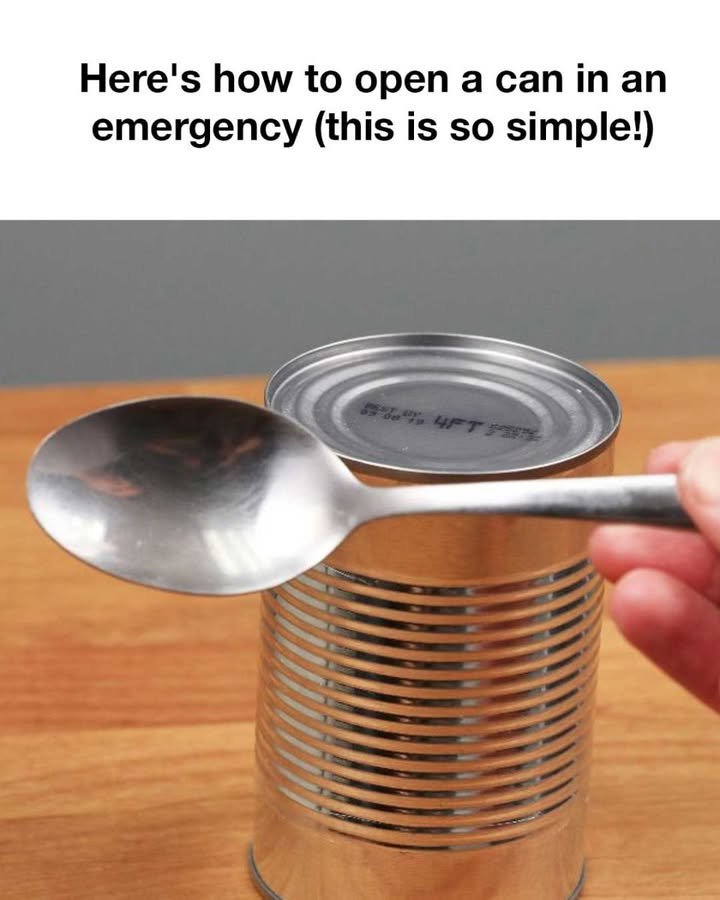
Here’s How to Open a Can in an Emergency (This Is So Simple — and It Could Save Your Meal)
No can opener? Learn simple, safe ways to open a can in an emergency using common household items—plus tips to avoid injury.
It’s 8:30 p.m.
The power’s out.
You’re hungry.
And the only food you have is in a can.
No electric opener.
No manual opener.
No backup.
Before you panic — take a breath.
There is a simple way to open a can in an emergency using basic surfaces you likely already have. It’s not magic. It’s not complicated. And when done carefully, it works.
Let’s walk through it safely.
Why This Works (Understanding the Lid Seal)
Canned food is sealed by crimping a thin metal lid tightly around the rim.
That rim is actually the weak point.
If you can wear down the crimped edge, the lid will loosen enough to remove.
This is basic friction and pressure — no special tools required.
Method 1: The Concrete or Rough Surface Technique
This is the simplest and most reliable emergency method.
What You Need:
-
A rough, hard surface (concrete sidewalk, driveway, brick, flat stone)
Step-by-Step Instructions:
-
Turn the can upside down.
The lid should face the ground. -
Place it flat against the rough surface.
-
Rub the can back and forth.
Use steady pressure.
Don’t slam it — just grind it evenly. -
Check after 20–30 seconds.
You’ll notice moisture forming around the rim. That means the seal is thinning. -
Flip it upright.
-
Press the lid inward gently.
It should pop open with light pressure.
You can use:
-
A spoon handle
-
The back of a knife (carefully)
-
Even your thumb if the seal is fully worn down
Why It Works
The friction removes the thin folded edge that holds the lid in place.
Once that seal weakens, internal pressure helps loosen the lid.
This technique is widely used in survival training and emergency preparedness courses, including those aligned with general readiness guidance from agencies like the Federal Emergency Management Agency.
Method 2: Using a Sturdy Metal Spoon
If you’re indoors without concrete access, this works surprisingly well.
What You Need:
-
A strong metal spoon (not plastic)
Steps:
-
Hold the can steady on a firm surface.
-
Place the tip of the spoon against the lid’s inner edge.
-
Rub back and forth firmly in one spot.
-
Once the metal thins, push through.
-
Work around the edge until the lid loosens.
This requires patience, but it’s effective.
Method 3: Pocket Knife (With Extreme Caution)
If you have a sturdy knife:
-
Hold the can steady.
-
Carefully puncture near the edge.
-
Repeat around the rim.
-
Pry upward gently.
⚠ Important: This method increases risk of slipping and injury. Only use if confident and stable.
Safety First: Avoid These Mistakes
Opening a can without a tool requires control.
Here’s what NOT to do:
-
❌ Don’t smash the can with a rock (you’ll spill contents)
-
❌ Don’t use fragile surfaces like glass
-
❌ Don’t grip near sharp metal edges
-
❌ Don’t rush
After opening, check for:
-
Metal shavings
-
Jagged edges
Wipe the rim before eating.
When This Skill Is Especially Useful
-
Power outages
-
Camping trips
-
Natural disasters
-
Broken can opener
-
Car emergency kits
-
College dorm rooms
The American Red Cross recommends keeping manual can openers in emergency kits — but knowing a backup method adds resilience.
Is This Safe for All Cans?
Works best for:
-
Soup cans
-
Vegetable cans
-
Beans
-
Pet food
More difficult for:
-
Pull-tab cans (if tab breaks off)
-
Extra-thick industrial cans
Always inspect before consuming.
Real-World Scenario
During a winter storm, a family loses power for 36 hours.
They have:
-
Flashlights
-
Bottled water
-
Canned soup
But the electric opener doesn’t work.
Instead of forcing the lid and risking cuts, they use their driveway surface and open dinner in under two minutes.
Small skills matter in uncomfortable moments.
Pros and Cons of the Friction Method
| Pros | Cons |
|---|---|
| Requires no tools | Needs rough surface |
| Works almost anywhere | Takes some effort |
| No electricity needed | Can create sharp edges |
| Reliable in emergencies | Not as clean as opener |
Frequently Asked Questions
Is it safe to eat food opened this way?
Yes, if no metal fragments fall inside and the food smells normal.
Will the contents spill?
Not if you keep the can upright and controlled.
Does this work on aluminum cans?
Most food cans are steel. Aluminum beverage cans are different and should not be opened this way.
How long does it take?
Usually 30–90 seconds with consistent pressure.
Can kids do this?
Adults should handle it due to sharp edges.
What if the lid won’t pop off?
Rub longer. The crimp must fully thin before it releases.
Is this considered a survival trick?
Yes. It’s commonly taught in basic preparedness training.
Should I still keep a manual can opener?
Absolutely. This is a backup, not a replacement.
Smart Preparedness Tip
After reading this, consider:
-
Adding a manual opener to your emergency kit
-
Keeping one in your car
-
Storing one in a camping bin
Redundancy prevents stress.
Knowing how to open a can without a can opener is simple.
All you need is friction, patience, and a steady hand.
It’s not about expecting disaster.
It’s about being capable when something small goes wrong.
Because sometimes the difference between frustration and calm is just knowing one practical trick.
If this helped, share it with someone who keeps all their food in cans “just in case.” And tell me — have you ever had to open a can the hard way?