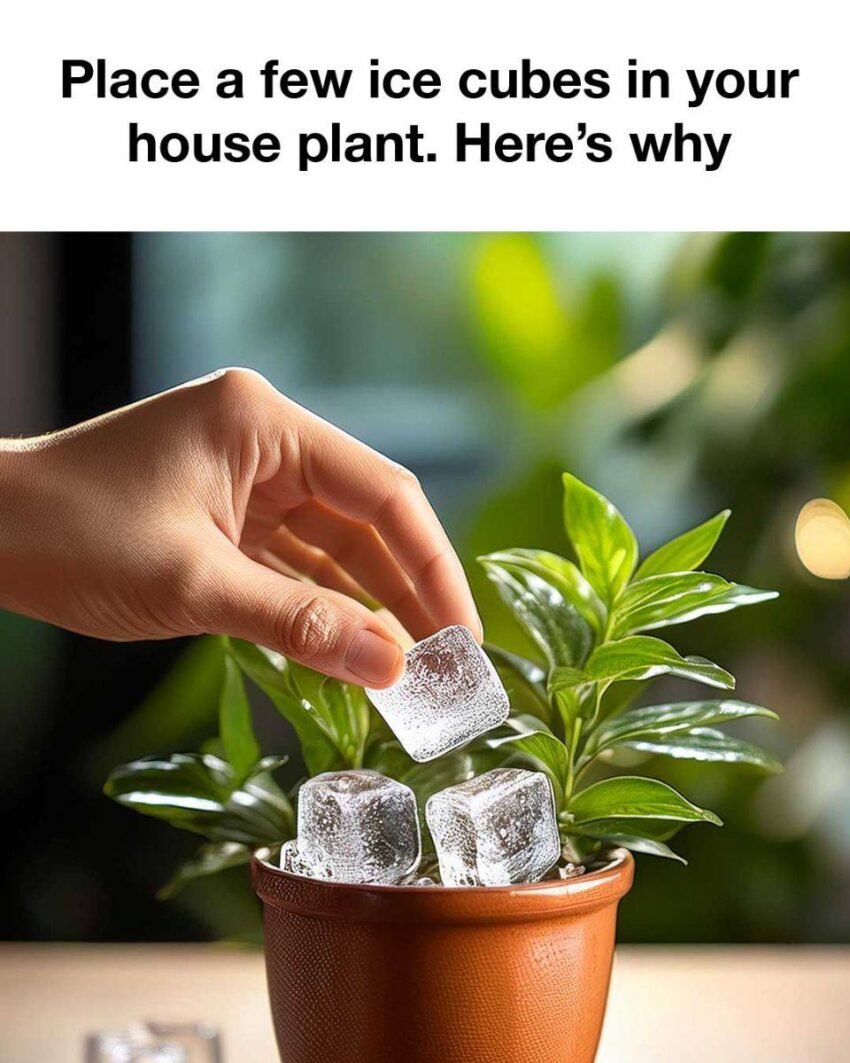
Place a Few Ice Cubes in Your Houseplant — Here’s Why This “Brilliant” Hack Actually Works
Heard about putting ice cubes in your houseplant? Discover why this simple watering hack works, when to use it, and when to avoid it.
I saw this hack the other day and honestly thought, “That’s either genius… or a terrible idea.”
The tip?
Place a few ice cubes on the soil of your houseplant instead of pouring water.
At first glance, it feels wrong. Plants are tropical, right? Why would you put ice on them?
But there’s real reasoning behind it — and in some cases, it actually makes sense.
Let’s break down why this trick works, when it’s helpful, and when you absolutely shouldn’t use it.
Why the Ice Cube Trick Became So Popular
Overwatering is the #1 reason houseplants die in American homes.
Not underwatering.
Not lack of sunlight.
Too much water.
Most beginners pour water until it drains, then repeat too often. The soil stays soggy, roots suffocate, and rot begins.
The ice cube hack solves one specific problem:
👉 Portion control.
Ice cubes melt slowly, delivering a measured amount of water over time.
How the Ice Cube Method Actually Works
When you place 2–3 ice cubes on top of the soil:
-
They melt gradually.
-
Water seeps evenly into the potting mix.
-
The soil absorbs moisture more slowly.
-
There’s less risk of flooding the roots.
It mimics gentle, controlled watering.
Think of it like a drip irrigation system — just very small-scale.
Why It’s Especially Popular for Orchids
This hack became widely shared because of orchids.
Phalaenopsis orchids (the kind most Americans buy at grocery stores) are often grown in bark-based mixes, not dense soil.
Orchid growers discovered that using 2–3 ice cubes weekly helped prevent overwatering.
It became so common that some big-box retailers even include ice cube watering instructions with orchid purchases.
The Science: Does Cold Water Hurt Plants?
Here’s the part that makes people nervous.
“Won’t ice shock the roots?”
In most indoor environments, the ice melts quickly and reaches room temperature before it deeply penetrates the root system.
Research shared by horticultural experts at institutions like University of Florida suggests that slow, moderate watering is more important than water temperature for most common houseplants.
The key factor isn’t the cold — it’s the quantity.
When the Ice Cube Hack Works Best
This method is most useful if:
-
You tend to overwater.
-
Your plant is small to medium-sized.
-
The pot has good drainage.
-
You’re watering orchids.
-
You want consistent weekly control.
It’s also helpful for people who travel and need predictable watering.
When You Should NOT Use Ice Cubes
This is important.
Avoid this method if:
-
Your plant is tropical and sensitive (like calatheas).
-
The plant is very large.
-
The soil is compact and poorly draining.
-
The pot has no drainage hole.
-
The plant requires deep, thorough watering.
Large plants need full root hydration — not just surface moisture.
Ice cubes won’t penetrate deeply enough for bigger root systems.
Pros and Cons of the Ice Cube Hack
✅ Pros
-
Prevents overwatering
-
Easy to measure
-
Low mess
-
Great for orchids
-
Beginner-friendly
❌ Cons
-
Not suitable for large plants
-
May not evenly hydrate dense soil
-
Can encourage shallow root growth if overused
Real-Life Example
Let’s say you have a small orchid on your kitchen counter.
Before the hack:
You watered it “a little” every few days. Leaves turned yellow. Roots rotted.
After switching to 3 ice cubes once a week:
Moisture stays controlled. Roots stay firm. Plant stabilizes.
The difference? Consistency and portion control.
A Better Alternative for Most Houseplants
For non-orchid plants, a slightly modified approach works even better:
Instead of ice cubes, try:
-
Measuring ¼ to ½ cup of room-temperature water.
-
Pouring slowly around the base.
-
Letting excess drain completely.
It gives the same controlled benefit without cold exposure.
Why This Hack Feels So Brilliant
Psychologically, people love hacks that:
-
Simplify care.
-
Reduce decision fatigue.
-
Prevent common mistakes.
The ice cube trick turns “How much water should I use?” into “Two cubes. Done.”
That clarity reduces plant anxiety — especially for beginners.
2025 Houseplant Care Trends
Current indoor gardening trends show a shift toward:
-
Low-maintenance care systems
-
Self-watering planters
-
Moisture meters
-
Simplified routines
The ice cube trick fits perfectly into this movement — structured and predictable.
Frequently Asked Questions
1. How many ice cubes should I use?
For small orchids: 2–3 standard cubes once a week.
2. Will ice kill my plant?
Not typically — unless the plant is extremely cold-sensitive.
3. Can I use this on succulents?
Better to use measured room-temperature water instead.
4. Does this work for all orchids?
It works best for common Phalaenopsis orchids in bark mix.
5. Should I place the cubes directly on the leaves?
No. Always place them on the soil or bark only.
6. Can I use crushed ice?
Regular cubes are better for slower melting.
7. What if my pot has no drainage?
Do not use this method. Drainage is essential.
Quick Checklist Before Trying It
✔ Is your plant small?
✔ Does it have drainage holes?
✔ Are you prone to overwatering?
✔ Is it an orchid?
If yes — this hack may help.
Placing a few ice cubes in your houseplant isn’t magic.
It’s about controlled watering.
For orchids and small plants, it can be a simple, effective method — especially if you tend to overdo it with the watering can.
But for larger or tropical plants, stick with measured room-temperature watering.
Smart plant care isn’t about hacks.
It’s about understanding what your plant actually needs.
Have you tried the ice cube method? Did it help or hurt your plant? Share your experience — plant people learn best from each other.