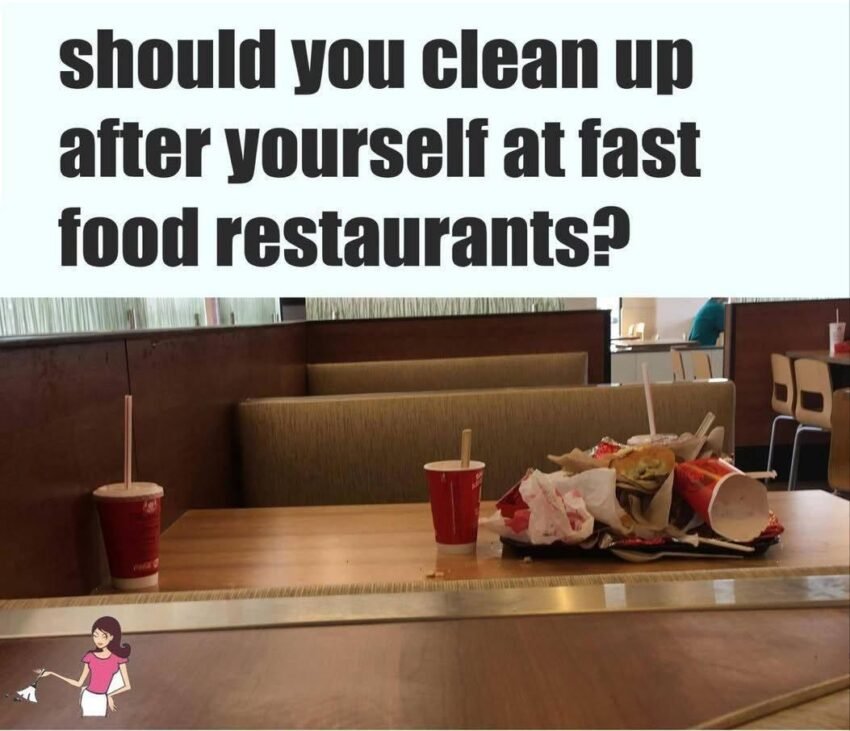
Should You Clean Up After Yourself at Fast Food Restaurants? The Etiquette Rule Most Americans Get Wrong
Should you throw away your tray at fast food restaurants? Discover the etiquette, employee perspective, and what most Americans overlook.
You finish your burger and fries.
The table is covered in napkins.
There’s an empty cup sweating ice water.
Your tray is stacked with wrappers.
You stand up.
And then comes the moment:
Do you leave it for staff—or clean it up yourself?
This tiny decision sparks surprising debate across the United States. Some people believe fast food employees are paid to clean tables. Others argue basic courtesy says you should throw your trash away.
So what’s the right move?
Let’s break it down—ethically, socially, practically—and from the employee perspective most customers never hear.
The Short Answer
In most U.S. fast food restaurants, you are expected—but not legally required—to throw away your trash and return your tray.
It’s not about obligation.
It’s about courtesy.
But the full answer is more nuanced than that.
Why This Question Even Exists
Fast food culture in America is unique.
Chains like McDonald’s, Chick-fil-A, Wendy’s, and Taco Bell operate on a self-service model:
-
You order at a counter or kiosk
-
You receive food on a tray or in a bag
-
You seat yourself
-
You dispose of waste in designated bins
Unlike full-service restaurants, there is no assigned server clearing your table for tips.
The model assumes shared responsibility.
But assumptions aren’t always obvious.
What Employees Actually Say
Many current and former fast food workers across the U.S. share similar perspectives:
Cleaning tables is part of the job.
But excessive mess slows service and affects morale.
Here’s what matters from an operational standpoint:
1. Labor Allocation
Fast food locations often run lean staffing.
During rush hours—like weekday lunch or Friday nights—employees juggle:
-
Drive-thru orders
-
Mobile pickups
-
In-store customers
-
Food prep
-
Cleaning
When customers leave large messes, employees must pause food production to restore seating space.
That impacts everyone waiting.
2. Respect Factor
Employees frequently mention one thing:
It’s not about the trash.
It’s about the signal.
When customers leave tables covered in spilled soda, crushed fries, and scattered wrappers, it communicates disregard.
Throwing away your tray communicates acknowledgment.
Why It Matters More in the United States
American fast food culture is built on speed and volume.
According to industry reports frequently covered by business publications like Forbes, quick-service restaurants depend on high table turnover and operational efficiency.
When tables remain dirty:
-
Customers struggle to find seating
-
Staff must reprioritize tasks
-
Cleanliness perception declines
In competitive urban markets like New York City or Los Angeles, cleanliness ratings directly influence foot traffic.
Your tray decision contributes to that ecosystem.
Situations Where You Should Absolutely Clean Up
Let’s be clear.
There are times when cleaning up is not just polite—it’s obvious.
✔ You dined in
If you sat at a table, throw your trash away.
✔ There are visible trash bins
Most fast food restaurants provide clearly marked disposal stations.
✔ It’s busy
During peak hours, clearing your space helps the next person.
✔ You made an unusual mess
Spilled ketchup packets, napkin confetti, tipped drinks? Clean it.
Situations Where It’s More Flexible
◾ You have mobility challenges
Staff assistance is appropriate.
◾ The trash area is overflowing
If bins are full, stacking neatly may be the most helpful action.
◾ You’re managing small children
Safety comes first. Do what you reasonably can.
The Social Psychology Behind It
Small public behaviors signal identity.
Behavioral research widely discussed in academic environments like Harvard University shows that minor cooperative actions reinforce social trust norms.
Throwing away your tray is a micro-cooperative act.
It subtly communicates:
-
I recognize shared space.
-
I contribute to communal order.
-
I respect service workers.
Tiny actions compound culture.
Common Arguments (And Honest Responses)
“They’re paid to clean.”
Yes. Cleaning is part of the job description.
But so is cooking.
You wouldn’t walk behind the counter and scatter fries on the floor just because someone is paid to sweep.
Being paid doesn’t remove courtesy.
“It creates jobs.”
This argument appears often—but it misunderstands labor economics.
Staffing levels are based on revenue, not customer messiness.
Leaving trash doesn’t increase hiring. It increases workload strain.
“I’m a paying customer.”
Correct.
And the business provided:
-
Food
-
Seating
-
Climate control
-
Restroom access
Disposing of personal waste is a minimal reciprocal action.
Pros and Cons of Cleaning Up
| Pros | Cons |
|---|---|
| Shows respect | Takes 30–60 seconds |
| Speeds table turnover | Minor inconvenience |
| Improves cleanliness | None significant |
| Sets example for kids | — |
Objectively, the cost-benefit ratio strongly favors cleaning up.
What About Restaurants That Clear Tables?
Some fast casual spots (not traditional fast food) offer partial service.
If staff actively clear tables during your visit, you may notice a different norm.
But in most quick-service chains, self-clearing is built into the design.
When in doubt, observe what others are doing.
Teaching Kids This Habit
If you’re a parent, this is a subtle teaching moment.
Children learn public responsibility through repetition.
Encourage them to:
-
Stack trays
-
Throw away wrappers
-
Wipe small spills
These behaviors build awareness that shared spaces require shared effort.
Common Mistakes People Make
-
Leaving large drink spills
-
Pushing trash off trays onto tables
-
Ignoring dropped food under chairs
-
Assuming someone will “handle it immediately”
During peak hours, cleanup may not be instant.
Your small effort helps maintain flow.
2025 Cultural Trend: Rising Service Worker Awareness
In recent years, there’s been growing public recognition of service worker challenges.
Social media discussions increasingly spotlight:
-
Staffing shortages
-
Customer behavior
-
Workplace stress
As awareness rises, etiquette expectations shift.
Cleaning up after yourself is becoming less debated—and more normalized.
Mini Scenario
Imagine it’s 12:30 p.m.
Lunch rush.
A family of five leaves a table scattered with fries, crushed cups, and open sauce packets.
Behind them, three customers circle looking for seating.
An employee must pause drive-thru prep to clear the table.
Now multiply that by ten tables.
Small actions scale.
Step-by-Step: The Right Way to Leave a Fast Food Table
-
Stack your tray
-
Place all wrappers and napkins inside
-
Empty liquids into designated drains if available
-
Dispose in trash bin
-
Return tray to rack (if provided)
-
Quickly scan for spills
Total time: under one minute.
Frequently Asked Questions
1. Is it required by law to clean up?
No. It’s etiquette, not a legal obligation.
2. What if I’m in a rush?
It takes less than a minute.
3. What if no one else is cleaning up?
Lead by example.
4. Are employees annoyed if I leave trash?
Most won’t confront you—but many prefer customers dispose of it.
5. Does it really make a difference?
Yes, especially during busy periods.
6. Is this different outside the U.S.?
Yes. Norms vary by country and service model.
7. Should I wipe down the table too?
Only if you made a spill. General sanitizing is staff responsibility.
8. What if bins are full?
Stack neatly and notify staff if possible.
9. Does this apply to mall food courts?
Yes. Food courts operate on self-clearing systems.
The Bigger Picture
Cleaning up after yourself isn’t about corporate loyalty.
It’s about social cooperation.
Fast food restaurants operate at massive scale. Millions of Americans dine in daily.
Micro-behaviors either strain or support that system.
Throwing away your tray is a small act of civic courtesy.
Conclusion: So, Should You?
Yes.
If you dine in at a fast food restaurant in the United States, you should clean up after yourself.
Not because you’re forced to.
Not because employees demand it.
But because it reflects awareness, respect, and basic social responsibility.
It takes less than a minute.
And it leaves the space better than you found it.
Next time you stand up from that table, pause.
Make the small choice that says something positive about you.
At most U.S. fast food restaurants, cleaning up your tray is the expected norm. It supports staff efficiency, improves cleanliness, and demonstrates basic courtesy—at almost no cost to you.
What do you think?
Do you always throw your trash away—or have you seen situations where it’s handled differently?