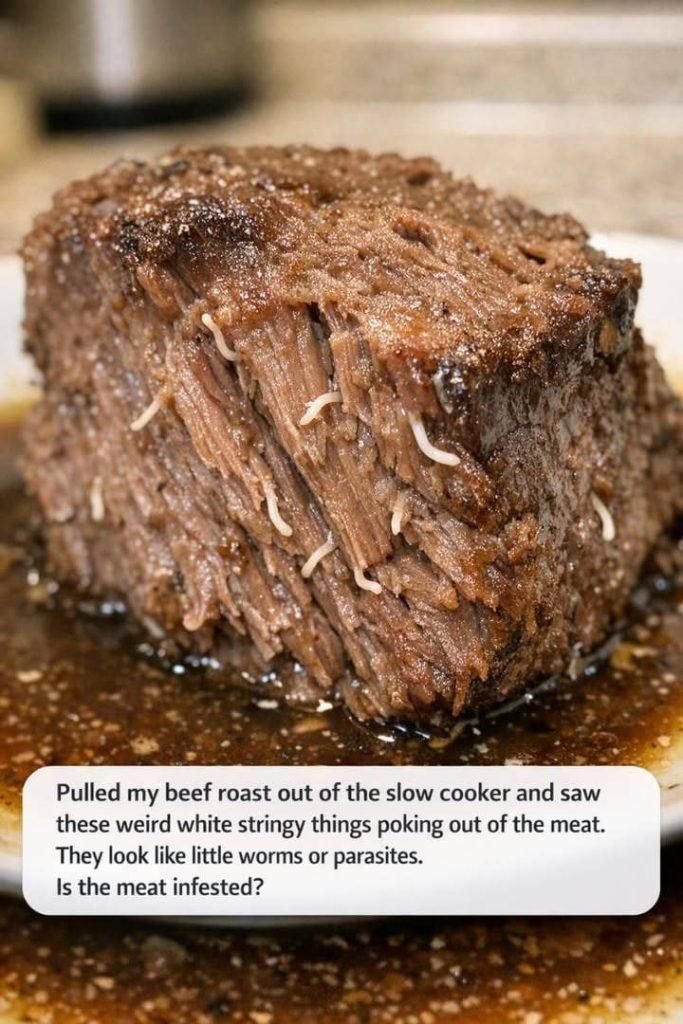
🔥 Pulled My Beef Roast from the Slow Cooker and Saw White Stringy Things — Is It Parasites or Just Meat?
Seeing white stringy fibers in cooked beef roast? Learn what they really are, why they appear in slow-cooked meat, and when (very rarely) you should worry.
You open the slow cooker expecting tender, fall-apart beef.
Instead, you see something unsettling.
White, stringy threads are poking out of the meat. They look unnatural—almost like tiny worms or parasites clinging inside the roast.
Your first thought is probably:
“Is this meat infected?”
That reaction is completely normal. Most people aren’t used to seeing raw muscle structure after long cooking times, especially when slow cooking breaks meat down in unexpected ways.
Here’s the truth that will calm you down quickly:
👉 In almost every case, those white stringy things are NOT parasites.
They are normal parts of the meat becoming visible after cooking.
Let’s break down exactly what you’re seeing—and why it happens.
🧠 The Short Answer: It’s Not Worms, It’s Connective Tissue
Beef is not a smooth, uniform substance. It’s made of:
- Muscle fibers
- Collagen (connective tissue)
- Tendons
- Fat layers
- Membranes between muscle groups
When beef cooks slowly over several hours, something important happens:
Collagen transforms.
It breaks down into gelatin, but not always evenly. Some parts:
- dissolve completely
- shrink into threads
- separate into visible white strands
Those “worm-like” fibers are usually:
- collagen strands
- fascia (thin connective tissue layers)
- tendon fragments
They become more visible as the meat softens.
🔬 Why Slow Cooking Makes It Look Strange
Slow cookers are amazing at turning tough meat into tender, juicy roast—but they also change appearance dramatically.
Here’s what’s happening inside the pot:
1. Heat breaks down collagen slowly
Collagen tightens first before softening, which can make it look like strings are “emerging.”
2. Muscle fibers separate
As protein structures relax, fibers pull apart and become more visible.
3. Fat renders out
As fat melts, it leaves behind pale connective tissue.
4. Water movement reshapes structure
Moisture shifts inside the meat, exposing internal layers.
What you’re left seeing is essentially the architecture of the meat, not anything foreign.
🧬 Could It Ever Be Parasites?
This is the concern that usually causes alarm, so let’s address it clearly.
In beef, parasites are extremely rare in properly sourced meat.
Common foodborne parasites people worry about include:
- Trichinella (mostly found in pork or wild game, not beef)
- Taenia saginata (beef tapeworm—rare and not visible like strings in cooked meat)
And here’s the key point:
👉 Parasites do NOT appear as long white elastic strands in cooked roast beef.
They would not survive typical slow cooking temperatures and would not look like fibrous threads attached to muscle.
So if your beef:
- came from a normal grocery source
- was cooked fully in a slow cooker
- reached proper internal temperature
Then the likelihood of parasites is essentially negligible.
🍖 What Those White Strings Actually Are (Most Likely Causes)
Let’s get specific about what you’re seeing.
✔ 1. Collagen fibers (most common)
These are the most likely explanation.
- Found in tough cuts like chuck roast
- Turn white when cooked
- Become gelatin-like or stringy
They are literally what makes slow-cooked beef tender.
✔ 2. Tendon or fascia remnants
Some cuts include thin connective sheets that:
- don’t fully dissolve
- pull apart into threads
- look “hair-like” or stringy
✔ 3. Muscle fiber separation
As beef cooks:
- muscle bundles loosen
- fibers become visible
- texture looks shredded or stringy
✔ 4. Silver skin fragments
A tough membrane that:
- whitens during cooking
- separates into strips
- often looks unusual if not trimmed before cooking
📊 Quick Comparison: Normal vs Concerning Signs
| Feature | Normal Beef Tissue | Potential Issue (Rare) |
|---|---|---|
| White stringy fibers | ✔ Collagen/fascia | ✘ Not parasite-like |
| Texture | Shredded, tender | Slimy, foul odor |
| Smell | Rich beef aroma | Sour or rotten smell |
| Appearance | Fibrous strands | Visible organisms (extremely rare) |
| Cooking result | Falls apart | Unsafe or undercooked meat |
If your roast smells normal and tastes normal, you’re dealing with standard connective tissue breakdown.
🧭 Why It Looks So Disturbing (Even When It’s Normal)
Your brain is wired to detect movement and irregular shapes as potential threats.
So when you see:
- thin white strands
- uneven fibers
- worm-like shapes
Your brain instantly categorizes it as “foreign.”
But in reality, slow cooking is simply:
revealing the internal structure of muscle tissue.
What was once hidden inside a firm roast is now visible because heat softened everything around it.
🍲 Real-World Example
Imagine a raw piece of beef as a tightly packed rope bundle.
Now cook it for 8 hours:
- The glue holding fibers together dissolves
- The bundle loosens
- Individual strands separate
- Fat melts away
What remains looks less like a steak… and more like fibers.
That transformation is exactly what you’re seeing.
⚠️ Common Mistakes That Lead to Confusion
Mistake 1: Expecting cooked meat to look uniform
Slow cooking does the opposite—it exposes structure.
Mistake 2: Not trimming connective tissue beforehand
Some cuts naturally contain more collagen.
Mistake 3: Comparing it to grilled steak
Grilling sears and hides structure; slow cooking reveals it.
Mistake 4: Assuming “strange texture = contamination”
Most texture changes are chemical breakdowns, not foreign organisms.
🧠 Expert Insight: Why Tough Cuts Are Designed for This
Cuts like chuck roast, brisket, or shoulder are intentionally rich in connective tissue.
Why? Because:
- collagen turns into gelatin when slow cooked
- gelatin creates juiciness and flavor
- it gives the dish richness and body
Without these “stringy” fibers, slow-cooked beef would actually be dry and less flavorful.
So ironically, what looks concerning is actually what makes the dish successful.
🧪 When You Should Be Concerned
While what you saw is almost certainly normal, here are rare red flags:
- Strong rotten or sulfur smell
- Slimy texture before cooking
- Green or gray discoloration
- Undercooked meat (very low internal temperature)
- Expired or improperly stored beef
If none of these are present, there’s usually no issue.
🧭 How to Prevent the “Worm-Like” Appearance (If It Bothers You)
If the texture visually bothers you:
✔ Trim visible silver skin before cooking
✔ Use more uniform cuts
✔ Sear meat before slow cooking
✔ Shred and mix thoroughly after cooking
These steps reduce visible strand-like structures.
🥩 Mini Scenario
You cook a chuck roast for 8 hours.
You open the lid expecting a smooth roast—but instead see stringy fibers stretching apart as you lift it with a fork.
First reaction: concern.
Second reaction (after learning):
“Oh… that’s just collagen breaking down.”
Third reaction:
“This is actually going to taste amazing.”
That shift from alarm to understanding is exactly what happens once you know what’s really going on.
❓ FAQs
1. Are white stringy things in beef worms?
No. They are almost always connective tissue like collagen or fascia.
2. Can parasites survive slow cooking?
Not in properly cooked beef. Standard slow cooking temperatures are safe.
3. Why does my beef look shredded after cooking?
Slow heat breaks down muscle fibers and connective tissue.
4. Is it safe to eat meat with these white strands?
Yes, as long as the meat is properly cooked and fresh.
5. Why didn’t I see this in grilled steak?
High-heat cooking contracts and hides muscle structure instead of breaking it down slowly.
6. What cuts of beef show this most?
Chuck roast, brisket, and shoulder cuts.
7. Does this mean the meat was low quality?
No—actually, tougher cuts are ideal for slow cooking.
8. Can I prevent this completely?
Not fully, but trimming connective tissue reduces visible strands.
🧾 Action Checklist
✔ Do:
- Use properly sourced beef
- Cook to safe internal temperature
- Understand connective tissue is normal
- Embrace collagen-rich cuts for flavor
✘ Avoid:
- Assuming texture = contamination
- Eating meat with off smells or spoilage signs
- Underestimating slow-cooked structural changes
- Panic based on appearance alone
🏁 Conclusion
What you saw in your slow cooker wasn’t something harmful or unusual—it was simply the natural structure of beef revealing itself under long, gentle heat.
Those white stringy fibers are part of what makes slow-cooked meat tender, rich, and flavorful.
Once you understand it, what once looked disturbing becomes just… cooking science in action.
White stringy fibers in slow-cooked beef are almost always collagen and connective tissue—not parasites, and not something dangerous.
If this helped clear things up, share it with someone who cooks at home—or keep it in mind the next time your slow cooker surprises you.