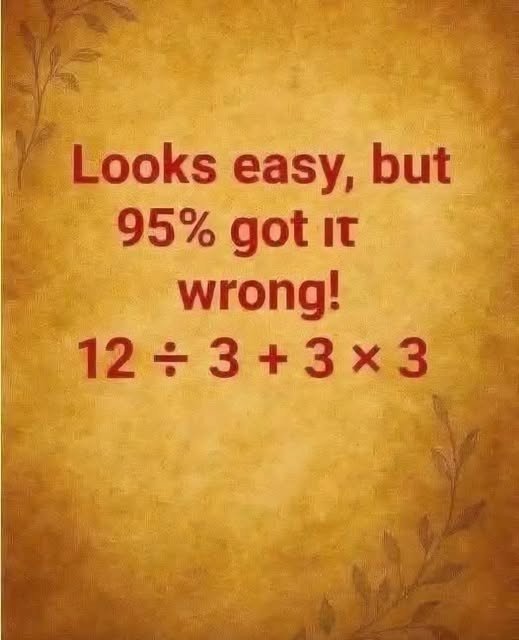
Looks Easy, But 95% Get It Wrong: Can You Solve 12 ÷ 3 + 3 × 3 Correctly?
Think you can solve 12 ÷ 3 + 3 × 3 easily? Most people get it wrong—learn the correct answer using PEMDAS rules explained simply.
At first glance, it looks like a basic math problem you could solve in seconds:
12 ÷ 3 + 3 × 3
No tricky fractions. No parentheses. No calculator needed.
And yet—most people still get it wrong.
Why? Because the human brain loves shortcuts, and those shortcuts often ignore the one rule that matters most in arithmetic: order of operations.
Let’s break it down properly so you never fall for this type of puzzle again.
Why This Problem Tricks So Many People
This equation is designed to test one thing: whether you follow math rules or just calculate left to right.
Most people instinctively do this:
- 12 ÷ 3 = 4
- 4 + 3 = 7
- 7 × 3 = 21 ❌ (wrong approach)
It feels natural—but it’s incorrect.
The mistake happens because your brain treats the equation like a simple sentence instead of a structured rule system.
The Correct Rule: PEMDAS / BODMAS
To solve it properly, you must follow the order of operations:
- P – Parentheses
- E – Exponents
- MD – Multiplication & Division (left to right)
- AS – Addition & Subtraction (left to right)
This rule is taught globally, including in U.S. schools, and is non-negotiable in mathematics.
Step-by-Step Solution (The Right Way)
Let’s solve:
12 ÷ 3 + 3 × 3
Step 1: Handle Division and Multiplication First (Left to Right)
- 12 ÷ 3 = 4
- 3 × 3 = 9
Now the expression becomes:
4 + 9
Step 2: Add
- 4 + 9 = 13
Final Answer: 13
Simple once you apply the correct rule—but easy to miss if you rush.
Why Most People Get 21 Instead of 13
Getting 21 isn’t random—it comes from a predictable thinking error:
Mistake Pattern:
- Solve left to right only
- Ignore multiplication priority
- Treat all operations equally
This is called left-to-right bias, and it’s one of the most common math reasoning errors.
Real-Life Importance of Order of Operations
This isn’t just a puzzle trick. The same rule is used in:
- Financial calculations
- Engineering formulas
- Coding and programming logic
- Scientific measurements
Even small mistakes in order can lead to completely wrong results in real-world applications.
For example, in programming languages like Python or JavaScript, order of operations determines whether software behaves correctly or fails.
Quick Mental Trick to Avoid Mistakes
Here’s a simple way to stay accurate:
“Multiply and Divide always come first”
Before touching addition or subtraction:
- Circle multiplication and division
- Solve them left to right
- Then finish addition/subtraction
This habit alone eliminates most errors.
Comparison: Wrong vs Correct Method
| Step | Wrong Method Result | Correct Method Result |
|---|---|---|
| First Operation | 12 ÷ 3 = 4 | 12 ÷ 3 = 4 |
| Next Step | + 3 = 7 | 3 × 3 = 9 |
| Final Step | × 3 = 21 | 4 + 9 = 13 |
Same numbers. Different logic. Completely different answer.
Why Your Brain Falls for This Trick
Your brain prefers:
- Speed over accuracy
- Familiar patterns over rules
- Left-to-right reading habits
This works in everyday life—but fails in structured math problems.
That’s why puzzles like this spread so easily online.
Pros and Cons of Math Trick Questions
Pros
- Improves logical thinking
- Strengthens attention to detail
- Builds mental discipline
Cons
- Can reinforce careless habits
- Creates overconfidence in quick guessing
- Confuses learners without rule practice
Common Mistakes (And Fixes)
Mistake: Solving strictly left to right
Fix: Always check for multiplication/division first
Mistake: Skipping rule review
Fix: Memorize PEMDAS/BODMAS
Mistake: Rushing the problem
Fix: Slow down and identify operations before calculating
Expert Insight
Educational researchers consistently emphasize that arithmetic mistakes are rarely about intelligence—they’re about process discipline.
Institutions like Khan Academy teach order-of-operations early because it forms the foundation for algebra and higher math.
Once mastered, it becomes automatic—but only through repetition.
Trend: Why These Puzzles Go Viral
In 2026, math puzzles like this are popular because:
- They trigger engagement on social media
- They create debate in comments
- They feel “too easy to be wrong”
That surprise factor is what drives sharing.
Future Outlook
Expect more:
- AI-generated math traps
- Interactive quiz content
- Short-form “comment your answer” challenges
But the core lesson will never change: rules matter more than intuition in math.
FAQ Section
1. What is the correct answer to 12 ÷ 3 + 3 × 3?
The correct answer is 13.
2. Why do people get 21?
They solve left to right instead of following order of operations.
3. What is PEMDAS?
It stands for Parentheses, Exponents, Multiplication/Division, Addition/Subtraction.
4. Is multiplication always first?
Not always—but it comes before addition and subtraction when no parentheses exist.
5. Why is order of operations important?
It ensures everyone gets the same answer in math and science.
6. Are these puzzles useful for learning?
Yes—they reinforce fundamental math rules.
7. Can calculators make this mistake?
No—calculators follow order of operations automatically.
8. Is BODMAS the same as PEMDAS?
Yes, just different naming systems used in different countries.
9. How can I improve at these problems?
Practice identifying operations before calculating.
10. Why are these puzzles so popular online?
They’re simple, surprising, and spark debate.
Action Checklist
Do:
- Identify multiplication/division first
- Follow PEMDAS/BODMAS rules
- Solve step-by-step slowly
- Double-check results
Avoid:
- Solving left to right blindly
- Rushing calculations
- Ignoring order rules
Conclusion
This equation looks simple—but that’s exactly why it tricks so many people.
Once you understand the rule behind it, the confusion disappears and the answer becomes obvious.
Math isn’t about guessing—it’s about structure.
The correct answer is 13, and the real lesson is learning to trust mathematical rules over instinct.
If this surprised you, share it with someone who enjoys brain teasers—and see if they get it right on the first try.