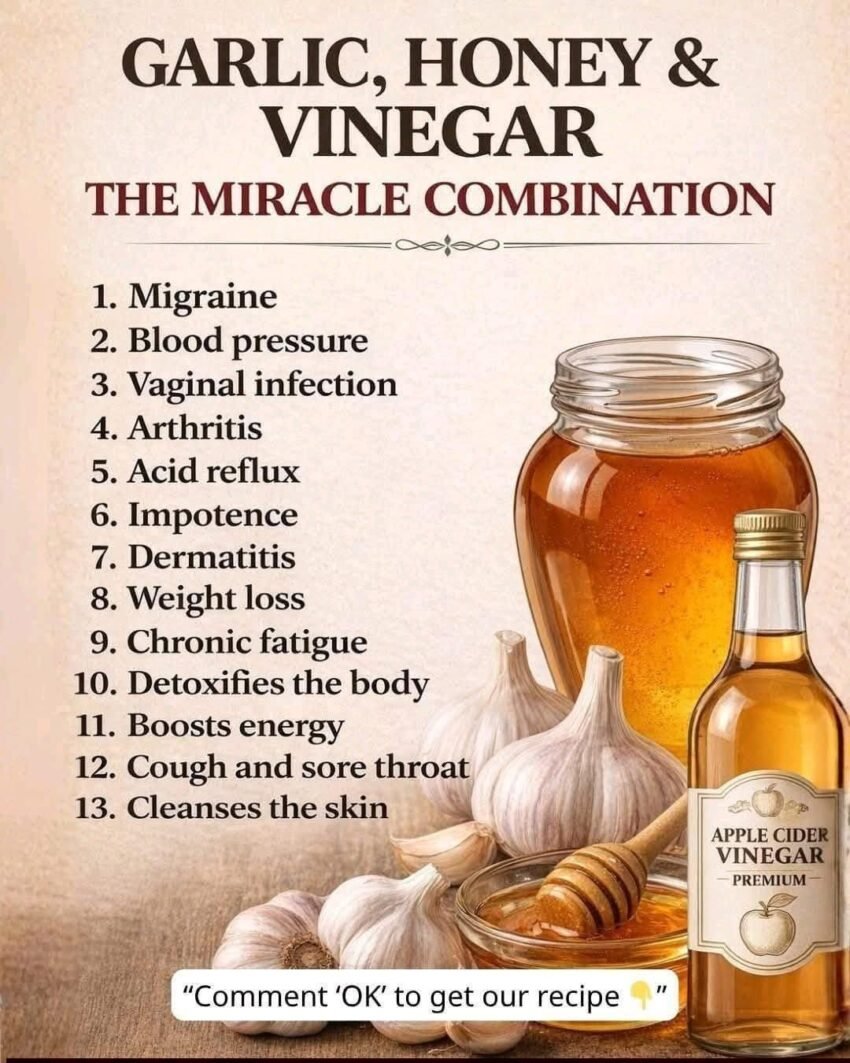
Garlic, Honey, and Vinegar: The Viral “Healing Combo” Everyone Talks About (What’s Real, What’s Exaggerated, and What You Should Know)
Garlic, honey, and vinegar are often called a natural remedy trio—but what does science actually say? Here’s a clear, realistic breakdown.
Every few months, the internet rediscovers a “forgotten remedy.”
This time, it’s a simple kitchen trio:
garlic, honey, and vinegar.
Scroll through social media and you’ll see claims like:
- “Boosts immunity instantly”
- “Cures inflammation naturally”
- “Detoxes your body overnight”
- “Ancient remedy doctors don’t tell you about”
It sounds powerful because it’s familiar.
Three everyday ingredients. No chemistry degree required. No prescription needed.
But once you strip away the hype, a more grounded picture appears—one that’s far more interesting than the viral claims themselves.
Let’s break it down properly.
Why This Combination Became So Popular
This trio didn’t become viral by accident.
Each ingredient already carries a strong reputation:
Garlic
Known for:
- Strong antimicrobial compounds (like allicin)
- Traditional use in folk medicine
- Strong association with immunity
Honey
Known for:
- Soothing properties
- Natural sweetness
- Historical use in wound care and cough relief
Vinegar
Known for:
- Acidity and preservation
- Digestive associations
- Cultural use in cleansing rituals and cooking
So when combined, they create a powerful narrative:
👉 “If each one is good alone… imagine them together.”
That’s how most viral “remedies” are born—not from science, but from storytelling.
What Actually Happens When You Combine Them
Let’s be honest and practical.
When you mix garlic, honey, and vinegar:
- You get a strong-tasting, acidic, sweet, pungent mixture
- Some compounds from garlic may remain active
- Honey can soften the harshness and add viscosity
- Vinegar adds acidity and preservation qualities
It becomes more of a tonic-style mixture than a medical solution.
What Science Actually Supports
Now the important part—what’s backed by evidence.
1. Garlic
Research suggests garlic may:
- Support cardiovascular health
- Have antimicrobial properties in lab settings
- Contribute to immune system function
But:
- Effects are modest
- Dosage and preparation matter
- It is not a standalone treatment for disease
2. Honey
Honey is better studied than most people realize:
- Can soothe cough symptoms (especially in children over 1 year)
- Has antibacterial properties in medical-grade forms
- Supports wound healing when used topically in clinical settings
But:
- Not a cure for infections
- Still a sugar source
3. Vinegar (especially apple cider vinegar)
Some studies suggest:
- May slightly improve blood sugar response after meals
- Can aid digestion in some individuals
But:
- Evidence is limited
- Overuse can irritate the stomach or damage tooth enamel
What Happens When You Combine Them?
Here’s the honest scientific view:
There is no strong clinical evidence that combining garlic, honey, and vinegar creates a super-remedy.
What you do get is:
- Mild individual benefits from each ingredient
- A traditional-style tonic
- A placebo-enhanced sense of wellness for some users
And that last part matters more than people think.
Why People Swear It “Works”
Even without strong evidence, many people report feeling better.
Why?
1. Consistency effect
People who try such mixtures often also:
- Eat more consciously
- Drink more fluids
- Pay more attention to health overall
2. Placebo response
Expectation can influence perceived improvement in symptoms like:
- Energy levels
- Digestion
- General wellness
3. Short-term dietary improvement
Replacing processed habits with homemade mixtures often improves lifestyle indirectly.
So the benefits are often behavioral, not biochemical magic.
Common Viral Claims vs Reality
| Claim | Reality |
|---|---|
| “Cures infections” | Not supported clinically |
| “Detoxes the body” | Body already detoxes via liver/kidneys |
| “Instant immunity boost” | No instant immune switch exists |
| “Ancient cure-all remedy” | Traditional use ≠ scientific proof |
| “Supports wellness in moderation” | Reasonable and plausible |
How People Usually Prepare It (Traditional Versions)
There is no single official recipe, but common versions include:
Basic mixture:
- Crushed garlic
- Raw honey
- Apple cider vinegar
Sometimes left to:
- Infuse for several hours or days
- Taken in small spoonfuls diluted in water
But again:
👉 This is a traditional tonic approach, not a medically standardized treatment.
Risks and Mistakes People Often Ignore
Even natural ingredients can cause issues when misused.
1. Overconsumption of vinegar
- Can irritate stomach lining
- May affect tooth enamel
2. Raw garlic sensitivity
- Can cause digestive discomfort in large amounts
- Strong compounds may irritate some individuals
3. Honey for infants
- Never safe for children under 1 year due to botulism risk
4. Replacing real treatment
This is the biggest mistake:
Using home mixtures instead of medical care for real conditions.
A More Realistic Way to Think About It
Instead of viewing this combo as a “cure,” a better framing is:
👉 A traditional wellness mixture with mild supportive properties.
Not a miracle.
Not a replacement.
Not a shortcut.
Just food-based ingredients with some interesting biological effects.
Why “Natural Remedies” Go Viral So Easily
This combination hits three emotional triggers:
- Simplicity → “I can make this at home”
- Control → “I don’t need medicine”
- Tradition → “Ancient wisdom must be powerful”
But virality often amplifies belief—not evidence.
That’s why understanding context is important.
FAQ Section
1. What is garlic, honey, and vinegar used for?
Commonly used in traditional wellness routines for general health support.
2. Does it cure diseases?
No scientific evidence supports it as a cure for any disease.
3. Can it boost immunity instantly?
No instant immune boost exists, but good nutrition supports overall immunity.
4. Is it safe to consume daily?
Small amounts are generally safe for most people, but moderation is key.
5. What are the side effects?
Possible stomach irritation, acidity issues, or tooth enamel damage from vinegar.
6. Is raw garlic better than cooked?
Raw garlic contains more active compounds, but may be harder to digest.
7. Can children take it?
Not recommended for young children without medical guidance.
8. Why do people believe in it so strongly?
Because individual ingredients have real health associations, which get exaggerated when combined.
Action Checklist
Do This:
✔ Use ingredients in moderation
✔ Treat it as a wellness supplement, not medicine
✔ Focus on overall diet quality
✔ Stay hydrated and balanced
Avoid This:
✘ Using it as a cure for illness
✘ Overconsuming vinegar or raw garlic
✘ Ignoring medical advice
✘ Believing viral health claims without evidence
Conclusion
Garlic, honey, and vinegar are all powerful in their own right—but not in the magical way viral posts often suggest.
Together, they form an interesting traditional mixture with mild supportive benefits, not a cure-all solution.
The real value isn’t in expecting miracles.
It’s in understanding how everyday ingredients can contribute to a healthier lifestyle—when used realistically.
This trio is a traditional wellness blend, not a scientific miracle cure—and understanding the difference is what keeps you truly informed.
If this helped clear up confusion, share it with someone who loves natural remedies—and ask:
How many “ancient secrets” are actually just everyday ingredients with good storytelling?