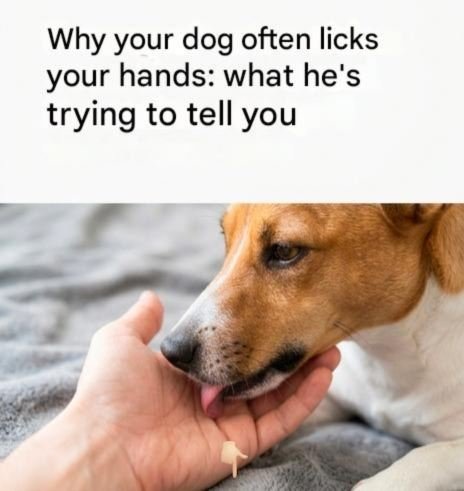
🐶 When Your Dog Licks Your Hands, It’s Never by Chance: What This Behavior Really Means
Why does your dog lick your hands? Discover the emotional, behavioral, and scientific reasons behind this common but meaningful canine behavior.
Your dog leans in. Their tail relaxes. Then it happens—soft, repetitive licking on your hand.
Most people brush it off as simple affection.
And yes, it can be that.
But in the world of dogs, very little behavior is random.
Licking is communication. It’s instinct. It’s emotional data your dog is trying to send you in the only language they fully control.
So when your dog licks your hands, it’s worth asking a better question:
What exactly are they trying to say?
🐾 Why Dogs Lick in the First Place
To understand hand licking, you have to understand licking itself.
Dogs use licking as a multi-purpose behavior that serves several functions:
- Communication
- Bonding
- Exploration
- Stress relief
- Social hierarchy signaling
In canine behavior science, licking is considered a natural social tool, not just a random habit.
Organizations like the American Kennel Club note that licking is deeply rooted in both instinct and learned social behavior from puppyhood.
🧠 1. Affection and Bonding
One of the most common reasons your dog licks your hands is simple:
They like you.
Dogs often lick their mothers as puppies to strengthen social bonds. That behavior carries into adulthood, extending to humans they trust.
What it means:
- “You are part of my pack”
- “I feel safe with you”
- “I want connection”
It’s their version of social bonding.
🧂 2. Salt and Taste Attraction
Your hands are not neutral.
They carry:
- Natural skin oils
- Sweat (which contains salt)
- Food residue or scents
Dogs are highly sensitive to smell and taste, so your skin becomes an interesting sensory experience.
Translation:
“You taste interesting, and I’m curious.”
😌 3. Self-Soothing Behavior
Licking can also be calming for dogs.
It releases:
- Endorphins (feel-good chemicals)
- A sense of routine and comfort
Dogs may lick when:
- They’re slightly anxious
- They’re overstimulated
- They want reassurance
In this context, licking your hand is part emotional regulation, part connection-seeking.
🧍 4. Social Respect or Submission
In dog social structures, licking can signal respect.
Lower-ranking dogs may lick higher-ranking members as a gesture of acknowledgment.
With humans, this often translates into:
- Gentle licking during calm moments
- Avoidance of eye contact while licking
It’s not fear—it’s social awareness.
🧠 5. Attention-Seeking Behavior
Let’s be honest—dogs learn quickly.
If licking your hand gets:
- Petting
- Talking
- Eye contact
- Reaction
They’ll repeat it.
Simple logic:
Behavior that gets attention gets reinforced.
🧪 6. Exploration of Your Emotional State
Dogs don’t just smell your hands—they read your whole body chemistry.
Changes in:
- Sweat composition
- Hormones
- Stress signals
can subtly influence their behavior.
This is why some dogs lick more when you’re:
- Stressed
- Sad
- Anxious
They may be responding to emotional cues you don’t even notice yourself.
⚠️ When Licking Becomes Excessive
While licking is normal, excessive licking can indicate:
- Anxiety
- Boredom
- Compulsive behavior
- Medical issues (rare cases)
If your dog licks constantly and cannot be distracted, it may be worth consulting a veterinarian or behavior specialist.
🧍 Real-Life Scenario
A woman in Chicago notices her dog licking her hands every evening after work.
At first, she thinks it’s just habit.
But she realizes something else:
On stressful days, the licking increases.
On relaxed days, it decreases.
Her dog wasn’t just reacting to her hands.
He was reacting to her.
🐶 Pros & Cons of Licking Behavior
✅ Pros
- Strengthens human-dog bond
- Helps dogs self-soothe
- Encourages communication
- Normal and natural behavior
❌ Cons
- Can become excessive in anxious dogs
- May spread bacteria if hygiene is poor
- Not always pleasant for all owners
- Sometimes misread as purely “cute” behavior
🚫 Common Misconceptions
❌ “My dog is just being random”
False. Most licking has a purpose.
❌ “It only means affection”
Not always—it can also mean stress, curiosity, or habit.
❌ “I should stop it completely”
Not necessary unless it becomes excessive.
🧠 Expert Insight: What Science Suggests
Dog behavior research shows that licking is part of a broader social communication system that evolved from wolves.
It combines:
- Pack bonding behavior
- Sensory exploration
- Emotional signaling
That’s why it feels so meaningful—it is meaningful.
🌍 2026 Pet Behavior Trend
Modern pet psychology is shifting toward:
- Emotional intelligence in dogs
- Human-dog emotional mirroring
- Stress-based behavior tracking
More owners are now recognizing that dogs often reflect household emotional states more than we realize.
🧾 What You Should Do
If your dog licks your hands normally:
- Accept it as bonding
- Gently redirect if you prefer less licking
- Reinforce calm behavior
If it becomes excessive:
- Increase exercise and stimulation
- Check for anxiety triggers
- Consult a vet or trainer if needed
🏁 Conclusion
When your dog licks your hands, it’s rarely random.
It can mean affection, curiosity, comfort, communication—or sometimes a mix of all four.
It’s not just a habit. It’s a language.
And once you understand it, you stop seeing it as a simple gesture—and start seeing it as a conversation.
Your dog isn’t just licking your hand—they’re responding to you, emotionally and instinctively, in the most natural way they know how.
If this changed how you think about your dog’s behavior, share it with another dog owner—and pay closer attention the next time your dog “says hello” with a lick.