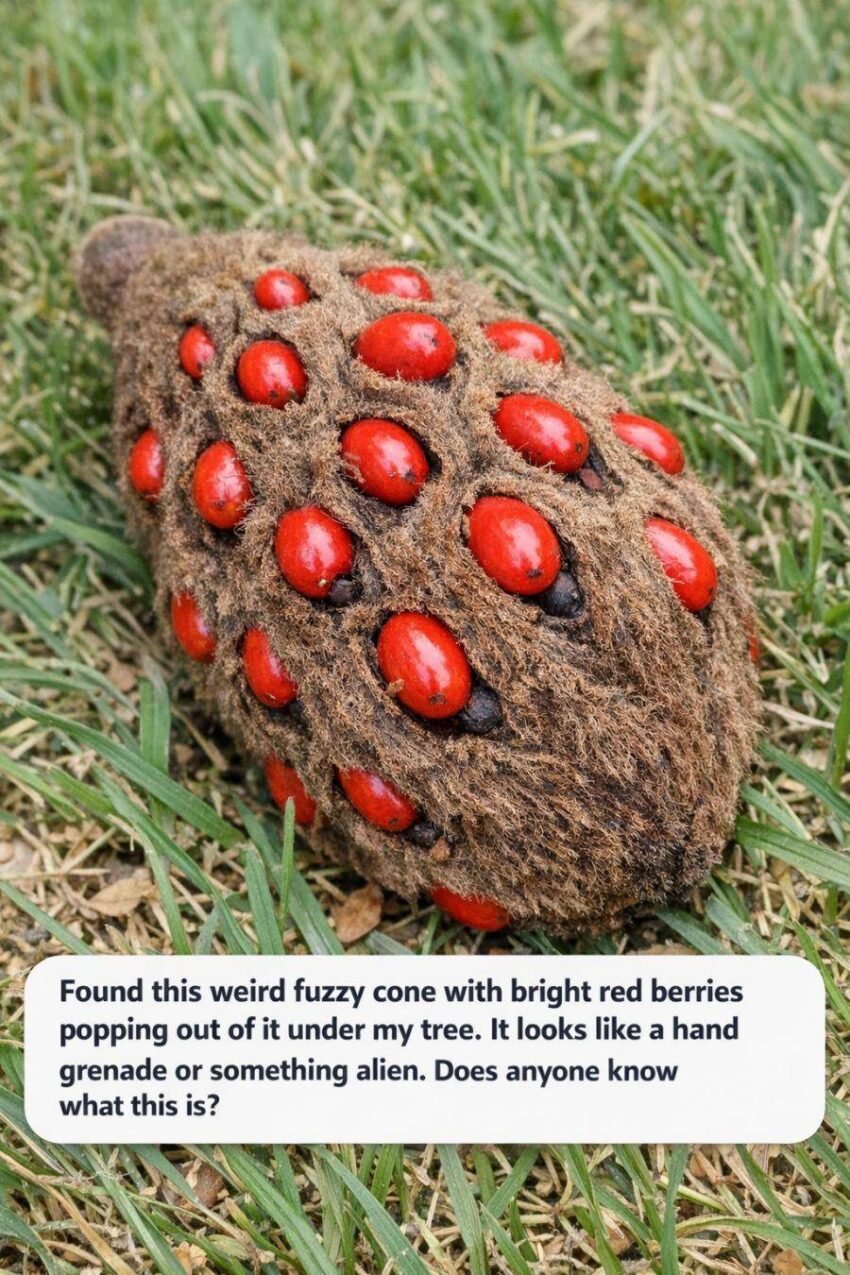
🔥 Found a Weird Fuzzy “Grenade” Under Your Tree? Here’s What It Actually Might Be (And Why It Looks So Alien)
Discovered a strange fuzzy cone with red berry-like parts under a tree? Learn what it likely is, why it appears, and whether it’s dangerous or harmless.
You walk outside expecting the usual—leaves, soil, maybe a fallen branch.
But instead, you spot something that makes you pause.
A strange, fuzzy cone-shaped object sitting under a tree… almost like a hand grenade. And then you notice it:
Bright red berry-like structures pushing out from it.
It doesn’t look normal. It doesn’t look familiar. And it definitely doesn’t look like anything you’ve seen in your garden before.
Naturally, your mind jumps between two extremes:
“Is this a plant?”
“Is this some kind of fungus?”
“Should I even touch it?”
The good news: in most cases, this kind of mystery growth is completely natural and harmless—just wildly unfamiliar.
Let’s decode what you likely found, why it appears, and how to safely identify it without guessing wrong.
🌿 First Things First: You’re Not Crazy—This Stuff Exists in Nature
Nature produces some genuinely bizarre structures, especially when fungi, plant galls, or seed formations interact with trees.
What you described—
fuzzy cone + woody base + bright red berry-like protrusions
usually points to one of a few fascinating biological phenomena:
- Fungal growths that hijack plant tissue
- Tree galls caused by insects or rust fungi
- Seed cones or fruit structures in unusual stages
- Rare ornamental or wild plant seed formations
And yes—some of them look like they belong in a science fiction movie.
🧠 The Top 4 Most Likely Identifications
Let’s go through the strongest possibilities based on your description.
🍄 1. Cedar-Apple Rust Gall (The #1 Suspect)
This is one of the most common “alien-looking” yard discoveries.
What it is:
A fungal infection caused by a rust fungus (often from the genus Gymnosporangium), which alternates between juniper/cedar trees and apple or pear trees.
Why it matches your description:
- Starts as a woody, fuzzy-looking gall (cone-like structure)
- Later produces bright orange-red gelatinous “horns” or protrusions
- Often appears suddenly after rain
Why it looks alien:
When moist, it expands and releases bright, jelly-like structures that look almost like coral or berries.
Is it dangerous?
- Not toxic to humans
- Can harm nearby fruit trees if left unmanaged
🌲 2. Pine Gall or “Witch’s Gall” (Insect-Induced Growth)
Another strong possibility if the structure is woody and cone-shaped.
What it is:
A deformity in tree tissue caused by insects or mites laying eggs inside buds.
What it looks like:
- Woody cone or bulb
- Fuzzy or rough exterior
- Sometimes small protrusions or seed-like growths
Why it happens:
The tree reacts to insect chemicals by growing abnormal tissue around the larvae.
Bright red parts?
In some cases, secondary infections or seed-like structures can appear reddish.
🍓 3. Stinkhorn Fungus (Juvenile Stage)
Some fungi start in a “egg-like” structure before bursting into strange shapes.
What it is:
A group of fungi known for rapid growth and unusual forms.
What it looks like early:
- Oval or cone-like “egg”
- Fuzzy or gelatinous surface
- Sometimes reddish interior when cut or split
Later stage:
Transforms into finger-like or lattice structures.
Important note:
Some species smell extremely foul when mature.
🌱 4. Unusual Seed or Fruit Cluster (Less Common but Possible)
Some plants produce cone-like seed structures that split open.
Examples include:
- Wild ornamental shrubs
- Certain conifers with unusual seed cones
- Invasive berry-producing vines
Why it could match:
- Bright red “berries” may actually be seeds or arils
- Cone shape may be dried plant structure
However, this is less likely unless you can identify the tree species nearby.
⚠️ Should You Be Worried?
In almost all cases: no, it’s not dangerous.
But here’s a practical breakdown:
| Possibility | Risk Level | Action |
|---|---|---|
| Rust gall fungus | Low | Monitor, remove if near fruit trees |
| Insect gall | Very low | Can be left alone |
| Stinkhorn fungus | Low | Avoid handling directly |
| Unknown plant structure | Low | Photograph + identify |
The real concern is not human safety—it’s tree health, especially if fruit trees are nearby.
🔍 Why These Strange Growths Appear
These formations usually come from one of three triggers:
1. Fungal infections
Fungi manipulate plant tissue for their own reproductive cycle.
2. Insect activity
Insects trigger abnormal growth as plants “seal off” invaders.
3. Environmental stress
Weather shifts, humidity, and soil conditions can amplify abnormal growth.
Nature essentially “misfires” growth patterns under stress or infection.
🧪 How to Identify What You Found (Simple Field Guide)
If you still have the object nearby, observe safely from a distance.
Ask yourself:
1. Is it hard or soft?
- Hard = likely gall or plant structure
- Soft/jelly-like = likely fungus
2. Does it smell?
- Foul smell → stinkhorn fungus likely
3. Is it attached to a tree branch?
- Yes → gall or plant-related
- No, on ground → fungus or fallen structure
4. Does it change after rain?
- Expands or becomes jelly-like → rust fungus
🧠 Expert Insight: Why Nature Creates “Alien Shapes”
Biologists often describe these growths as “developmental errors with purpose.”
That means:
- They are not random accidents
- They follow biological patterns
- They serve reproduction or defense functions
What looks like a grenade is actually:
- A survival mechanism
- A reproductive structure
- Or a plant’s response to invasion
Nature doesn’t aim for beauty—it aims for function.
🚫 What You Should NOT Do
If you find something like this again:
- Don’t assume it’s dangerous and panic
- Don’t ingest or burn it
- Don’t spray chemicals immediately
- Don’t ignore it if it’s spreading to other plants
And most importantly:
👉 Don’t try to cut it open if you’re unsure (some fungi release spores or irritants when disturbed)
📸 Real-World Lookalikes People Commonly Confuse
Many homeowners misidentify these as:
- Alien eggs or insect nests
- Poisonous mushrooms
- Fruit gone wrong
- Animal remains
- Even “foreign objects dropped from above”
In reality, most are just misunderstood natural growths.
🧾 Simple Action Plan If You Find One
✔️ Do this:
- Take clear photos from multiple angles
- Note which tree it’s near
- Check after rain for changes
- Compare with local plant guides
❌ Avoid this:
- Touching without gloves
- Removing immediately without identification
- Ignoring spread to nearby plants
❓ FAQ
1. Is this thing dangerous to humans?
In most cases, no. These are typically fungi or plant growths.
2. Can it spread to other trees?
Yes, if it’s a fungal gall like cedar-apple rust.
3. Why does it look like berries?
Many fungal and plant structures mimic fruit-like shapes during reproduction.
4. Should I remove it?
Only if it’s affecting fruit trees nearby.
5. Can I touch it?
It’s better to avoid direct contact until identified.
6. Does it mean my tree is dying?
Not necessarily—many trees survive these infections.
7. Will it come back next year?
Some galls and fungi are seasonal and can reappear.
8. Can weather cause this?
Yes, moisture and humidity often trigger visible fungal growth.
9. Is it a rare species?
Usually no—many of these appear locally but go unnoticed.
10. Who can identify it for sure?
A local agricultural extension office or plant pathology expert.
🧾 Final Checklist
✔️ If you found something like this:
- Observe, don’t panic
- Document it with photos
- Check nearby tree species
- Monitor changes over time
- Consult a local expert if needed
❌ Don’t:
- Assume it’s dangerous
- Destroy it immediately
- Ignore spread patterns
- Handle without protection
🏁 Conclusion
What looks like a mysterious “alien grenade” under your tree is almost always a natural biological structure doing exactly what nature designed it to do—just in a way that catches you off guard.
Whether it’s a fungal gall, insect reaction, or unusual plant formation, these strange shapes remind us of something important:
Nature doesn’t always look familiar—but it always makes sense when you understand it.
That weird fuzzy cone isn’t likely something dangerous—it’s nature’s way of solving a biological problem in the most unexpected visual form possible.
If you’ve seen something similar, you’re not alone—share it, compare it, and keep exploring the hidden weirdness growing right in your backyard.