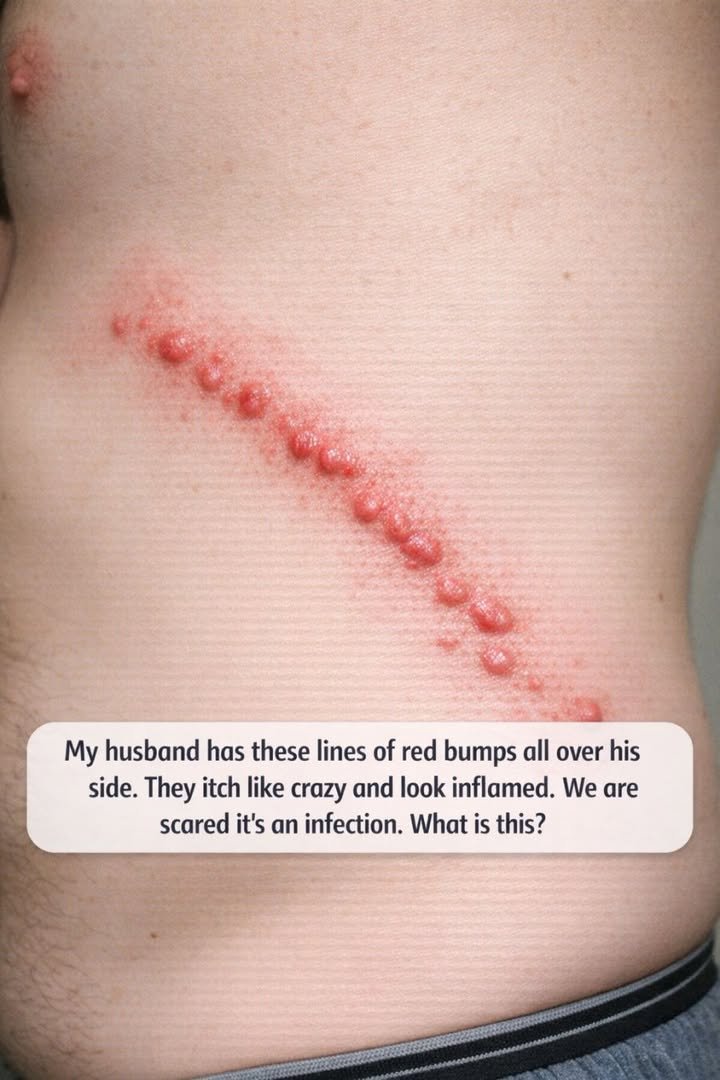
🔥 Red, Itchy, and Spreading? 7 Possible Causes of Those Mysterious Bumps on Your Husband’s Side (And What to Do Next)
Red, itchy bumps in lines on the skin? Discover the most likely causes, when to worry, and what to do next—clear, expert-backed guidance.
It starts small. A few red bumps. Maybe you think it’s a rash or a bug bite. But then… they spread. They itch like crazy. They form lines. And suddenly, you’re both staring at it thinking: Is this something serious?
That moment—when uncertainty turns into worry—is more common than you think.
Skin reactions can look alarming, especially when they appear suddenly and don’t follow a familiar pattern. The truth? There are a handful of conditions that can cause exactly what you’re describing—and some need quick attention, while others are harmless but uncomfortable.
In this guide, you’ll get clear, medically grounded insight into what might be happening, how to tell the difference between causes, and exactly what to do next—without panic, guesswork, or misinformation.
What Could Cause Red, Itchy Bumps in Lines?
When bumps appear in a linear pattern, that detail matters more than most people realize. It narrows down the possibilities significantly.
Here are the most likely culprits:
1. Bed Bug Bites (The “Breakfast, Lunch, Dinner” Pattern)
This is one of the most common causes of line-shaped itchy bumps.
Key signs:
- Bites appear in rows or clusters
- Extremely itchy
- Often show up overnight
- Common on exposed skin (side, arms, back)
Bed bugs tend to bite multiple times in a straight line as they move across the skin.
👉 If the bumps appeared after sleep, this jumps to the top of the list.
2. Contact Dermatitis
This happens when the skin reacts to something it touched.
Common triggers:
- New laundry detergent
- Fabric dyes
- Soaps or body wash
- Plants (like poison ivy)
Why lines?
If the skin brushed against something (like a plant or chemical), the rash often follows that path.
3. Shingles (Herpes Zoster)
This one can be scary—and for good reason.
Key signs:
- Pain or burning before rash appears
- Rash forms in a band or stripe (often on one side)
- Fluid-filled blisters may develop
- Usually doesn’t cross the body’s midline
Shingles follows nerve pathways, which is why it often appears in a line.
⚠️ This requires medical attention—especially within the first 72 hours.
4. Scabies
Caused by microscopic mites burrowing into the skin.
Clues:
- Intense itching (especially at night)
- Thin, wavy lines or tracks
- Common in skin folds but can spread
Highly contagious through close contact.
5. Hives
Hives can sometimes appear in patterns due to scratching or pressure.
Characteristics:
- Raised, red welts
- Move or change shape
- Triggered by allergies, stress, or heat
6. Poison Ivy Rash
Classic for linear streaks.
Why?
The plant brushes across the skin, leaving behind oil that causes the reaction.
Symptoms:
- Intense itching
- Red streaks
- Blistering in severe cases
7. Folliculitis
Less common in lines, but possible if irritation follows friction patterns (like tight clothing).
Why This Matters (Especially in the U.S.)
In the U.S., certain causes are more common due to lifestyle and environment:
- Bed bug cases have risen in urban areas (per reports from organizations like CDC)
- Outdoor exposure increases poison ivy risk
- Shared living spaces increase scabies transmission
Ignoring symptoms can lead to:
- Infection from scratching
- Spreading to others (scabies, bed bugs)
- Delayed treatment (shingles complications)
How to Tell the Difference (Quick Comparison Table)
| Symptom Feature | Likely Cause |
|---|---|
| Straight line bites, appear overnight | Bed bugs |
| Pain before rash, one-sided stripe | Shingles |
| Rash after outdoor exposure | Poison ivy |
| Severe nighttime itching, burrow lines | Scabies |
| Reaction where skin touched something | Contact dermatitis |
| Raised, shifting welts | Hives |
Step-by-Step: What You Should Do Right Now
Step 1: Observe Carefully
Ask:
- Did this appear overnight?
- Is it painful or just itchy?
- Is it spreading?
Step 2: Avoid Scratching
Scratching:
- Worsens inflammation
- Increases infection risk
Use:
- Cold compress
- Over-the-counter anti-itch creams (like hydrocortisone)
Step 3: Check Environment
Look for:
- Bed bugs (mattress seams, sheets)
- New products (detergents, soaps)
- Outdoor exposure
Step 4: Monitor Symptoms
Watch for:
- Fever
- Blistering
- Rapid spread
- Severe pain
Step 5: Seek Medical Care If Needed
Go to a doctor if:
- You suspect shingles
- Rash worsens quickly
- It doesn’t improve in 3–5 days
Real-World Scenario
A couple in Chicago noticed red bumps on the husband’s side after a weekend trip. At first, they thought it was an allergy.
But the pattern—three bites in a row—gave it away.
It turned out to be bed bugs from a hotel stay.
They avoided weeks of worsening symptoms by catching it early and treating both the skin and the home.
Common Mistakes (And How to Avoid Them)
Mistake #1: Assuming it’s “just a rash”
👉 Fix: Always consider pattern and timing
Mistake #2: Ignoring pain (not just itching)
👉 Fix: Pain + rash = possible shingles
Mistake #3: Treating symptoms but not the cause
👉 Fix: Address environment (bugs, allergens)
Mistake #4: Waiting too long for help
👉 Fix: If unsure, get checked early
Expert-Level Insights You Won’t Hear Often
- Linear patterns are rarely random—something caused a directional exposure
- Shingles can start without visible rash for days
- Bed bug bites may not appear immediately (delayed reaction)
- Stress can amplify itching perception significantly
2026 Update: What’s Changing
- Increased telehealth dermatology access in the U.S.
- AI-assisted skin analysis apps improving early detection
- Rising awareness of indoor pest-related skin issues
Pros & Cons of Self-Treating vs Seeing a Doctor
Self-Treatment Pros:
- Fast relief
- Lower cost
Cons:
- Risk of misdiagnosis
- Delayed proper treatment
Doctor Visit Pros:
- Accurate diagnosis
- Prescription treatment if needed
Cons:
- Cost/time
Mini Case Scenario
A husband develops itchy red lines after yard work. His partner suspects poison ivy.
They wash the area quickly, apply calamine lotion, and avoid scratching.
Result? Symptoms resolve in a week—no complications.
Early action made the difference.
❓ Frequently Asked Questions
1. Are line-shaped bumps always bed bugs?
No. While common, they can also be from poison ivy, scabies, or contact dermatitis.
2. How do I confirm bed bugs?
Check mattress seams, look for tiny dark spots, or consult pest control.
3. Is this contagious?
Depends on the cause. Scabies is contagious; bed bug bites are not (but bugs spread).
4. When should I worry?
If there’s pain, fever, or rapid spread—seek medical help.
5. Can stress cause this?
Stress can trigger hives, but usually not linear bite patterns.
6. How long should it last?
Most mild rashes improve within 3–7 days. Longer duration needs evaluation.
7. Can I treat it at home?
Yes, for mild cases—but monitor closely.
8. What if it becomes painful?
Pain suggests something more serious like shingles.
9. Should I isolate bedding?
If bed bugs are suspected—yes, immediately.
10. Can it come back?
Yes, if the root cause isn’t addressed.
🧾 Action Checklist
✅ What To Do
- Inspect the rash pattern closely
- Use anti-itch treatments
- Check for environmental triggers
- Monitor symptoms daily
- Seek medical advice if worsening
❌ What To Avoid
- Scratching aggressively
- Ignoring pain signals
- Assuming it’s harmless
- Delaying treatment for days
🏁 Conclusion
Seeing red, itchy bumps spreading across your husband’s side can feel unsettling—but the pattern itself offers powerful clues.
In many cases, the cause is manageable. Sometimes, it just needs attention sooner rather than later.
The key isn’t panic—it’s informed action.
Pay attention to patterns. Act early. And when in doubt, get a professional opinion.
Line-shaped itchy bumps aren’t random—they’re a signal. Understand the cause, act quickly, and you’ll likely resolve it faster than you expect.
If you found this helpful, share it with someone who might be dealing with the same concern—or drop your question below.