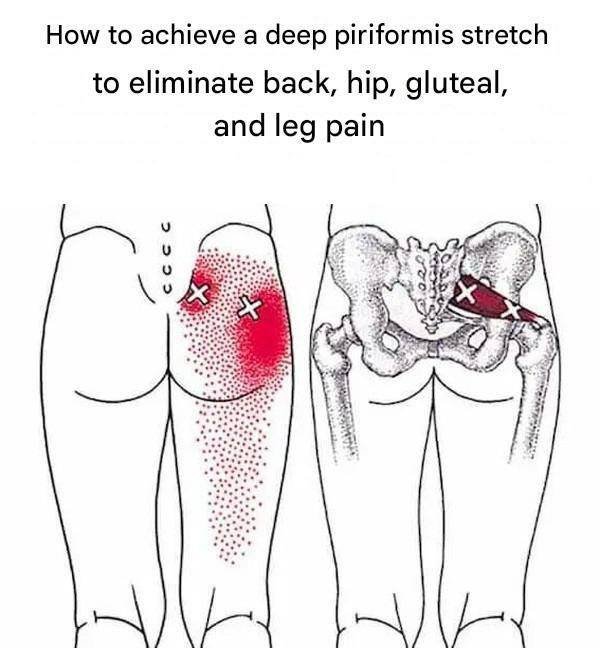
How to Achieve a Deep Piriformis Stretch to Eliminate Back, Hip, Gluteal, and Leg Pain (Step-by-Step Guide for Lasting Relief)
Learn how to safely perform a deep piriformis stretch to relieve sciatica-like pain in the back, hips, glutes, and legs with simple, effective techniques.
When Sitting Pain Travels Down Your Leg
That deep ache in your buttock.
The tightness in your hip.
The strange, shooting discomfort that runs down your leg after sitting too long.
For many people, this isn’t just “muscle soreness.”
It’s often linked to a small but powerful muscle called the piriformis.
When it becomes tight or irritated, it can compress nearby nerves and create pain that feels like it’s coming from your lower back, hips, or even down the leg.
The good news?
Targeted stretching can make a significant difference.
In this guide, you’ll learn:
- What the piriformis muscle does
- Why it causes pain
- Safe deep stretching techniques
- Step-by-step instructions
- Common mistakes to avoid
- When to seek medical help
Let’s break it down clearly and safely.
What Is the Piriformis Muscle?
The piriformis is a small, flat muscle located deep in the buttock, running from the lower spine to the top of the thigh bone.
Its main function is to help with:
- Hip rotation
- Leg movement
- Stabilizing the pelvis
Because of its location, it sits very close to the sciatic nerve in many people.
When tight, it can irritate or compress that nerve.
This condition is often associated with what is known as Piriformis Syndrome.
Why Piriformis Tightness Causes Pain
When the piriformis muscle becomes tight or inflamed:
- It presses on nearby nerves
- Blood flow becomes restricted
- Movement becomes limited
This can lead to:
- Lower back pain
- Deep buttock pain
- Hip stiffness
- Shooting leg pain (sciatica-like symptoms)
Who Is Most at Risk?
You may be more prone to piriformis tightness if you:
- Sit for long hours
- Drive frequently
- Run or cycle often
- Have weak hip muscles
- Experience poor posture
Before You Start: Important Safety Notes
A deep stretch should never cause sharp pain.
Stop immediately if you feel:
- Sharp nerve pain
- Numbness
- Tingling that worsens
If symptoms are severe or persistent, consult a healthcare professional or physiotherapist.
The 5 Most Effective Deep Piriformis Stretches
1. Figure-4 Stretch (Basic Deep Release)
How to do it:
- Lie on your back
- Bend both knees
- Cross your right ankle over your left knee
- Pull your left thigh toward your chest
- Hold for 20–30 seconds
What it does:
- Deeply stretches piriformis
- Relieves glute tightness
- Reduces nerve pressure
2. Seated Piriformis Stretch
Steps:
- Sit on a chair
- Place your right ankle over your left knee
- Keep your back straight
- Lean forward gently
Benefits:
- Great for office workers
- Can be done anywhere
- Improves hip flexibility
3. Supine Knee-to-Opposite-Shoulder Stretch
How to perform:
- Lie on your back
- Pull right knee toward left shoulder
- Keep shoulders relaxed
- Hold for 20–30 seconds
Effect:
- Targets deep glute muscles
- Helps release sciatic tension
4. Standing Piriformis Stretch
Steps:
- Stand near a wall for support
- Cross one ankle over opposite knee
- Sit back slightly like a chair position
- Hold for balance and stretch
Best for:
- Beginners
- People with limited floor mobility
5. Pigeon Pose (Advanced Deep Stretch)
How to do it:
- Start in a plank position
- Bring right knee forward
- Place shin diagonally across body
- Extend left leg straight behind
- Lean forward slowly
Benefits:
- Deepest piriformis release
- Improves hip mobility
- Reduces chronic tightness
Comparison: Gentle vs Deep Stretches
| Type | Best For | Intensity |
|---|---|---|
| Seated stretch | Beginners | Mild |
| Figure-4 stretch | General relief | Moderate |
| Pigeon pose | Chronic tightness | Deep |
Common Mistakes to Avoid
❌ Forcing the Stretch
Stretching too hard can irritate the sciatic nerve.
❌ Holding Breath
Breathing helps muscles relax—don’t hold it.
❌ Skipping Warm-Up
Cold muscles are more prone to strain.
❌ Ignoring Pain Signals
Sharp pain is not normal stretching discomfort.
How Often Should You Stretch?
For best results:
- 1–2 times daily
- 20–30 seconds per stretch
- Repeat 2–3 sets
Consistency matters more than intensity.
Supporting Habits for Faster Relief
✔ Improve Posture
Avoid long periods of sitting without movement.
✔ Strengthen Glutes
Weak glutes often contribute to piriformis overload.
✔ Take Movement Breaks
Stand and walk every 30–60 minutes.
✔ Apply Heat
Heat helps relax tight muscles before stretching.
When Stretching Isn’t Enough
If pain persists despite regular stretching, it may involve:
- Disc issues
- Severe nerve compression
- Hip joint problems
In such cases, professional evaluation is important.
Mini Scenario: A Common Recovery Pattern
A 38-year-old office worker experienced:
- Constant buttock pain
- Shooting leg discomfort
- Worse symptoms after sitting
After daily figure-4 stretching and posture correction:
- Pain reduced within 2 weeks
- Mobility improved
- Sitting became more comfortable
Consistency made the difference.
Frequently Asked Questions
1. How long does it take for piriformis stretching to work?
Some people feel relief in days; chronic cases may take weeks.
2. Can stretching make it worse?
Yes, if done too aggressively or incorrectly.
3. Is walking helpful?
Yes, gentle walking improves circulation and mobility.
4. Should I stretch during pain?
Only mild stretching—avoid pushing through sharp pain.
5. Can piriformis pain mimic sciatica?
Yes, it often feels very similar.
6. Is sitting bad for piriformis syndrome?
Prolonged sitting can worsen symptoms.
7. Do I need equipment?
No, most stretches use body weight only.
8. When should I see a doctor?
If pain persists, worsens, or affects mobility.
Action Checklist: Daily Relief Routine
✔ Do This
- Stretch daily (gentle consistency)
- Take movement breaks
- Use heat before stretching
- Strengthen hips and glutes
- Maintain good posture
❌ Avoid This
- Overstretching into pain
- Sitting for long uninterrupted hours
- Ignoring nerve-like symptoms
- Skipping recovery days
Conclusion: Small Muscle, Big Impact
The piriformis may be small, but when it tightens, it can affect your entire lower body.
The key to relief is not force—it’s consistency, gentle stretching, and awareness of how your body responds.
With the right approach, many people experience noticeable improvement in mobility and pain reduction. A deep piriformis stretch, done correctly and consistently, can significantly reduce hip, back, and leg pain—but it must be gentle, progressive, and paired with healthy movement habits.
If this guide helped you, share it with someone dealing with hip or leg pain—or start incorporating these stretches today to support long-term mobility and comfort.