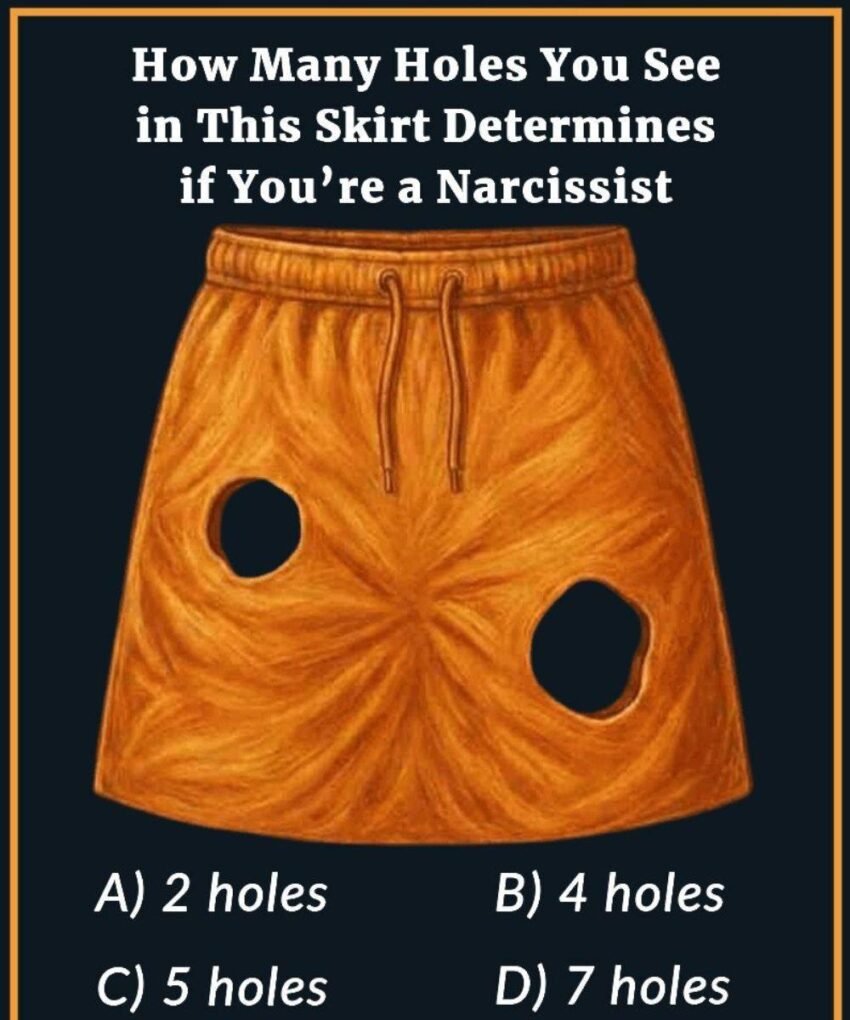
How Many Holes Do You See in This Skirt? The Viral Illusion That Claims to Reveal Narcissism (And What It Actually Says About You)
A viral skirt illusion claims to reveal narcissism based on how many holes you see. Here’s the truth behind it—and what your answer really means.
The Question That Hooks You Instantly
You’ve probably seen it before.
A simple image. A skirt. And one question:
“How many holes do you see?”
Some people say 2.
Others say 4.
A few go all the way up to 8.
Then comes the twist:
“Your answer reveals if you’re a narcissist.”
That’s where curiosity turns into something deeper.
Because now it’s not just a puzzle—it’s personal.
But here’s the uncomfortable truth:
That claim isn’t real.
And understanding why is far more interesting than the illusion itself.
What Is the “Skirt Hole Illusion”?
The image shows what looks like a skirt (or sometimes shorts) with visible openings. At first glance, it seems straightforward.
But the longer you look, the more ambiguous it becomes:
- Are you counting only the visible holes?
- Do you include the waistband opening?
- What about the holes you can’t see from this angle?
Your brain starts filling in gaps.
That’s the point.
It’s not testing your personality—it’s testing your perception and assumptions.
Why People Think It Reveals Narcissism
Let’s break down why this illusion spreads so fast.
1. It Feels Personal
Anything that claims to reveal something about you immediately grabs attention.
“Narcissist” is a loaded word. It creates tension.
You want to know:
- “Am I one?”
- “What does my answer say about me?”
That emotional hook keeps people engaged.
2. It Creates Instant Debate
There’s no single obvious answer.
So people argue:
- “It’s clearly 2!”
- “No, it’s 4!”
- “You’re missing the hidden ones!”
Debate = engagement. Engagement = virality.
3. It Exploits Confirmation Bias
If someone already believes personality can be decoded from simple tests, they’re more likely to accept the claim.
But here’s the reality:
There is no scientific link between counting holes in an image and narcissism.
What Psychology Actually Says About Narcissism
If we’re going to use the word “narcissist,” we should be accurate.
In psychology, narcissism is associated with traits studied in fields like Clinical Psychology.
It includes patterns like:
- Inflated sense of self-importance
- Need for excessive admiration
- Lack of empathy
- Sensitivity to criticism
Diagnosing it isn’t done through a visual puzzle.
Professionals use structured assessments like the Narcissistic Personality Inventory (NPI), not viral images.
So What Does Your Answer Reveal?
Now here’s the interesting part.
Your answer might not reveal narcissism—but it does hint at how your brain processes information.
🧠 1. Attention to Detail
People who count more holes tend to:
- Look beyond the obvious
- Consider hidden or implied elements
They’re exploring possibilities.
⚡ 2. Cognitive Framing
Some people stick strictly to what’s visible.
Others include what could logically exist.
Neither is wrong—they’re just different thinking styles.
🔍 3. Perception vs Interpretation
This illusion sits right between seeing and interpreting.
It shows how quickly we move from:
“I see this” → “This must mean that”
That jump is where most misunderstandings happen.
Step-by-Step: How to Approach Visual Illusions Like This
If you want to “solve” these more accurately (or at least understand them better), try this:
Step 1: Define the Rules
What exactly are you counting?
Visible holes only? All possible openings?
Step 2: Separate Observation from Assumption
What do you actually see vs what you’re inferring?
Step 3: Consider Multiple Interpretations
Could someone reasonably arrive at a different answer?
Step 4: Accept Ambiguity
Some illusions are designed to have no single correct answer.
That’s the trick.
Real-World Example: Why This Matters Beyond the Meme
This isn’t just about a skirt.
It reflects how people interpret information in everyday life.
Think about:
- Reading headlines differently
- Misunderstanding tone in messages
- Jumping to conclusions in conversations
The same mental shortcuts apply.
Common Mistakes People Make
❌ Treating It Like a Personality Test
It’s not. There’s no scientific backing.
Fix: Enjoy it as a perception puzzle, not a diagnosis.
❌ Assuming One “Correct” Answer
The ambiguity is intentional.
Fix: Understand the logic behind different answers.
❌ Overgeneralizing Results
“You got 4, so you’re X type of person.”
That’s not how human psychology works.
Pros and Cons of Viral Personality Illusions
| Pros | Cons |
|---|---|
| Fun and engaging | Often misleading |
| Encourages discussion | Can spread misinformation |
| Sparks curiosity | Oversimplifies psychology |
| Easy to share | Creates false labels |
Why These Illusions Keep Going Viral in 2026
Short answer: they’re perfectly engineered for attention.
They combine:
- Simplicity
- Personal relevance
- Controversy
- Shareability
Platforms reward that combination.
And people can’t resist asking others:
“What did you get?”
A Quick Scenario You’ve Probably Experienced
You’re scrolling.
You see the image.
You pause.
You count.
You second-guess.
Then you check the comments.
Suddenly, you’re invested.
That’s not an accident.
It’s how curiosity loops work.
The Bigger Insight Most People Miss
The real takeaway isn’t about the skirt.
It’s about how easily we accept conclusions when they’re packaged in a compelling way.
If something feels true, we often don’t question it.
But we should.
Especially when it involves labels like “narcissist.”
FAQ: What People Keep Asking
1. How many holes are actually in the skirt?
There’s no universally agreed answer—it depends on interpretation.
2. Does my answer reveal my personality?
No. There’s no scientific evidence supporting that.
3. Why do people get different answers?
Because they apply different assumptions and perspectives.
4. Is this based on real psychology?
No. It’s a viral myth, not a validated test.
5. What is narcissism really?
A complex personality trait studied in clinical psychology.
6. Why do I feel judged by the result?
Because the framing makes it personal.
7. Are there real personality tests online?
Yes, but credible ones are based on research—not images.
8. Why do these illusions spread so fast?
They trigger curiosity, debate, and emotional reactions.
9. Can illusions reveal anything useful?
They can show how you perceive and interpret information.
10. Should I take these seriously?
Enjoy them—but don’t treat them as facts.
Action Checklist
Do This:
✔ Treat viral illusions as entertainment
✔ Question bold psychological claims
✔ Understand different perspectives
✔ Focus on real, evidence-based insights
Avoid This:
✘ Labeling yourself based on a meme
✘ Assuming one “correct” interpretation
✘ Sharing misleading claims as facts
✘ Overanalyzing harmless puzzles
The skirt illusion isn’t exposing narcissists.
It’s exposing something else:
How quickly we believe something when it feels intriguing enough.
And maybe that’s the real test.
Your answer doesn’t define your personality—but your willingness to question it says a lot more.
Seen a different version of this illusion? Drop your answer and reasoning—you might be surprised how many ways people see the same image.