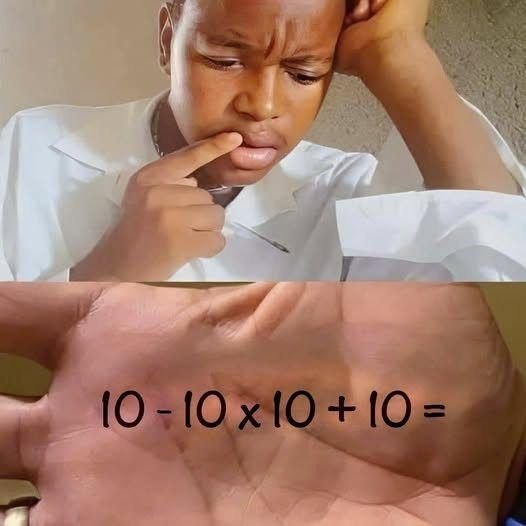
10 − 10 × 10 + 10: The Simple Math Problem That Still Tricks Millions — And What PEMDAS Really Means
Confused by 10 − 10 × 10 + 10? Learn how PEMDAS actually works, why order of operations matters, and the common mistakes people make.
When people see a math problem like:
10 − 10 × 10 + 10
they often split into two camps almost instantly.
One group confidently blurts out an answer. The other pauses, squints, and thinks, “Wait… multiplication first, right?”
What’s fascinating is that even adults who use math daily—teachers, business owners, engineers, shoppers comparing discounts, even people balancing budgets—still occasionally get tripped up by order of operations.
And honestly, that makes sense.
Most people weren’t taught why mathematical operations happen in a specific order. They were simply told to memorize PEMDAS and move on.
The result? Confusion, viral social media arguments, calculator mistakes, wrong spreadsheet formulas, and plenty of unnecessary frustration.
This guide clears all of that up.
You’ll learn:
- Why expressions like 10 − 10 × 10 + 10 confuse people
- What PEMDAS actually means
- The correct way to solve order-of-operations problems
- Common traps and misconceptions
- Real-world situations where this matters more than you think
- Smarter ways to avoid mistakes permanently
By the end, these expressions won’t feel tricky anymore. They’ll feel predictable.
The Correct Answer to 10 − 10 × 10 + 10
Let’s settle the problem first.
Here’s the expression:
10-10\times10+10
Many people instinctively solve from left to right:
- 10 − 10 = 0
- 0 × 10 = 0
- 0 + 10 = 10
That answer is wrong.
The correct method follows the order of operations:
- Multiplication first
- Then addition and subtraction from left to right
So we solve:
10-(10\times10)+10
First:
- 10 × 10 = 100
Now the expression becomes:
10-100+10
Then work left to right:
- 10 − 100 = −90
- −90 + 10 = −80
Final answer:
10-10\times10+10=-80
That single rule—doing multiplication before subtraction—is exactly why PEMDAS exists.
What PEMDAS Actually Means
PEMDAS is an acronym used in American schools to teach the standard order of operations.
It stands for:
- Parentheses
- Exponents
- Multiplication
- Division
- Addition
- Subtraction
Here’s the important part most classrooms rush through:
Multiplication and division are equals.
Addition and subtraction are equals.
That means you don’t always multiply before dividing, or add before subtracting.
Instead, you solve them from left to right.
For example:
20\div5\times2
You do:
- 20 ÷ 5 = 4
- 4 × 2 = 8
Not:
- 5 × 2 first
The same rule applies to addition and subtraction.
That tiny detail is responsible for thousands of online arguments every year.
Why People Get Order of Operations Wrong
There’s a psychological reason these problems spread so aggressively online.
Your brain naturally prefers sequential processing.
Humans instinctively want to read math left to right because that’s how English works. But mathematics has hierarchy rules layered on top of sequence.
That creates cognitive friction.
In simple terms:
Your eyes say one thing.
Math rules say another.
Social media amplifies this because people answer quickly instead of carefully.
There’s also another issue:
Many adults learned PEMDAS mechanically instead of conceptually.
They memorized:
“Please Excuse My Dear Aunt Sally.”
But they never deeply understood why multiplication takes priority.
Without conceptual understanding, the rule fades over time.
Why Order of Operations Exists at All
Imagine a world without standardized operation order.
The expression:
2+3\times4
could equal:
- 20
- 14
- or even something else
depending on who solved it.
That would destroy consistency in:
- engineering
- finance
- coding
- architecture
- science
- accounting
- economics
A construction blueprint interpreted differently by two contractors could become a safety hazard.
A spreadsheet formula calculated inconsistently could create financial losses.
A programming equation processed incorrectly could break software.
PEMDAS creates universal mathematical language.
It’s less about school rules and more about ensuring everyone arrives at the same answer.
The Hidden Logic Behind PEMDAS
Most people treat PEMDAS like arbitrary instructions.
It’s actually rooted in mathematical structure.
Addition and subtraction are considered “lower-level” operations.
Multiplication is essentially repeated addition.
Exponents are repeated multiplication.
So the hierarchy reflects complexity layers.
For example:
2^3
means:
2\times2\times2
And multiplication itself represents repeated addition.
The system builds upward logically.
That’s why exponents happen before multiplication, and multiplication before addition.
It’s not random. It’s structural.
The Most Common PEMDAS Mistakes
1. Solving Strictly Left to Right
This is the classic mistake behind 10 − 10 × 10 + 10.
People ignore operation hierarchy entirely.
Fix:
Always scan for multiplication/division before addition/subtraction.
2. Misunderstanding Multiplication and Division
Many students think multiplication always comes before division.
Wrong.
They’re equal priority.
Example:
24\div6\times2
Correct:
- 24 ÷ 6 = 4
- 4 × 2 = 8
Not 24 ÷ 12.
3. Ignoring Parentheses
Parentheses override everything.
Example:
(10-10)\times10+10
Now subtraction happens first.
That changes the answer completely.
4. Calculator Entry Errors
People often enter expressions incorrectly into calculators.
Especially older calculators.
Some evaluate linearly unless parentheses are used.
Modern scientific calculators usually follow standard conventions, but assumptions still cause mistakes.
5. Social Media “Trick Math” Confusion
Many viral equations are intentionally formatted ambiguously to generate arguments and engagement.
Tiny spacing differences can radically alter interpretation.
That’s not educational. It’s bait.
Real-Life Situations Where PEMDAS Matters
People often ask:
“When will I ever use this in real life?”
More often than you think.
Budgeting and Personal Finance
Imagine calculating:
Monthly expenses − discounts × quantity + tax
A wrong operation order could distort your budget.
Small errors repeated monthly become expensive.
Spreadsheet Formulas
Excel and Google Sheets rely heavily on operation hierarchy.
A misplaced parenthesis can completely alter:
- payroll totals
- tax calculations
- business forecasts
- sales reports
Coding and Programming
Programming languages follow operation precedence rules.
Developers constantly use PEMDAS-like logic.
Incorrect precedence can create software bugs that are difficult to trace.
Shopping Discounts
Retail math often involves layered operations:
Original price − discount × quantity + shipping
Miscalculations affect purchasing decisions.
Construction and Engineering
Formulas in engineering depend on precise sequencing.
Incorrect operations can affect measurements, load calculations, and material estimates.
This isn’t classroom trivia. It’s operational accuracy.
A Step-by-Step Method That Rarely Fails
If you freeze during multi-step expressions, use this simple approach.
Step 1: Circle Parentheses
Anything inside parentheses gets solved first.
Example:
(5+3)\times2
Step 2: Handle Exponents
Look for powers like:
3^2
Step 3: Scan Left to Right for Multiplication and Division
Treat them equally.
Step 4: Finish with Addition and Subtraction
Again, left to right.
That’s it.
Most errors happen because people skip the scanning step.
The Problem With Mnemonics Like “Please Excuse My Dear Aunt Sally”
Mnemonics help memory, but they sometimes damage understanding.
Students often mistakenly believe:
- Multiplication always beats division
- Addition always beats subtraction
because of acronym order.
A better way to think about PEMDAS is:
- Grouping
- Powers
- Multiplication/Division together
- Addition/Subtraction together
Some teachers now use:
- GEMA
- BODMAS
- BIDMAS
depending on country and curriculum.
The acronym matters less than understanding hierarchy.
PEMDAS vs BODMAS vs BIDMAS
Different countries teach different acronyms.
Here’s a quick comparison:
| Acronym | Meaning | Common Regions |
|---|---|---|
| PEMDAS | Parentheses, Exponents, Multiplication, Division, Addition, Subtraction | United States |
| BODMAS | Brackets, Orders, Division, Multiplication, Addition, Subtraction | UK, Australia |
| BIDMAS | Brackets, Indices, Division, Multiplication, Addition, Subtraction | UK schools |
Despite the wording differences, the mathematical rules are effectively the same.
That surprises many people.
Why Viral Math Problems Explode Online
There’s a reason these equations dominate comment sections.
They trigger three powerful psychological responses:
1. Confidence Bias
People assume basic arithmetic is easy.
That confidence makes wrong answers emotionally sticky.
2. Public Competition
Math puzzles create low-stakes intellectual competition.
Everyone wants to be right publicly.
3. Ambiguity Frustration
Poor formatting creates uncertainty.
Humans dislike uncertainty, so arguments intensify.
Social platforms know this. Controversial equations drive comments, shares, and engagement.
The 2026 Shift in Math Education
Math education in the United States has changed significantly in recent years.
Schools increasingly focus on:
- conceptual understanding
- mathematical reasoning
- visual learning
- practical application
Instead of rote memorization alone.
That means students are being encouraged to understand why order of operations exists, not just memorize acronyms.
Digital learning tools are also changing how students interact with equations.
Interactive graphing platforms and AI-powered tutoring systems now visualize operation sequencing in real time.
That’s a major improvement over static worksheets.
A Mini Story: The Spreadsheet Mistake That Cost a Small Business
A small online retailer once ran a holiday discount campaign using a spreadsheet formula for bundled pricing.
The intended formula was:
(Base price − discount) × quantity + shipping
But the spreadsheet was entered without parentheses.
The result:
Discounts multiplied incorrectly across orders.
For several days, the company unknowingly undercharged customers.
The financial loss wasn’t catastrophic, but it was painful enough to force a complete audit of pricing formulas.
The surprising part?
Everyone involved “knew math.”
The issue wasn’t intelligence. It was operation order.
That’s how these mistakes happen in the real world.
Expert-Level Tips for Avoiding Order-of-Operations Errors
Write Intermediate Steps
Mental math increases error rates dramatically.
Professionals often write temporary simplifications even for simple expressions.
Use Parentheses Generously
In programming and spreadsheets, extra parentheses improve clarity.
Even when mathematically unnecessary.
Slow Down at Mixed Operations
Expressions combining subtraction and multiplication create the most mistakes.
Pause intentionally.
Don’t Trust Viral Formatting
Many online equations use spacing tricks.
Rewrite the expression clearly before solving.
Understand the Logic, Not Just the Acronym
Memorization fades.
Conceptual understanding lasts longer.
Common Myths About PEMDAS
“Math Is Just Memorization”
No.
Strong math ability usually comes from pattern recognition and structure understanding.
“Adults Don’t Need This”
Adults use operation sequencing constantly through:
- taxes
- loans
- budgeting
- software
- measurements
- business calculations
“Calculators Eliminate the Need”
Only if expressions are entered correctly.
A calculator cannot fix conceptual misunderstanding.
“There’s Only One Way to Learn It”
Different methods work for different brains.
Visual learners often benefit from color-coding operations.
Others prefer procedural checklists.
Pros and Cons of Teaching PEMDAS Through Acronyms
| Pros | Cons |
|---|---|
| Easy to remember | Can oversimplify concepts |
| Helpful for beginners | Creates false operation hierarchy assumptions |
| Widely recognized | Encourages memorization over understanding |
| Fast classroom teaching tool | Students may forget conceptual reasoning |
The best math instruction combines memory aids with logic explanation.
Practice Problems to Strengthen Understanding
Try solving these mentally before checking the answers.
Problem 1
8+2\times5
Answer:
8+(2\times5)=18
Problem 2
(8+2)\times5
Answer:
(8+2)\times5=50
Problem 3
30\div5+2
Answer:
(30\div5)+2=8
Notice how tiny changes dramatically alter outcomes.
That’s the entire point of operation order.
Frequently Asked Questions
What is the correct answer to 10 − 10 × 10 + 10?
The correct answer is −80 because multiplication happens before subtraction and addition.
Does multiplication always come before division?
No. Multiplication and division have equal priority. Solve them from left to right.
Why is PEMDAS important?
PEMDAS ensures everyone interprets mathematical expressions consistently, which is critical in science, engineering, finance, and technology.
Is PEMDAS used worldwide?
Different countries use different acronyms like BODMAS or BIDMAS, but the mathematical principles are largely the same.
Why do people argue about viral math problems online?
Many viral equations are intentionally formatted ambiguously to trigger engagement and debate.
Do calculators always follow PEMDAS?
Modern scientific calculators usually do, but some basic calculators process inputs differently. Parentheses help avoid mistakes.
What happens if you ignore order of operations?
You can produce incorrect answers that affect budgeting, coding, formulas, measurements, and calculations.
Is PEMDAS still taught in US schools in 2026?
Yes, but many schools now emphasize conceptual understanding rather than memorization alone.
What’s the easiest way to avoid mistakes?
Work step by step, use parentheses clearly, and scan for multiplication/division before addition/subtraction.
Are parentheses always solved first?
Yes. Parentheses override the normal order of operations.
Quick Action Checklist
Do This
✔ Look for parentheses first
✔ Solve exponents before multiplication
✔ Treat multiplication and division equally
✔ Work left to right when operations share priority
✔ Write intermediate steps when unsure
✔ Use parentheses for clarity
✔ Double-check spreadsheet formulas
✔ Slow down on mixed-operation expressions
Avoid This
✘ Solving strictly left to right
✘ Assuming multiplication always beats division
✘ Relying entirely on mental math
✘ Trusting ambiguous viral formatting
✘ Ignoring calculator entry structure
✘ Memorizing PEMDAS without understanding it
Final Thoughts
At first glance, an expression like:
10 − 10 × 10 + 10
looks almost laughably simple.
Yet it exposes something surprisingly important:
Most math mistakes don’t come from intelligence gaps. They come from process gaps.
People rush.
They rely on instinct.
They trust memory shortcuts more than structure.
PEMDAS exists to create consistency in a world that depends on accurate calculations. Whether you’re balancing a household budget, building software, teaching students, analyzing data, or simply helping your child with homework, understanding operation order prevents avoidable errors.
And once the logic clicks, these problems stop feeling tricky.
They become systematic.
That’s the real breakthrough.
If this guide helped clarify PEMDAS or finally made order of operations feel intuitive, share it with someone who still argues with viral math posts online. And if you’ve ever been fooled by one of these equations yourself, you’re definitely not alone.
The expression 10 − 10 × 10 + 10 equals −80, because multiplication must happen before addition and subtraction according to the order of operations.