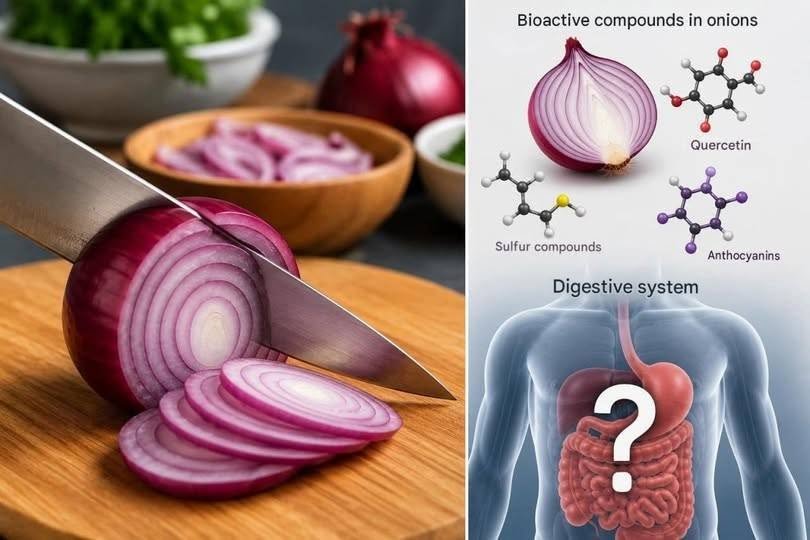
Myth or Medical Reality: Does Eating Raw Onions Really Cause Heartburn? The Truth Revealed
Does eating raw onions cause heartburn? Learn what medical evidence says about onions, acid reflux, personal triggers, and practical ways to reduce symptoms.
You eat a few slices of raw onion with dinner.
A little while later, there’s that familiar burning sensation behind your breastbone.
Your throat feels irritated. Maybe you notice a sour taste in your mouth.
So you start wondering:
Was it the onion?
This is a surprisingly common question for people dealing with heartburn or gastroesophageal reflux disease (GERD).
Raw onions are often blamed for triggering reflux, but the medical reality is more nuanced. Some people clearly notice worse symptoms after eating onions, while others can eat them without a problem.
So is raw onion actually a cause of heartburn?
Sometimes it may be a personal trigger—but it’s not accurate to say that raw onions automatically cause acid reflux in everyone.
Current guidance from the National Institute of Diabetes and Digestive and Kidney Diseases (NIDDK) emphasizes that people with GERD may have individual food triggers. Its commonly listed trigger foods include acidic foods, alcohol, chocolate, coffee and caffeine, high-fat foods, mint, and spicy foods; onions aren’t listed as a universal trigger.
That distinction matters.
Let’s separate the popular claim from what the evidence actually tells us.
First, What Exactly Is Acid Reflux?
Acid reflux occurs when stomach contents move back upward into the esophagus.
The esophagus is the tube connecting your mouth and stomach.
A muscular ring called the lower esophageal sphincter normally helps keep stomach contents from moving upward.
When reflux occurs, stomach contents can travel into the esophagus and sometimes all the way into the throat.
You may experience:
- A burning sensation in the chest
- A sour or acidic taste
- Regurgitation
- Chest discomfort
- Nausea
- Difficulty or pain when swallowing
- Chronic cough or hoarseness in some cases
Occasional reflux is common.
When reflux repeatedly causes symptoms or complications, it may be classified as gastroesophageal reflux disease, or GERD.
And this is where the onion question becomes interesting.
Myth: Raw Onions Cause Acid Reflux in Everyone
Reality: Onions May Trigger Symptoms in Some People, But Not Everyone
There is an important difference between a food being a universal cause of a condition and being an individual symptom trigger.
Raw onions may bother certain people with reflux.
But that doesn’t mean everyone with GERD needs to eliminate onions.
Medical guidance increasingly favors identifying your own triggers rather than following a huge list of foods that supposedly everyone with reflux must avoid. NIDDK specifically recommends paying attention to foods and drinks that make your individual symptoms worse.
That means your experience matters.
If you consistently eat raw onions and develop heartburn afterward, onions may be a useful food to investigate.
If you eat onions regularly without symptoms, there’s no medical reason to assume they’re automatically harming you.
Why Might Raw Onions Trigger Heartburn in Some People?
Researchers and clinicians have proposed several possible explanations for why certain foods may worsen reflux symptoms.
But it’s important not to turn a possible mechanism into a proven universal rule.
The response to food can vary significantly between individuals.
Raw onions can also be pungent and irritating to some people, and they may be eaten alongside other potential reflux triggers.
For example, consider a typical restaurant meal:
Raw onions + spicy sauce + fried food + large portion + soda + late dinner
If heartburn appears afterward, blaming the onion alone may be misleading.
The entire meal and the timing may matter.
Research on GERD dietary factors indicates that large meal volume, high-calorie meals, and certain lifestyle patterns can increase reflux burden, while evidence for many individual “trigger foods” is less consistent.
Raw Onion vs. Cooked Onion: Does It Matter?
This is where personal experimentation can become useful.
Some people find raw onions more irritating than cooked onions.
Cooking changes the texture, flavor, and chemical profile of foods, so it’s reasonable that an individual may tolerate cooked onion differently.
But there isn’t a simple medical rule saying:
“Raw onions cause GERD, while cooked onions don’t.”
That’s too absolute.
If you suspect onions trigger your symptoms, you could compare your response to:
- Raw onion
- Lightly cooked onion
- Fully cooked onion
- A smaller serving
- A meal without onion
Keep other factors relatively consistent.
That makes it easier to identify whether onion itself appears to be contributing.
Myth: If Onions Give You Heartburn, You Have GERD
Reality: One Episode Doesn’t Diagnose GERD
Eating a particular food and experiencing heartburn afterward doesn’t automatically mean you have GERD.
Almost anyone can experience occasional reflux.
GERD is a persistent condition involving recurring symptoms or complications associated with reflux.
For example, you might normally tolerate onions perfectly well but experience heartburn after:
- A very large meal
- Eating immediately before bed
- A high-fat dinner
- Drinking alcohol
- Eating spicy food
- Lying down shortly after eating
That single episode doesn’t necessarily mean you have a chronic disease.
The pattern over time is more important.
Myth: The More Onion You Eat, the More Reflux You’ll Have
Reality: Portion Size and the Whole Meal Matter
It’s tempting to think of food triggers as an on/off switch.
Eat onion → reflux.
Don’t eat onion → no reflux.
Human digestion isn’t always that simple.
The amount you eat can matter.
So can what you eat with it.
Imagine two situations.
Situation A
You eat a small amount of raw onion with a balanced meal several hours before bed.
No symptoms occur.
Situation B
You eat a large burger topped with raw onions, spicy sauce, fries, and a large soda at 10:30 p.m., then lie down shortly afterward.
You experience significant heartburn.
Was the onion responsible?
Possibly—but there’s no way to know from that experience alone.
The second meal contains several factors associated with reflux symptoms.
One of the Biggest Reflux Triggers May Not Be a Specific Food
Here’s something many people overlook:
When you eat can matter.
If your symptoms happen at night, eating too close to bedtime can be particularly important.
NIDDK recommends leaving at least 3 hours between eating and lying down or going to bed when nighttime or positional reflux is a problem.
This is a practical change that doesn’t require eliminating an entire category of foods.
For example, instead of immediately deciding that onions are forbidden forever, consider moving dinner earlier and observing what happens.
What Does the Evidence Say About “Trigger Foods”?
This is where online reflux advice can become confusing.
You may find long lists claiming that people with GERD should never eat:
- Tomatoes
- Citrus
- Onions
- Garlic
- Coffee
- Chocolate
- Spicy food
- Dairy
- Bread
- Fruit
- And dozens of other foods
But the scientific evidence isn’t that simple.
A recent review of dietary factors in GERD notes that many commonly reported trigger foods have inconsistent evidence linking them to objective reflux, while larger meal volume and higher calorie intake have stronger support as contributors to reflux burden.
That doesn’t mean food never matters.
It means individual responses matter.
What Foods Are Commonly Associated With Reflux Symptoms?
According to NIDDK, foods and drinks commonly linked with GERD symptoms include:
- Acidic foods such as citrus and tomatoes
- Alcohol
- Chocolate
- Coffee and other caffeine sources
- High-fat foods
- Mint
- Spicy foods
NIDDK recommends talking with a healthcare professional about foods or drinks that seem to make your own symptoms worse.
Notice what’s missing from that universal list:
There isn’t a rule saying every person with GERD must avoid raw onions.
That’s an important distinction.
Could the Way You Eat Onions Matter?
Absolutely.
Consider these different examples:
Raw onions in a salad
You eat a small amount with lunch.
Raw onions on a greasy burger
You eat them alongside a high-fat meal.
Onion rings
The onion is coated and fried.
Onion in a spicy dish
The meal contains several possible triggers.
Caramelized onions
The onions are cooked and often combined with butter or oil.
These are not physiologically identical meals.
If you experience symptoms after “onions,” look at the entire food context.
How to Find Out Whether Raw Onions Are Your Personal Trigger
Instead of guessing, try a simple food-and-symptom experiment.
Step 1: Keep a short food diary
For several days, record:
- What you ate
- Approximate portion size
- Time of the meal
- When symptoms appeared
- What the symptoms felt like
- Whether you were lying down afterward
You don’t need an elaborate spreadsheet.
A few notes in your phone can be enough.
Step 2: Look for patterns
Suppose you notice:
Raw onions → heartburn within a few hours → repeated several times
That’s more useful information than one isolated episode.
Now suppose you notice:
Raw onions at lunch → no symptoms
but:
Raw onions in large late-night meals → symptoms
That points toward a more complicated pattern.
Step 3: Consider the preparation
Compare your response to smaller portions of raw onion versus cooked onion if you can do so safely and comfortably.
Don’t intentionally provoke severe symptoms.
The goal is to identify patterns—not to make yourself sick.
Step 4: Look beyond the onion
Ask:
- Was the meal high in fat?
- Was it spicy?
- Was the portion unusually large?
- Did you drink alcohol?
- Did you consume caffeine?
- Did you eat close to bedtime?
- Did you lie down afterward?
These factors may be more important than the onion itself.
A Simple “Onion Test” for Your Own Eating Pattern
You can think of the process as a three-part comparison.
| Situation | What to observe |
|---|---|
| Small amount of raw onion with a normal meal | Any symptoms? |
| Cooked onion with a similar meal | Any difference? |
| Meal without onion | Does the pattern change? |
Don’t treat this as a medical diagnostic test.
It’s simply a way to become more aware of your individual food patterns.
Myth: Everyone With Heartburn Should Follow a Strict “GERD Diet”
Reality: Over-Restricting Your Diet Isn’t Always Necessary
One of the biggest problems with online health advice is the tendency to turn a list of possible triggers into a list of forbidden foods.
That can leave people unnecessarily avoiding nutritious foods.
A better strategy is usually targeted modification.
If a specific food repeatedly causes symptoms, reducing it may make sense.
If it doesn’t bother you, there may be no reason to eliminate it solely because someone online says it’s a reflux trigger.
Recent clinical literature similarly supports individualized dietary changes rather than universal elimination of every commonly suspected trigger.
What Can You Do If Raw Onions Really Trigger Your Heartburn?
You don’t necessarily have to give up onions forever.
Try practical adjustments.
Reduce the portion
A smaller amount may be easier to tolerate.
Try cooked onions
You may find cooked onions more comfortable than raw ones.
Eat them earlier
If nighttime symptoms are your main problem, avoid eating meals close to bedtime.
Pair them with a lighter meal
A heavy, high-fat meal may be more problematic than the onion itself.
Keep a food diary
Use patterns rather than assumptions to guide your choices.
Don’t deliberately challenge severe symptoms
If a food reliably causes significant symptoms, you don’t need to repeatedly test it.
What About Onion Supplements or “Natural Remedies”?
Be cautious with online claims that a particular food, supplement, or herbal product can “cure” reflux.
Heartburn has multiple potential causes, and persistent GERD may require medical evaluation and treatment.
The American College of Gastroenterology’s clinical guideline describes medications—particularly proton pump inhibitors—as an important treatment option for GERD, alongside appropriate lifestyle measures.
If you’re considering supplements, discuss them with a healthcare professional, particularly if you’re taking prescription medications.
Natural does not automatically mean risk-free.
Lifestyle Changes That May Help More Than Avoiding One Food
If reflux is a recurring problem, don’t focus exclusively on onions.
Several evidence-supported strategies may be more useful.
Avoid lying down soon after eating
For nighttime symptoms, leaving at least three hours between eating and bedtime may help.
Consider weight management if appropriate
For people with overweight or obesity, weight loss may reduce GERD symptoms.
Identify your personal triggers
Don’t automatically eliminate every food on an internet list.
Pay attention to meal size
Large meals can increase reflux burden.
Consider your sleeping position
For nighttime reflux, clinical literature supports measures such as elevating the head of the bed, and some evidence supports left-side sleeping.
When Heartburn Is More Than a Food Problem
Occasional heartburn isn’t necessarily dangerous.
But frequent symptoms shouldn’t simply be blamed on onions—or any other single food.
Talk with a healthcare professional if heartburn:
- Happens frequently
- Keeps returning despite lifestyle changes
- Interferes with sleep
- Requires frequent over-the-counter medication
- Causes difficulty swallowing
- Causes painful swallowing
- Is associated with persistent vomiting
- Is accompanied by unexplained weight loss
- Doesn’t improve with appropriate treatment
NIDDK recommends medical evaluation when GERD is suspected or when symptoms don’t improve with over-the-counter medicines or lifestyle changes.
Chest Pain Is Different
Heartburn can feel like chest pain.
But you should never assume that unexplained chest pain is simply acid reflux.
If chest discomfort is severe, new, persistent, or accompanied by symptoms such as shortness of breath, sweating, dizziness, or pain spreading to the arm, jaw, back, or shoulder, seek emergency medical attention.
A potentially serious heart problem can sometimes resemble indigestion or heartburn.
When in doubt, it’s safer to get urgent medical evaluation.
Common Mistakes People Make
Mistake #1: Blaming every symptom on onions
One episode isn’t enough to establish a food trigger.
Better approach: Look for a repeated pattern.
Mistake #2: Eliminating dozens of foods
An unnecessarily restrictive diet can make healthy eating harder.
Better approach: Remove or reduce foods that consistently cause your symptoms.
Mistake #3: Ignoring meal timing
Eating a large meal right before bed can be more relevant than one ingredient.
Better approach: Give yourself several hours between eating and lying down if nighttime reflux is a problem.
Mistake #4: Assuming “natural” remedies are automatically safe
Supplements can interact with medications and aren’t substitutes for appropriate treatment.
Better approach: Discuss persistent symptoms and supplements with a healthcare professional.
Mistake #5: Ignoring frequent heartburn
Regular symptoms may indicate GERD or another condition requiring evaluation.
Better approach: Don’t keep self-treating indefinitely without discussing persistent symptoms.
Frequently Asked Questions
Does raw onion cause acid reflux?
Raw onion may trigger heartburn symptoms in some individuals, but there isn’t a universal rule that raw onions cause reflux in everyone. Food triggers vary considerably between people.
Are cooked onions better for acid reflux?
Some people may tolerate cooked onions better than raw onions, but this isn’t guaranteed. If you suspect onions are a trigger, compare your symptoms after different preparations while keeping other meal factors similar.
Should I completely avoid onions if I have GERD?
Not necessarily. If onions consistently worsen your symptoms, reducing or avoiding them may help. If they don’t cause symptoms, there may be no reason to eliminate them solely because you have GERD.
Why does raw onion give me heartburn?
The exact reason can vary. Your individual sensitivity, the amount eaten, the rest of the meal, and factors such as meal size and timing may all contribute. Research does not support assuming that one mechanism explains every person’s reaction.
Can onions cause heartburn even if I don’t have GERD?
Yes. Occasional reflux can happen to people who don’t have chronic GERD. A single episode after eating onions does not establish a diagnosis.
Is onion worse than garlic for acid reflux?
There isn’t a simple medical ranking that applies to everyone. Both may bother some individuals, while others tolerate them without problems. Your personal response is more useful than a universal food ranking.
Can eating onions at night cause reflux?
If onions are one of your personal triggers, eating them as part of a late meal could contribute to symptoms. More broadly, eating close to bedtime can worsen nighttime reflux, which is why NIDDK recommends leaving at least three hours before lying down when nighttime symptoms occur.
What should I eat instead of raw onions if they trigger heartburn?
You don’t need one universal substitute. Try cooked vegetables or other ingredients that you personally tolerate. The goal is to maintain a nutritious, varied diet while reducing foods that repeatedly trigger your symptoms.
How can I tell whether onions are really causing my heartburn?
Keep a food diary and record the type and amount of onion, the rest of the meal, timing, and when symptoms appear. Repeated patterns are more informative than a single episode.
When should I see a doctor about heartburn?
Seek medical advice for frequent or persistent symptoms, difficulty or pain with swallowing, unexplained weight loss, persistent vomiting, or symptoms that don’t improve with appropriate lifestyle changes or over-the-counter treatment. New or severe chest pain should be treated as an urgent medical issue rather than automatically assumed to be heartburn.
The Truth About Raw Onions and Heartburn
So, is the claim that raw onions cause heartburn a myth?
It’s a myth if it’s presented as a universal rule.
But it’s a medical reality that individual foods can trigger or worsen symptoms in some people.
That’s the key distinction.
If you eat raw onions and consistently experience heartburn afterward, your body may be giving you useful information about a personal trigger.
But if you tolerate onions without symptoms, there’s no good reason to assume that you must eliminate them simply because they’re commonly blamed for reflux.
Instead of asking:
“Are onions bad for everyone with heartburn?”
A better question is:
“Do onions consistently make my symptoms worse?”
That shift—from internet food lists to your actual symptom pattern—is much closer to the way modern reflux management is approached.
And don’t overlook the bigger picture.
Meal size, high-fat foods, alcohol, caffeine, spicy foods, weight, smoking, and especially eating too close to bedtime can all influence reflux symptoms.
So the next time raw onions appear on your plate, you don’t necessarily need to panic—or automatically push them away.
Pay attention.
Track the pattern.
And if heartburn keeps coming back, don’t assume an onion is the whole story.
Your symptoms deserve an explanation, not a food myth.