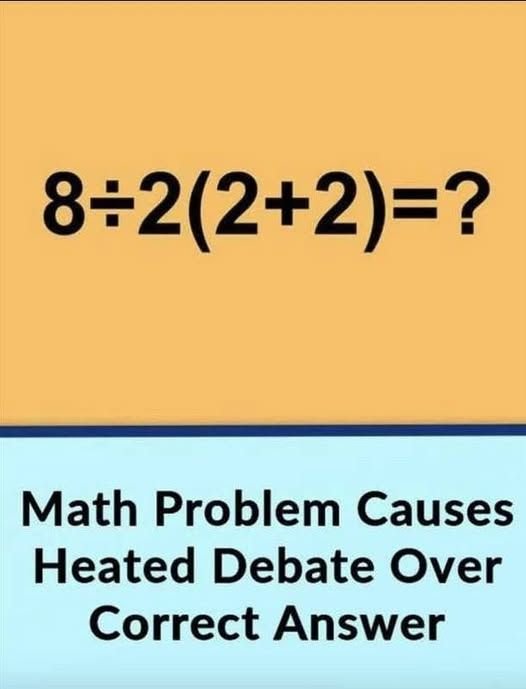
Math Problem Causes Huge Controversy as People Disagree on How to Solve It — And the Internet Can’t Agree on the Answer
A simple-looking math problem sparks massive online debate as people disagree on the correct solution. Here’s why it confuses so many.
At first glance, it looks harmless.
A basic math expression. Something you’d expect in a middle school worksheet. The kind of problem most people assume they can solve in under ten seconds.
And yet… it has triggered arguments across social media, classrooms, comment sections, and even family group chats.
Not because the math is advanced.
But because people are convinced different rules apply.
That’s where the controversy begins.
A single expression.
Two competing answers.
And hundreds of people absolutely certain they’re right.
Let’s break down why.
The Problem That Sparked the Debate
Here’s the expression that caused the disagreement:
8÷2(2+2)8\div2(2+2)8÷2(2+2)
Some people say the answer is 16.
Others insist it is 1.
And both groups are confident enough to argue loudly about it.
So what’s going on?
The issue isn’t the math itself.
It’s interpretation.
Why This Problem Confuses So Many People
This isn’t really a test of arithmetic.
It’s a test of how people read mathematical structure.
The confusion comes from one key idea:
Implicit multiplication is ambiguous in human reading
In expressions like:
2(2+2)2(2+2)2(2+2)
most people understand it as multiplication.
But when division appears next to it, things get messy.
Because suddenly the expression can be interpreted in two valid ways depending on grouping.
And grouping changes everything.
Interpretation 1: Left-to-Right (Common Calculator View)
Some people solve it like this:
8÷2×(2+2)8\div2\times(2+2)8÷2×(2+2)
Step 1:
(2+2)=4(2+2)=4(2+2)=4
Now:
8÷2×48\div2\times48÷2×4
Then solve left to right:
8÷2=48\div2=48÷2=4
4×4=164\times4=164×4=16
So this interpretation gives:
👉 16
Interpretation 2: Fraction Structure View
Others interpret the original expression differently:
82(2+2)\frac{8}{2(2+2)}2(2+2)8
Step 1:
(2+2)=4(2+2)=4(2+2)=4
Now:
times4}”}}
Step 2:
88=1\frac{8}{8}=188=1
So this interpretation gives:
👉 1
So Who Is Right?
Here’s the uncomfortable truth:
Both sides think they are applying PEMDAS correctly.
But the real issue is not PEMDAS itself.
It’s notation clarity.
Mathematics is precise, but human-written expressions often are not.
This expression is ambiguous because:
- Division can be interpreted as a fraction
- Implicit multiplication can bind tightly or loosely depending on context
- There are no parentheses enforcing structure
So the controversy isn’t about math skill.
It’s about formatting.
What PEMDAS Actually Says (and Doesn’t Say)
PEMDAS stands for:
- Parentheses
- Exponents
- Multiplication
- Division
- Addition
- Subtraction
But here’s the part most people miss:
Multiplication and division are the same level of priority
That means:
8÷2×48\div2\times48÷2×4
must be solved left to right.
But PEMDAS does NOT clearly define how to interpret:
2(2+2)2(2+2)2(2+2)
as either:
- multiplication with higher binding
- or part of a grouped denominator
That gap is where the controversy lives.
Why the Internet Keeps Falling Into This Trap
This type of problem spreads because it hits three psychological triggers:
1. Confidence Bias
People assume basic math must have a single obvious answer.
So they don’t question structure.
2. Pattern Habit
Most people learned math through simplified worksheets.
They aren’t trained to analyze ambiguous notation.
3. Ego Defense
Once someone picks an answer, they defend it emotionally.
Even when shown alternative interpretations.
That turns a math question into a debate.
Not logic.
What Mathematicians Actually Say
In higher mathematics, this expression would never be left ambiguous.
It would be written as either:
\frac{8}{2(2+2)}}
or
into explicit structure.
For example:
Instead of:
8÷2(2+2)8\div2(2+2)8÷2(2+2)
rewrite as either:
(8÷2)×(2+2)(8\div2)\times(2+2)(8÷2)×(2+2)