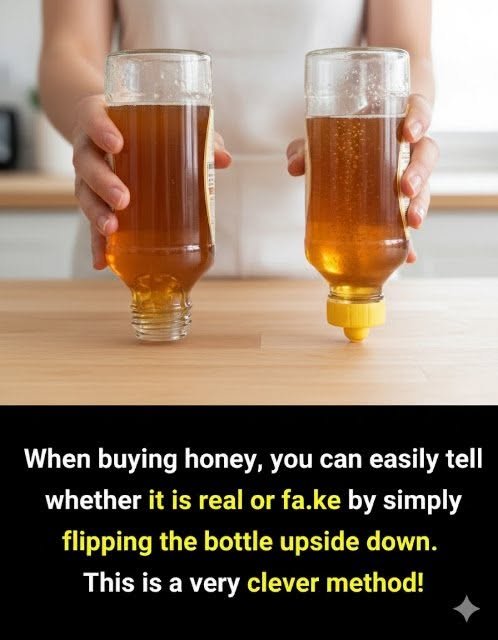
A Simple Trick to Spot Real Honey: Does Flipping the Bottle Really Work?
Does flipping a honey bottle reveal if it’s real? Learn what the viral bottle-flip test can—and cannot—tell you about honey authenticity.
You may have seen the trick online: turn a jar of honey upside down and watch what happens.
If a large bubble slowly travels toward the bottom, the claim goes, you have “real” honey. If it moves quickly—or the honey seems too runny—the product may be fake, diluted, or mixed with syrup.
It sounds wonderfully simple. No laboratory. No special equipment. No complicated ingredients.
But there’s a problem.
The bottle-flip test cannot reliably tell you whether honey is genuine.
The movement you see is influenced by properties such as viscosity, temperature, crystallization, container shape, and the honey’s composition. Those characteristics can vary naturally among genuine honeys. They can also change during storage and processing.
That doesn’t mean the trick is completely useless. It can show you something about how the honey flows. What it cannot do is prove that what you’re holding is authentic honey.
And that distinction matters more than ever. The U.S. Food and Drug Administration continues to monitor honey for economically motivated adulteration—when cheaper sweeteners are added or substituted to increase profit. In its fiscal-year 2025 sampling, FDA tested 102 domestic and imported honey samples and found four violative samples. The agency cautions that these assignments were not designed to estimate the prevalence of adulteration in the entire honey market.
So, if you’ve already flipped your bottle and watched the bubble crawl upward, what exactly did you learn?
Let’s take a closer look.
The viral bottle-flip test, explained
The test is usually presented like this:
- Take a sealed bottle or jar of honey.
- Turn it upside down.
- Watch the large air bubble inside.
- Observe how quickly it moves through the honey.
- Decide whether the honey is “real” based on the speed.
Some versions claim that authentic honey produces a slow-moving bubble because genuine honey is thick, while fake honey produces a rapidly moving bubble because added syrup or water makes it thinner.
There is a small piece of real science hiding inside that explanation.
Honey is a viscous liquid, and viscosity affects how quickly it flows.
But viscosity is not an authenticity detector.
That’s the crucial distinction.
A genuine honey can be relatively fluid. Another genuine honey can be extremely thick or partly crystallized. The Codex standard for honey recognizes that honey can naturally be fluid, viscous, partly crystallized, or entirely crystallized.
So when a bottle moves differently from another bottle, you’re observing a physical property—not receiving a certificate of authenticity.
Why the bottle flip seems so convincing
The trick works psychologically because it gives you a visible answer to an invisible question.
You cannot look at honey and see its sugar profile, moisture content, floral origin, or whether undeclared sweeteners have been added.
But you can see a bubble move.
That makes the test feel scientific.
It’s similar to watching oil spread across water or observing how quickly one syrup pours compared with another. The movement looks objective. You can repeat it. You can compare two jars side by side.
The problem is that a visible difference doesn’t necessarily identify the cause.
Suppose Honey A has a slow-moving bubble and Honey B has a fast-moving bubble.
That tells you they behave differently under those conditions.
It doesn’t automatically tell you:
- Honey A is authentic.
- Honey B is adulterated.
- Honey A has less water.
- Honey B contains corn syrup.
- One product is “natural” and the other isn’t.
There are simply too many variables.
What actually determines how honey flows?
Honey is not a single standardized liquid with one universal texture.
Its physical behavior depends on its composition and conditions.
Temperature is particularly important.
A honey jar sitting in a warm kitchen can behave very differently from the same jar stored somewhere considerably cooler. As temperature changes, so does the way the honey flows.
That means two bottles containing genuine honey could produce dramatically different bottle-flip results simply because one is warmer.
The Codex honey standard itself illustrates why laboratory measurements require controlled conditions: its moisture determination method uses refractive-index measurements at a specified temperature, around 20°C, with temperature corrections when necessary.
That is a useful clue.
If professionals account for temperature when measuring a characteristic of honey, it should make us skeptical of a casual kitchen test that treats flow speed as a yes-or-no authenticity test.
Moisture matters, too
Honey naturally contains water.
The Codex standard specifies moisture limits for honey, with different provisions for certain varieties.
Water content influences the physical behavior of honey, including how easily it flows.
But here’s where the viral test falls apart again.
Even if you somehow determined that a honey was relatively thin, you still wouldn’t know why.
Was it warmer?
Does it naturally have a different composition?
Is it a different floral variety?
Has it crystallized differently?
Was it stored under different conditions?
Or has something been added?
A bottle flip cannot distinguish those possibilities.
Crystallized honey makes the test even less useful
Here’s a simple scenario.
You buy two jars of genuine honey.
One is clear and fluid.
The other has started crystallizing and looks thick, cloudy, or grainy.
Flip both.
The first may move readily.
The second may barely move at all.
Does that mean one is fake?
No.
Crystallization is a natural phenomenon in honey. The Codex standard explicitly recognizes honey in forms ranging from fluid to partly or entirely crystallized.
In fact, using thickness or crystallization as proof of authenticity creates a classic food myth:
“Real honey must behave this way.”
There isn’t one correct physical appearance for all genuine honey.
Honey varies according to floral source, composition, storage conditions, and other factors.
So a bottle that crystallizes is not automatically “real,” and a bottle that remains liquid is not automatically “fake.”
The biggest misconception: thick honey equals real honey
This is probably the most important point to remember.
Thickness is not the same thing as authenticity.
A thick substance can be adulterated.
A genuine product can also be relatively fluid.
The bottle-flip trick essentially asks you to use viscosity as a proxy for authenticity.
But a proxy only works when the property being measured has a dependable relationship with the thing you’re trying to identify.
Here, that relationship is too weak to support a yes-or-no conclusion.
Think of it this way:
A slow-moving bubble tells you the honey is resisting flow.
That’s all.
It doesn’t tell you exactly what’s causing that resistance.
And that is why the test may be interesting—but shouldn’t be treated as proof.
So can fake honey pass the bottle-flip test?
Yes.
That’s one of the reasons the test is unreliable.
An adulterated honey product could have a viscosity that looks very similar to genuine honey.
Depending on what was added and in what proportion, the resulting mixture could behave in a way that seems perfectly convincing during a bottle flip.
Conversely, genuine honey could behave in a way that makes someone incorrectly suspect it.
The FDA has documented that different undeclared sweeteners require different analytical approaches. Its honey testing has included stable carbon isotope ratio analysis to identify certain patterns associated with adulteration, while FDA scientists have also investigated infrared spectroscopy and chemometric methods as rapid screening tools.
That tells you something important.
Authenticity testing is considerably more complicated than watching a bubble move.
What does the FDA actually look for?
This is where the conversation gets much more interesting.
The FDA defines economically motivated adulteration as the substitution, addition, or removal of something in a food to increase its apparent value or reduce production costs.
For honey, that can involve undeclared sweeteners made from sources such as cane, corn, rice, or sugar beets.
The agency has conducted multiple sampling assignments.
In 2021–2022, FDA tested 144 imported honey samples and found 14 violative samples, or 10%.
In 2022–2023, FDA tested 107 imported samples and found three violative samples, or 3%. FDA specifically warned that the two assignments were not designed for statistical comparison.
Then, in fiscal year 2025, the agency tested 54 domestically produced samples and 48 imported samples. Four samples were found to be violative—two domestic and two imported—for an overall 4% violation rate in that particular assignment. Again, FDA cautions against treating the result as a market-wide prevalence estimate.
These numbers don’t mean that a particular percentage of honey sold in American stores is fake.
They mean something more modest and more useful:
Honey adulteration is a real food-fraud issue, and regulators use laboratory methods to look for it.
That is very different from saying a bottle flip can identify fake honey.
Why laboratory testing is different
A laboratory can look for characteristics that a kitchen test cannot see.
For example, FDA has used Stable Carbon Isotope Ratio Analysis, or SCIRA, in honey investigations. This type of analysis examines the carbon-isotope composition of the sample to identify patterns inconsistent with authentic honey.
FDA researchers have also explored infrared spectroscopy combined with statistical analysis as a rapid screening approach for certain adulterants. In one FDA Science Forum project, the researchers reported that the approach could distinguish authentic and commercial samples and detect certain rice- and corn-syrup adulteration under the tested conditions.
Notice the difference.
The laboratory isn’t asking:
“Did the bubble move slowly?”
It’s asking questions about chemical composition.
That’s the level of analysis required when you want meaningful evidence about authenticity.
What about the water test?
You’ve probably seen another popular method:
Put a spoonful of honey into a glass of water.
The claim is that real honey supposedly sinks or clumps together, while fake honey dissolves quickly.
Again, it sounds plausible.
And again, it isn’t a dependable authenticity test.
Honey is water-soluble because its major components are sugars. How quickly a sample disperses depends on factors including temperature, concentration, agitation, viscosity, and the particular composition of the sample.
So if one honey dissolves differently from another, that doesn’t establish that one is authentic and the other is fake.
The same problem appears with the tissue-paper test, thumb test, flame test, and other viral methods.
They may demonstrate a physical property.
They don’t necessarily identify adulteration.
Does the thumb test work?
Another common claim says you should put a drop of honey on your thumb.
If it stays in place, it’s supposedly real.
If it spreads quickly, it’s supposedly fake.
But the underlying problem hasn’t changed.
You’re measuring how a viscous liquid behaves on a surface.
You’re not analyzing whether undeclared syrup has been added.
Temperature, viscosity, surface tension, and the amount of honey can all affect what you observe.
So the thumb test belongs in the same category as the bottle flip:
interesting observation, unreliable authenticity test.
What about the flame test?
This one deserves extra skepticism.
The viral version often involves dipping a match or cotton swab into honey and attempting to light it. The supposed logic is that real honey won’t burn easily because it contains relatively little water, while diluted honey will.
But even if you observe a difference in how something burns, that doesn’t give you a reliable composition analysis.
And deliberately bringing a flame into a food-testing experiment at home is unnecessary.
There’s no reason to turn honey authenticity into a fire experiment when better approaches exist.
Does crystallization prove honey is real?
No.
But this myth is more complicated than the others.
Crystallization is a perfectly normal characteristic of honey. Some honeys crystallize quickly, while others can remain liquid for a long time.
The Codex standard recognizes fluid, viscous, partly crystallized, and entirely crystallized honey.
So:
Crystallized ≠ automatically authentic.
And:
Liquid ≠ automatically fake.
If someone tells you that “real honey always crystallizes,” be cautious.
The natural world is rarely that tidy.
What should you look for when buying honey?
If your goal isn’t to conduct a laboratory investigation but simply to make a better purchasing decision, start with the label.
FDA guidance states that accurate and consistent labeling of honey and honey products helps prevent adulteration or misbranding and allows consumers to make more informed choices.
If a product contains added sweeteners, the labeling matters.
FDA explains that when other sweeteners are added to honey, the resulting product should be labeled as a blend rather than simply “honey,” with the added sweeteners properly declared in the ingredient statement.
So before you flip the jar, read it.
Check the product name
Is it labeled as honey, or is it a honey blend or another sweetener product?
The distinction matters.
Read the ingredient statement
For a packaged product, the ingredient list can provide useful information about what you’re actually buying.
Look at the producer
A transparent producer who identifies the source, origin, or beekeeper can give you more information than a generic label with vague claims.
Don’t assume a higher price proves authenticity
Expensive honey can still require verification.
Price is not a laboratory test.
Don’t assume “raw” automatically means verified authentic
“Raw” describes processing characteristics, not a magical guarantee against food fraud.
A better way to use the bottle flip
There’s actually a reasonable place for this viral trick.
Just change the question.
Instead of asking:
“Does this prove my honey is real?”
ask:
“What does this tell me about the honey’s consistency right now?”
Now the test becomes a simple observation.
If the honey flows very slowly, that tells you something about its current physical state.
If it flows quickly, that tells you something else.
You can use that information to compare products or simply satisfy your curiosity.
What you shouldn’t do is turn that observation into a conclusion about authenticity.
That’s the difference between measurement and diagnosis.
A simple at-home honey-check routine
If you’re standing in your kitchen wondering whether your jar is legitimate, use this approach.
Step 1: Read the label
Look for the product name and ingredient information.
Don’t skip this step in favor of a viral hack.
Step 2: Inspect the packaging
Check that the container is intact and properly sealed.
FDA advises consumers to avoid food products with damaged or compromised packaging and to inspect containers when purchasing food.
Step 3: Look at the honey
Color isn’t a reliable authenticity test because genuine honey naturally varies in color.
Clear, amber, dark, pale, cloudy, and crystallized appearances can all occur depending on the honey.
Step 4: Smell and taste it normally
Flavor and aroma can provide useful information about whether the product seems consistent with its stated type, but they still aren’t definitive laboratory authentication.
Step 5: Use the bottle flip only as a curiosity test
Watch how the honey moves.
Then stop.
Don’t declare it real or fake based on that observation.
Step 6: For serious concerns, seek actual testing
If you’re a consumer concerned about a particular product, contacting the manufacturer or appropriate food-safety authority is more meaningful than relying on viral kitchen experiments.
For commercial verification, laboratory analysis is the appropriate route.
Bottle flip vs. real authenticity testing
| Method | What it actually tells you | Can it prove honey is authentic? |
|---|---|---|
| Bottle flip | How the honey flows under those conditions | No |
| Water test | How the sample disperses in water | No |
| Thumb test | How a drop behaves on a surface | No |
| Flame test | How the sample behaves near a flame | No |
| Crystallization | Something about its physical state | No |
| Label inspection | What the producer declares | No, but useful |
| Laboratory analysis | Chemical/compositional characteristics | Much more meaningful |
The last row is the key.
Authenticity is a question about composition.
Flow behavior is only one physical characteristic.
Why “real honey” isn’t always going to look the same
One of the easiest mistakes consumers make is creating a mental picture of what genuine honey is supposed to look like.
Maybe you grew up with thick golden honey.
Maybe your local beekeeper sells pale, almost transparent honey.
Maybe your grandmother’s honey crystallized into a creamy texture.
All three can be genuine.
Honey’s appearance varies according to floral and plant source, and the Codex standard recognizes differences in color, flavor, aroma, and consistency.
This is why visual tests can be so misleading.
The more natural variation exists in a food, the harder it becomes to identify authenticity from appearance alone.
What the bubble is really doing
Let’s return to that dramatic moment when you turn the bottle upside down.
The bubble starts moving.
Slowly.
Then faster.
Maybe it stops.
Maybe it splits.
Maybe the honey barely moves at all.
What’s happening?
You’re seeing the interaction between an air pocket and a viscous fluid.
The resistance to movement is related to the honey’s flow properties under those particular conditions.
But the bottle doesn’t know whether the honey came from a beekeeper, a supermarket, or a laboratory.
It doesn’t know whether a sweetener was added.
It simply responds to the physical characteristics of the liquid.
That’s why the trick can be scientifically interesting without being scientifically conclusive.
The temperature trap most viral videos ignore
Imagine testing the same jar twice.
At 70°F, the honey moves slowly.
Later, after the jar has warmed significantly, it moves faster.
Did the honey suddenly become fake?
Obviously not.
Nothing about its authenticity necessarily changed.
The physical behavior changed because the conditions changed.
This is one reason standardized laboratory measurements are so different from casual kitchen tests. Codex’s honey methods account for temperature when measuring characteristics such as refractive index and moisture.
A bottle-flip video usually doesn’t control for:
- Temperature
- Container dimensions
- Bubble size
- Honey variety
- Crystallization
- Storage history
- Exact composition
- Measurement time
- Bottle orientation
That’s a lot of uncontrolled variables for a test that supposedly produces a binary answer.
What if your honey moves extremely fast?
Don’t panic.
A fast-moving bubble is not proof that the honey is fake.
At most, it’s a reason to ask more questions.
Check the label.
Look at the ingredients.
Consider whether the honey is unusually warm.
Compare it with another product under similar conditions.
If you’re still concerned, investigate the producer or seek professional testing.
That’s a much more rational sequence than immediately throwing the jar away.
What if your honey barely moves?
The same principle applies.
Slow movement doesn’t prove authenticity.
It may reflect higher viscosity, lower temperature, crystallization, or other physical characteristics.
You have learned something about how the sample behaves.
You haven’t proven where its ingredients came from.
A mini case scenario: two jars, one viral test
Imagine Sarah buys two bottles of honey at a grocery store.
The first bottle is a light-colored clover honey.
The second is a darker wildflower honey.
She puts both in the same cabinet.
One afternoon, she turns both upside down.
The clover honey’s bubble moves quickly.
The wildflower honey’s bubble crawls.
Sarah remembers a social media video claiming slow movement means real honey.
She concludes the wildflower honey is authentic and the clover honey is fake.
But that conclusion doesn’t follow from the evidence.
She has compared two products with different characteristics.
She hasn’t established why they move differently.
The more scientifically responsible conclusion would be:
“These two honeys have different flow behavior under these conditions.”
That’s it.
It may sound less exciting.
It’s also much harder to fool yourself with.
The 2026 lesson: food fraud testing is becoming more sophisticated
The honey industry isn’t relying on bottle flips to solve authenticity problems.
FDA continues to conduct sampling and develop analytical approaches for honey adulteration. Its FY25 program specifically notes that different methods are needed to detect undeclared sweeteners from different sources.
That point is easy to overlook.
There isn’t necessarily one universal chemical fingerprint that makes every adulteration problem disappear.
Different adulterants can require different analytical approaches.
That helps explain why a single household trick cannot realistically perform the same job.
Researchers are exploring faster screening technologies, including infrared-based approaches combined with statistical models. FDA reported promising results in one study involving rice and corn syrup adulteration, while describing it as a screening approach rather than a magical all-purpose home test.
The direction is clear:
More sophisticated food-authenticity testing is moving toward chemical fingerprints, instrumental analysis, and data-driven screening—not visual tricks.
Does “100% pure honey” settle the question?
It helps tell you what the producer is claiming.
But a claim on a label is still a claim.
The FDA’s ongoing honey-monitoring work exists partly because economically motivated adulteration can involve products being sold under labels that don’t accurately reflect their composition.
That doesn’t mean you should distrust every honey jar.
It means consumers should understand the difference between:
A product claim
and
independent verification.
The same principle applies to many foods.
A label is useful.
A laboratory test is stronger evidence.
A viral TikTok test is neither.
Pros and cons of the bottle-flip trick
Pros
- Takes only seconds.
- Costs nothing.
- Easy to perform.
- Can show differences in flow behavior.
- Makes an interesting demonstration of viscosity.
- May encourage consumers to think more critically about food authenticity.
Cons
- Cannot reliably prove honey is genuine.
- Can produce false suspicion.
- Doesn’t control temperature.
- Doesn’t account for natural variation among honeys.
- Can confuse crystallization with adulteration.
- Doesn’t identify specific added sweeteners.
- Has no established yes/no threshold for authenticity.
- Can give consumers unjustified confidence in a product.
That final point is particularly important.
A bad test can be dangerous not only because it produces false accusations, but because it can create false reassurance.
If a questionable product passes the bottle flip, you might stop asking questions.
The 8-second rule to remember
Here’s an easy way to remember the entire article:
Flip the bottle if you’re curious. Don’t trust the flip as proof.
That’s the rule.
A slow bubble does not certify honey.
A fast bubble does not expose fake honey.
Crystals do not certify honey.
Water tests do not certify honey.
A thumb test does not certify honey.
A flame test certainly doesn’t need to enter your kitchen.
If authenticity genuinely matters, move up the evidence ladder:
Label → producer information → regulatory information → laboratory analysis.
Frequently Asked Questions
Does flipping a honey bottle prove it is real?
No. The bottle-flip test measures how the honey behaves as it flows, but flow speed can be affected by temperature, viscosity, crystallization, composition, and other factors. It cannot reliably establish authenticity.
Why does real honey move slowly when flipped?
Honey is viscous, so it can resist flow and make an air bubble move slowly. But the exact speed varies among genuine honeys and under different conditions. Slow movement is therefore not proof that a product is authentic.
Can fake honey also be thick?
Yes. Thickness alone cannot establish what ingredients are present. An adulterated product can potentially have physical properties similar to genuine honey.
Does real honey always crystallize?
No. Genuine honey can be fluid, viscous, partly crystallized, or entirely crystallized. The Codex standard recognizes these different physical states.
Does putting honey in water show whether it is real?
No reliable conclusion can be drawn from how quickly honey disperses in water. Water tests are influenced by physical properties and conditions and are not validated authenticity tests.
Can you tell real honey by its color?
Not reliably. Genuine honey naturally varies in color depending on its floral and plant source. Color alone is not an authenticity certificate.
How does the FDA detect fake honey?
FDA has used analytical methods including Stable Carbon Isotope Ratio Analysis to investigate certain forms of economically motivated adulteration. The agency also researches newer screening approaches, including infrared spectroscopy and chemometric analysis.
Is honey adulteration actually a problem in the United States?
FDA testing has found violative samples in multiple honey-import sampling assignments, and the agency continues monitoring both imported and domestically produced honey. However, these targeted assignments are not designed to represent the percentage of all honey sold in the United States that is adulterated.
What is the best way to buy authentic honey?
Start by reading the product label and ingredient information, researching the producer when possible, and being cautious about unsupported authenticity claims. If definitive authentication is required, laboratory analysis is far more appropriate than a household test.
Should I throw away honey that fails the bottle test?
Not based on that test alone. A fast-moving or slow-moving bubble does not prove that honey is fake. Investigate the label and source before drawing conclusions.
Your Honey Authenticity Checklist
What to do
- Read the product name.
- Check the ingredient statement.
- Look for clear producer information.
- Inspect the packaging and seal.
- Understand that genuine honey varies naturally.
- Remember that crystallization is normal.
- Treat the bottle flip as a curiosity test.
- Seek credible information if a product seems suspicious.
- Use laboratory analysis when definitive authentication is necessary.
What to avoid
- Calling honey fake because a bubble moves quickly.
- Calling honey authentic because a bubble moves slowly.
- Assuming all genuine honey must crystallize.
- Assuming clear honey is fake.
- Assuming dark honey is more authentic.
- Treating viral social-media tests as laboratory methods.
- Using a flame experiment to “prove” authenticity.
- Assuming a premium price guarantees purity.
The bottle-flip trick is fun.
It is visual.
It is easy.
And it has just enough real science behind it to make the claim sound convincing.
But it does not reliably identify real honey.
What you’re seeing is primarily a demonstration of how the honey flows under particular conditions. Genuine honey naturally varies in viscosity and consistency, and factors such as temperature and crystallization can dramatically change what happens inside the bottle.
Meanwhile, actual honey authenticity testing looks at composition using analytical methods that are far beyond what the average kitchen experiment can determine. FDA’s ongoing work demonstrates just how sophisticated the problem of honey adulteration can be.
So the next time someone tells you to flip a honey bottle and watch the bubble, go ahead.
Watch it.
Just don’t let the bubble make the decision for you.
A slow-moving bubble may mean thick honey. A fast-moving bubble may mean thinner honey. Neither result proves whether the honey is real.
If this cleared up the viral honey test, share it with someone who has tried the bottle trick, leave a comment with the honey test you’ve seen online, and explore more evidence-based guides to spotting food claims that sound scientific—but aren’t quite what they seem.
This article is for general educational purposes and is not a substitute for laboratory food-authenticity testing or regulatory advice.