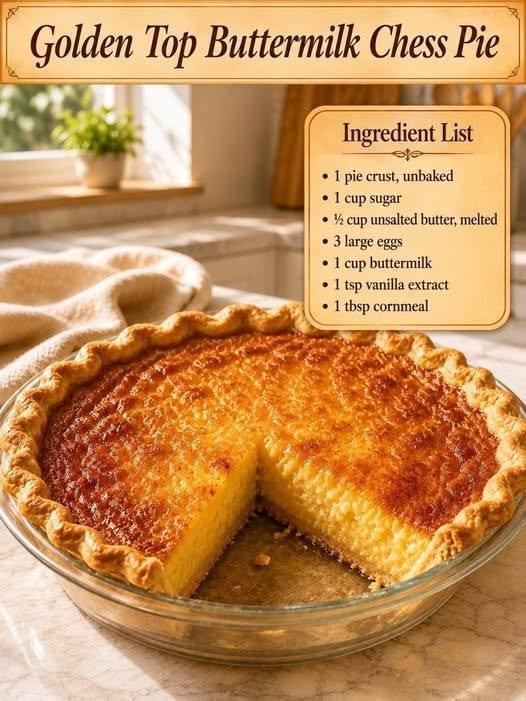
Golden Top Buttermilk Chess Pie
There is something wonderfully old-fashioned about a Southern chess pie. It does not need a towering swirl of frosting or a pile of fresh fruit to get attention. Set one on the table with its glossy golden top and flaky crust, and people somehow know exactly what to do next.
Cut into it, and the real magic appears: a smooth, creamy custard tucked inside a crisp pastry shell. The flavor is rich but not heavy, sweet but balanced by tangy buttermilk, with just enough vanilla and butter to make every bite taste warm and familiar.
This Golden Top Buttermilk Chess Pie is the kind of dessert that belongs at Sunday dinner, Thanksgiving, family reunions, and holiday tables. It is simple enough for a beginner, yet the finished pie looks and tastes wonderfully special.
And there is one detail that makes all the difference: getting that creamy center without overbaking the custard. Follow the visual cues in this recipe, and you will know exactly when to pull the pie from the oven.
💛 Why You’ll Love This Buttermilk Chess Pie
- Classic Southern comfort: A timeless dessert with a rich history and homemade charm.
- Silky and creamy: The filling bakes into a smooth, tender custard rather than a firm, rubbery one.
- Beautiful golden top: A lightly caramelized surface gives the pie its signature appearance.
- Easy ingredients: Most of what you need is probably already in your pantry.
- Beginner-friendly: No complicated pastry techniques are required if you use a prepared crust.
- Budget-friendly: Simple ingredients create an impressive dessert.
- Make-ahead friendly: The pie needs time to cool and set, making it perfect for entertaining.
- Perfect for holidays: Serve it at Thanksgiving, Christmas, Easter, or a Southern-style Sunday dinner.
- Comforting and nostalgic: It tastes like something pulled from an old family recipe box.
- Naturally vegetarian: The classic recipe contains no meat.
- A beautiful contrast: Crisp crust, creamy center, and golden top make every bite interesting.
🧾 Ingredients
Yield: 1 standard 9-inch pie, about 8 servings
Prep time: 20 minutes
Bake time: 45–55 minutes
Cooling time: At least 2 hours
Total time: About 3 hours
Difficulty: Easy to moderate
For the crust
- 1 unbaked 9-inch pie crust (about 200–225 g / 7–8 oz) — homemade or store-bought
- 1 tablespoon (8 g) all-purpose flour, for dusting if needed
For the buttermilk chess filling
- 1 ½ cups (300 g / 10.6 oz) granulated sugar
- ¼ cup (30 g / 1.1 oz) all-purpose flour
- 2 tablespoons (16 g / 0.6 oz) fine yellow cornmeal
- ¼ teaspoon fine salt
- ½ cup (113 g / 4 oz) unsalted butter, melted and slightly cooled
- 3 large eggs (about 150 g / 5.3 oz without shells)
- 1 cup (240 ml / 8 fl oz) full-fat buttermilk
- 2 teaspoons (10 ml) pure vanilla extract
- 1 tablespoon (15 ml) fresh lemon juice
- 1 teaspoon finely grated lemon zest, optional
- ⅛ teaspoon freshly grated nutmeg, optional but traditional in spirit
Why these ingredients matter
Buttermilk provides the gentle tang that keeps the pie from tasting overwhelmingly sweet. It also contributes to the tender custard texture.
Eggs are the structure of the filling. They allow the liquid ingredients to set into a creamy custard during baking.
Cornmeal is a classic chess pie ingredient. You do not use enough to make the filling taste like cornbread. Instead, it gives the pie its traditional character and helps create a delicate texture.
Flour gives the filling additional structure and helps prevent a loose center.
Butter brings richness and gives the finished pie a smooth, luxurious mouthfeel.
Lemon juice is the quiet flavor booster. You should not taste a strong lemon flavor. Instead, it sharpens the buttermilk and balances the sugar.
Vanilla rounds everything out with warm sweetness.
Nutmeg is optional, but a tiny amount adds an old-fashioned bakery aroma.
🥧 What Is Chess Pie?
Chess pie is a classic Southern dessert made with a simple custard-style filling, usually built around eggs, sugar, butter, and some combination of flour or cornmeal.
Buttermilk chess pie adds tangy buttermilk to that rich filling.
The finished dessert should have a golden, slightly caramelized top and a smooth, creamy interior.
It is not quite cheesecake, not quite pudding, and not exactly a traditional egg custard.
It is its own wonderful thing.
🍳 Kitchen Tools You’ll Need
Basic tools
- 9-inch pie plate
- Large mixing bowl
- Medium mixing bowl
- Whisk
- Rubber spatula
- Measuring cups and spoons
- Cooling rack
- Baking sheet
Optional tools
- Kitchen scale
- Fine-mesh sieve
- Citrus zester
- Instant-read thermometer
Pro alternative: No pie weights for blind-baking? You can use parchment paper filled with dry beans or uncooked rice as temporary weights.
For this particular recipe, however, you can also skip a full blind bake if your crust is sturdy and you follow the baking instructions carefully.
👩🍳 How to Make Golden Top Buttermilk Chess Pie
1. Prepare the pie crust
Place the unbaked pie crust into a 9-inch pie plate.
Gently press it into the bottom and sides without stretching the dough.
Fold the edges under and crimp them with your fingers or a fork.
Place the crust in the refrigerator for 20–30 minutes.
This chilling time helps the butter in the pastry firm up, which reduces shrinking during baking.
Meanwhile, preheat your oven to 375°F (190°C).
Place a baking sheet on the middle rack to preheat.
Pro tip: Baking the pie on a hot baking sheet gives the bottom crust a better chance of becoming crisp rather than pale and soft.
2. Prepare the dry ingredients
In a large bowl, whisk together:
- 1 ½ cups sugar
- ¼ cup flour
- 2 tablespoons cornmeal
- ¼ teaspoon salt
- Optional nutmeg
Whisk for about 30 seconds.
This distributes the flour and cornmeal evenly and prevents little pockets of dry ingredients in the custard.
3. Add the melted butter
Pour the melted butter into the dry mixture.
Whisk until combined.
The mixture will look thick and slightly grainy.
That is completely normal.
Important: Make sure the melted butter has cooled slightly. It should be warm, not hot.
Very hot butter can partially cook the eggs later.
4. Add the eggs
Crack the eggs into a separate bowl.
Lightly beat them with a fork or whisk.
Add them to the sugar and butter mixture.
Whisk gently until the mixture becomes smooth.
Do not whip aggressively.
You are mixing a custard, not making a cake batter.
What should NOT happen: Do not beat excessive air into the filling. Too much air can cause the pie to puff dramatically in the oven and then collapse unevenly as it cools.
5. Add buttermilk and flavorings
Slowly whisk in:
- 1 cup buttermilk
- 2 teaspoons vanilla
- 1 tablespoon lemon juice
- Optional lemon zest
Mix until smooth.
The filling should be fluid and creamy, with no visible streaks of egg.
At this stage, the aroma should be sweet, buttery, and lightly tangy.
6. Strain the filling
For the smoothest possible texture, pour the filling through a fine-mesh sieve into a clean bowl.
This step is optional, but it is one of the easiest ways to make a homemade custard feel bakery-quality.
The sieve catches tiny bits of egg, flour, or undissolved cornmeal.
Chef tip: If perfectly creamy texture is your priority, do not skip this step.
7. Fill the crust
Remove the chilled crust from the refrigerator.
Slowly pour the filling into the shell.
Do not fill beyond the edge of the crust.
If you have a little extra filling, reserve it rather than overfilling the pie.
Carefully transfer the pie onto the preheated baking sheet.
8. Start baking at higher heat
Bake at 375°F (190°C) for 15 minutes.
This initial burst of heat helps the crust begin setting and encourages the top of the custard to develop that beautiful golden color.
After 15 minutes, reduce the oven temperature to 325°F (165°C).
Continue baking for another 30–40 minutes.
The exact timing depends on your oven and the depth of your pie plate.
9. Watch the center carefully
This is the most important part of the recipe.
The edges should look set.
The top should be a deep golden yellow with a few tiny cracks or a gently puffed appearance.
The center should still have a small, controlled wobble when you gently move the pie.
Think of gelatin rather than liquid.
It should jiggle as one piece rather than slosh.
Do not wait until the center is completely firm.
The residual heat will continue cooking the custard after the pie leaves the oven.
Overbaking is the fastest way to lose that creamy texture.
For an extra-precise check, the center should be around 175–180°F (79–82°C) when measured carefully with an instant-read thermometer.
10. Cool completely
Remove the pie from the oven and place it on a cooling rack.
Let it cool at room temperature for at least 2 hours.
Do not cut into it immediately.
I know.
The smell is incredible, the top is golden, and everyone wants a slice.
But patience pays off.
The custard needs time to finish setting.
Cutting too early can cause the filling to spread rather than hold its beautiful creamy shape.
11. Chill for the cleanest slices
Once the pie has cooled, refrigerate it for 1–2 hours if you want especially neat slices.
For serving, you can let it sit at room temperature for about 15–20 minutes.
This takes the refrigerator chill off while keeping the custard nicely set.
👨🍳 Chef-Level Tips for Perfect Creamy Chess Pie
Use full-fat buttermilk
Low-fat buttermilk can work, but full-fat provides a richer mouthfeel.
Do not overmix
Gentle whisking is enough.
Too much air creates bubbles and can cause the filling to puff and crack.
Keep the butter warm, not hot
Let melted butter cool for about 5–10 minutes before combining it with the eggs.
Strain the custard
This is the easiest professional trick in the recipe.
A quick pass through a fine-mesh sieve gives you a smoother, more luxurious filling.
Don’t overbake
This is the number-one mistake.
The pie should look slightly underdone in the center when it leaves the oven.
It will continue setting as it cools.
Let it cool gradually
Avoid putting a piping-hot pie directly into a cold refrigerator.
Rapid temperature changes can encourage condensation and affect the crust.
Bake on the lower-middle part of the oven
The hot baking sheet helps the bottom crust cook, while the moderate oven temperature protects the delicate custard.
⚠️ Common Mistakes and How to Fix Them
My filling is rubbery.
It was probably overbaked.
Next time, remove the pie when the center still has a gentle wobble.
The middle is completely liquid.
It needs more time.
Return it to a 325°F (165°C) oven for another 8–10 minutes, checking frequently.
The crust is pale.
Make sure your oven is fully preheated and bake the pie on a preheated baking sheet.
You can also chill the shaped crust before filling it.
The top is browning too quickly.
Loosely cover the edges or entire pie with aluminum foil.
Do not press the foil directly onto the custard.
The pie cracked badly.
A small crack is not a disaster.
Large cracks can happen from overbaking, excessive air in the filling, or sudden temperature changes.
Cover the pie with a little whipped cream before serving and nobody will complain.
My pie has bubbles.
Too much whisking can incorporate air.
Tap the filled pie plate gently on the counter a couple of times before baking to release large air bubbles.
🍋 Variations & Customizations
Classic Southern Version
Keep the recipe exactly as written.
The combination of buttermilk, vanilla, butter, cornmeal, and a hint of lemon gives you the traditional character you want.
Lemon Buttermilk Chess Pie
Increase the lemon zest to 2 teaspoons and lemon juice to 2 tablespoons.
This creates a brighter, more citrus-forward pie without turning it into a lemon pie.
Brown Sugar Chess Pie
Replace ½ cup of the granulated sugar with packed light brown sugar.
The filling will have deeper caramel notes and a slightly darker golden color.
Extra-Vanilla Version
Increase vanilla to 1 tablespoon.
For a bakery-style flavor, use pure vanilla extract rather than imitation vanilla.
Nutmeg Chess Pie
Add ¼ teaspoon freshly grated nutmeg.
This gives the pie a warm, old-fashioned flavor that works beautifully during the holidays.
Orange-Scented Chess Pie
Replace the lemon zest with 1 teaspoon finely grated orange zest.
The orange adds a subtle sweetness and pairs surprisingly well with buttermilk.
Gluten-Free Version
Replace the all-purpose flour in the filling with a 1:1 gluten-free baking flour blend and use a certified gluten-free pie crust.
Always check package labels for cross-contact if gluten avoidance is important.
🧊 Storage & Reheating Guide
Refrigerator
Once cooled, cover the pie and refrigerate for up to 4 days.
The crust may gradually soften, but the filling will remain delicious.
Can you make it ahead?
Absolutely.
This is an excellent make-ahead dessert.
Bake it one day before serving, allow it to cool completely, then cover and refrigerate.
Bring it out about 15–20 minutes before serving.
Freezer
Chess pie can be frozen, although the crust may lose a little crispness.
For best results:
- Cool the pie completely.
- Wrap it tightly in plastic wrap.
- Add a layer of aluminum foil.
- Freeze for up to 2 months.
Thaw overnight in the refrigerator.
Let it sit at room temperature for about 20 minutes before serving.
Reheating
This pie is best served chilled or at room temperature.
If you want it slightly warm, heat individual slices gently in the microwave for about 10–15 seconds.
Do not overheat. High heat can cause the custard to separate.
🍽️ Serving Suggestions
A slice of buttermilk chess pie does not need much help.
Still, a few simple additions can make it spectacular.
Whipped cream
A spoonful of lightly sweetened whipped cream provides a cool, airy contrast to the dense custard.
Fresh berries
Serve with strawberries, raspberries, or blueberries for a bright, slightly tart contrast.
Powdered sugar
A very light dusting adds a pretty finish without changing the flavor significantly.
Vanilla ice cream
For the ultimate Southern-style dessert, serve a slice with a small scoop of vanilla ice cream.
The cold ice cream slowly melts against the creamy pie.
It is dangerously good.
Coffee
A cup of hot black coffee is one of the best pairings for this sweet, buttery dessert.
Tea
Try black tea, chai, or unsweetened iced tea.
✨ How to Get That Beautiful Golden Top
The golden top is one of the reasons this pie looks so inviting.
A few things help create it:
- Use the correct amount of sugar.
- Start baking at 375°F (190°C).
- Do not cover the pie unless the top is browning too quickly.
- Bake until the custard is set around the edges.
- Avoid excessive liquid on the surface.
- Let the pie cool naturally.
The ideal top should be glossy to lightly matte, golden brown around the edges, and deeply golden across the center.
A few tiny cracks are perfectly acceptable.
This is a homemade pie, not a glass sculpture.
💡 Did You Know?
The name “chess pie” has inspired several stories over the years, but its exact origin is uncertain.
What is much less mysterious is why the pie became such a lasting favorite: it relies on inexpensive pantry staples and transforms them into something rich and satisfying.
Sugar, eggs, butter, flour, cornmeal, and buttermilk may not sound glamorous individually.
Together, they become a dessert with remarkable depth.
That is the beauty of old-fashioned cooking.
🥗 Nutrition Information Per Serving
Approximate values based on 8 slices:
- Calories: 430–470
- Protein: 6–7 g
- Carbohydrates: 61–66 g
- Fat: 19–22 g
- Fiber: 1–2 g
- Sugar: approximately 40–45 g
- Calcium: Moderate
- Vitamin A: Moderate
- Iron: Small amount
Values will vary depending on the pie crust and specific ingredients used.
Dietary information
- Vegetarian: Yes
- Vegan: No
- Gluten-free: Not as written, but easily adaptable
- Dairy-free: No
- Keto: No
- Low-carb: No
- Nut-free: Yes, as written
- Weight-loss friendly: Best treated as an occasional dessert because it is relatively high in sugar and calories.
❓ Frequently Asked Questions
1. What is the difference between buttermilk pie and chess pie?
They are similar Southern custard pies, but chess pie traditionally contains ingredients such as cornmeal and flour, while buttermilk pie focuses more heavily on buttermilk as part of its custard base. Recipes overlap, and some pies can reasonably be described as both.
2. Why is my chess pie runny in the middle?
It may simply need more cooling time. Custard continues to set as it cools. If it remains genuinely liquid after several hours, it was likely underbaked.
3. Should buttermilk chess pie be refrigerated?
Yes. Because the filling contains eggs and dairy, refrigerate leftovers once the pie has cooled.
4. Can I use a store-bought pie crust?
Absolutely. A quality refrigerated pie crust makes this recipe especially easy. Chill the shaped crust before filling it for the best results.
5. How do I know when chess pie is done?
The edges should be set and the center should have a gentle wobble when the pie is carefully moved. It should not look liquid or sloshy. Remember that the filling continues cooking as it cools.
6. Why did my chess pie puff up?
Egg-based custards naturally expand in the oven. Excessive whisking or overbaking can make the puffing more dramatic. A gentle mix and moderate oven temperature help.
7. Can I make chess pie the day before?
Yes, and it is actually one of the best ways to serve it. The pie needs several hours to cool and set, so overnight preparation works beautifully.
❤️ Final Thoughts
Some desserts chase trends.
This one does not have to.
A Golden Top Buttermilk Chess Pie has been winning people over for generations with nothing more than a flaky crust, a creamy custard, a golden top, and that unmistakable sweet-tangy flavor.
The key is patience.
Let the butter cool. Mix the custard gently. Strain it if you want an exceptionally smooth texture. Watch the center carefully in the oven. And, most importantly, resist the temptation to slice the pie while it is still hot.
Give it time to cool and set.
Then cut through that golden top and reveal the creamy center underneath.
Serve it with whipped cream, fresh berries, or a scoop of vanilla ice cream—or enjoy it completely on its own with a cup of coffee.
If you make this classic Southern buttermilk chess pie, leave a comment and tell me how your golden top turned out. Did you add lemon, nutmeg, or extra vanilla? Share the recipe with someone who loves old-fashioned Southern desserts, and save it for your next holiday dinner or family gathering.
Sometimes the simplest pies are the ones that become family favorites.