A Simple Family Riddle That Tricks Almost Everyone: How Many People Are Really in the Family?
A classic family riddle sounds complicated but has a surprisingly simple answer. Discover the logic behind this brain teaser and why people often get it wrong.
How Many People Are in the Family? The Riddle That Makes People Overthink
Sometimes the simplest questions are the ones that make our brains work the hardest.
A short family riddle has been confusing people for years:
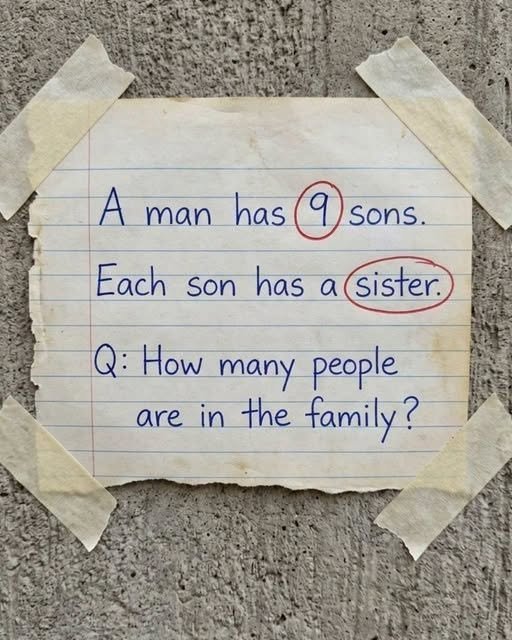
“A man has 9 sons. Each son has a sister. How many people are in the family?”
At first glance, many people quickly start adding numbers:
- 1 father
- 9 sons
- 9 sisters
That gives an answer of 19 people.
But is that really what the riddle says?
The answer depends on one small detail that many people overlook.
The Hidden Trick in the Question
The important sentence is:
“Each son has a sister.”
It does not say:
“Each son has a different sister.”
The wording allows all nine sons to have the same sister.
Think about a normal family. If parents have nine boys and one girl, every boy can truthfully say:
“I have a sister.”
They all share the same sibling.
So the family consists of:
- The father: 1 person
- Nine sons: 9 people
- One daughter: 1 person
Total: 11 people
Why People Get the Answer Wrong
This riddle works because our brains often make assumptions without checking the exact wording.
When we hear:
“Each son has a sister,”
we may imagine:
- Son 1 → Sister 1
- Son 2 → Sister 2
- Son 3 → Sister 3
and so on.
But the sentence never creates nine separate sisters.
This is a great example of how language can influence our thinking.
The Power of Careful Reading
Many everyday mistakes happen because people respond to what they expect to hear rather than what is actually written.
This applies to:
- Contracts
- Instructions
- News headlines
- Exam questions
- Workplace communication
A small word can completely change meaning.
Words like:
- Each
- Every
- Only
- At least
- Exactly
often require extra attention.
A Lesson From a Simple Riddle
The answer is not difficult because of mathematics.
There is no complicated calculation.
The challenge is understanding the structure of the sentence.
Good problem-solving requires:
- Reading carefully
- Questioning assumptions
- Looking for hidden details
- Avoiding rushed conclusions
Sometimes the biggest obstacle is not the problem itself—it is the way we approach it.
Similar Brain Teasers That Test Your Thinking
Riddle 1
A farmer has 17 sheep. All but 9 run away. How many sheep are left?
Answer: 9 sheep.
The phrase “all but 9” means 9 remained.
Riddle 2
You have three apples and take away two. How many apples do you have?
Answer: Two apples.
The question asks how many you have taken, not how many remain.
Riddle 3
A doctor gives you three pills and tells you to take one every 30 minutes. How long will they last?
Answer: One hour.
You take the first immediately, the second after 30 minutes, and the third after 60 minutes.
Why Brain Teasers Are Good for the Mind
Puzzles and riddles encourage mental flexibility.
They help improve:
- Logical reasoning
- Attention to detail
- Creative thinking
- Problem-solving skills
For children, puzzles can support learning skills. For adults, they provide a fun way to challenge thinking patterns.
Even simple riddles remind us that slowing down and analyzing information can lead to better decisions.
Frequently Asked Questions
Is the answer always 11 people?
Yes, based on the usual interpretation of the riddle: one father, nine sons, and one shared sister.
Could the family have more people?
Technically yes. The riddle only tells us about the father and children mentioned. There could also be a mother or other family members, but they are not included in the information given.
Why is this riddle considered tricky?
Because people often assume each son has a different sister, even though the wording does not say that.
What skill does this puzzle test?
It tests careful reading and logical interpretation rather than math ability.
Final Thoughts
The answer to this family riddle is simple:
11 people.
But the reason it is memorable is the lesson behind it. A single assumption can completely change an answer.
The next time you face a tricky question, take a moment to look beyond your first impression. Sometimes the solution is hidden not in complicated details, but in the exact meaning of the words.
Nine sons do not automatically mean nine sisters. Careful reading reveals that the entire family can be just 11 people.