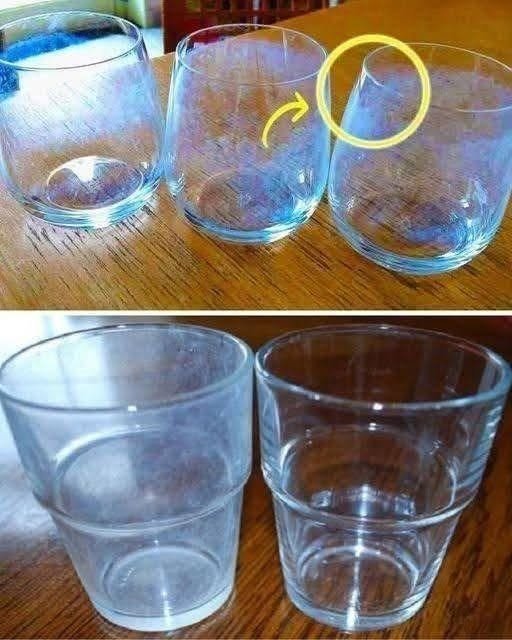
How to Remove White Patina From Glasses and Make Them Sparkle With a Brilliant Trick
Cloudy glasses covered in white buildup? Learn how to remove hard-water residue safely and make drinking glasses look sparkling clean again.
Introduction
Have you ever taken a glass out of the dishwasher, held it up to the light, and noticed a stubborn white, cloudy coating covering the surface?
You wash it again.
Nothing changes.
You try more dish soap.
Still cloudy.
You may even wonder whether the glass has simply become old and permanently dull.
Before throwing it away, try one simple approach.
That white “patina” is often mineral buildup caused by hard water, particularly calcium deposits. Fortunately, if the glass is still structurally sound and the problem is surface residue, an acidic household cleaner can often dissolve the buildup and restore much of the glass’s shine.
But there’s an important catch:
Not every cloudy glass can be restored.
Sometimes the surface has been permanently etched, especially after repeated dishwasher cycles. In that case, cleaning may improve the appearance, but it won’t completely reverse the damage.
Here’s how to tell the difference—and how to give your glasses their best chance of sparkling again.
Why Do Glasses Develop a White Patina?
The cloudy white layer you see is often caused by minerals in water.
Hard water contains dissolved minerals, particularly calcium and magnesium.
When water evaporates from a glass, some of those minerals can remain behind.
Over time, repeated washing can create a noticeable film.
The result can look like:
- White spots
- A chalky coating
- Cloudiness
- Hazy patches
- A dull appearance
- A rough-looking surface
This is particularly noticeable on clear drinking glasses.
Is It Dirt or Permanent Damage?
This is the first thing you should determine.
There are two common possibilities.
1. Mineral buildup
This is the good news.
If minerals are sitting on the surface, they can often be dissolved with an acidic solution.
2. Glass etching
This is more difficult.
Repeated exposure to harsh dishwasher detergents, high temperatures, soft-water conditions, or other factors can damage the glass surface.
The glass itself becomes microscopically rough or etched.
When that happens, the cloudy appearance isn’t simply sitting on top of the glass.
The surface has changed.
No household cleaning trick can reliably turn etched glass back into brand-new glass.
The Simple Test Before You Start
Before trying to remove the white coating, inspect the glass carefully.
Run your fingers over the surface.
If it feels reasonably smooth but looks cloudy, mineral residue is a possibility.
You can also try cleaning a small area first.
If the cloudy coating becomes noticeably clearer, you’re probably dealing with removable buildup.
If nothing changes at all, even after a suitable descaling treatment, the glass may be etched.
The Brilliant Trick: Use White Vinegar
One of the simplest ways to tackle mineral deposits is white vinegar.
Why?
Vinegar contains acetic acid, which can help dissolve mineral deposits such as calcium carbonate.
You don’t need an expensive specialist product for ordinary mineral buildup.
What you’ll need
- White distilled vinegar
- Warm water
- A soft sponge or microfiber cloth
- A clean towel
- A bowl or container large enough for the glass
Avoid abrasive scouring pads.
Glass can scratch, and scratches can make an already cloudy glass look even worse.
Step-by-Step: How to Remove the White Buildup
Step 1: Rinse the Glass
Start by rinsing the glass with warm water.
This removes loose residue and any remaining food or drink particles.
There’s no need to scrub aggressively.
Step 2: Prepare a Vinegar Solution
For a straightforward cleaning solution, mix:
Equal parts white vinegar and warm water.
For example:
1 cup white vinegar + 1 cup warm water
You can adjust the amount depending on how many glasses you’re cleaning.
You don’t need to make an enormous quantity.
Step 3: Soak the Glass
Place the cloudy glass in the solution.
Let it soak for approximately 15–30 minutes.
For stubborn mineral deposits, a longer soaking period may help.
However, there’s no advantage to aggressively soaking delicate or decorative glassware for excessive periods.
Step 4: Gently Wipe the Surface
Remove the glass and use a soft sponge or microfiber cloth to gently wipe the cloudy areas.
Don’t use steel wool or a rough abrasive pad.
The goal is to remove dissolved mineral residue—not scratch the glass.
Step 5: Rinse Thoroughly
Rinse the glass with clean water.
This removes the vinegar and loosened mineral residue.
Step 6: Dry Immediately
Here’s a surprisingly important step.
Dry the glass thoroughly with a clean, lint-free towel.
If you simply leave it to air-dry in a hard-water area, new mineral spots can form as the remaining water evaporates.
For maximum shine, polish gently with a microfiber cloth.
The Sparkle Test
Hold the glass under a bright light.
Turn it slowly.
Look for:
- Remaining white spots
- Hazy areas
- Streaks
- Water marks
If the glass now looks clear and reflective, you’ve likely removed the surface buildup.
If the cloudiness remains exactly the same, you may be dealing with etching rather than residue.
What If Vinegar Doesn’t Work?
Don’t immediately assume the glass is ruined.
There are several possibilities.
The deposits may be particularly stubborn
You may need a dedicated limescale or mineral-deposit cleaner that is specifically labeled as suitable for glass.
Follow the product instructions carefully.
The glass may be etched
If repeated descaling attempts make little or no difference, permanent surface damage becomes more likely.
The cloudiness may be caused by something else
Not every white mark is hard-water buildup.
The residue could come from:
- Dishwasher detergent
- Food residue
- Incorrect washing conditions
- Grease
- Mineral deposits
- Surface etching
Identifying the cause is more useful than simply using stronger and stronger cleaners.
A Word of Caution About Baking Soda
You may see advice online recommending baking soda for cloudy glasses.
Baking soda can be useful for many household cleaning jobs, but it is mildly abrasive.
For delicate glassware, aggressive rubbing with abrasive powders isn’t necessarily the best approach.
If your problem is mineral scale, start with an acidic cleaner such as diluted white vinegar rather than trying to scrub the coating away.
Dissolve the deposit instead of grinding it off.
Never Mix Vinegar With Bleach
This is important.
Never mix vinegar with chlorine bleach or products containing bleach.
The combination can produce dangerous chlorine gas.
Use cleaning products separately and follow their labels.
Also avoid mixing household cleaning chemicals simply because an online cleaning tip recommends combining them.
When in doubt, keep it simple.
What About Lemon Juice?
Lemon juice is also acidic and can help with some mineral deposits.
However, for a large batch of cloudy glasses, white vinegar is generally more practical because it’s inexpensive and readily available.
If you prefer a more pleasant scent, lemon-based cleaning products designed for the surface can be an alternative.
Why Dishwashers Can Make Glasses Cloudy
If your glasses repeatedly become cloudy after dishwasher cycles, the problem may not be the glasses themselves.
Your dishwasher conditions can contribute.
Potential factors include:
- Hard water
- Excessive detergent
- Water temperature
- Long wash cycles
- Poor rinsing
- Incorrect detergent dosage
- Water-softener settings
- Repeated exposure to harsh cleaning conditions
That’s why simply cleaning the glasses once may not solve the problem permanently.
You also need to address why the deposits keep appearing.
How to Prevent the White Patina From Coming Back
Once your glasses are clean, prevention becomes the next goal.
1. Check Your Water Hardness
If your home has hard water, mineral deposits can return quickly.
Your local water supplier may publish information about water hardness, or you can use an appropriate home water-hardness test.
2. Don’t Automatically Use More Dishwasher Detergent
More detergent isn’t necessarily better.
Follow the detergent manufacturer’s instructions and consider your water hardness and dishwasher settings.
Using excessive detergent can contribute to residue and may not improve cleaning.
3. Use the Correct Dishwasher Settings
Modern dishwashers are designed to work with specific detergent and rinse-aid systems.
Check your owner’s manual.
If your dishwasher has a water-softening system, make sure it is configured correctly for your water conditions.
4. Consider Rinse Aid
Rinse aid can help water drain from glass surfaces more effectively, potentially reducing water spots.
Follow the dishwasher manufacturer’s recommendations for use.
5. Remove Glasses Promptly
Leaving wet glasses sitting for long periods gives water more time to evaporate and leave minerals behind.
If practical, unload them once the cycle is complete.
The Mistake That Can Make Cloudy Glasses Worse
One of the biggest mistakes is scrubbing harder.
When people see a stubborn white coating, they naturally assume it needs more force.
But if you’re dealing with mineral deposits, excessive scrubbing isn’t the solution.
And if the glass is already etched, abrasive scrubbing can potentially make the surface look worse.
Think of the problem this way:
Mineral buildup?
Dissolve it.
Etched glass?
You may not be able to reverse it.
Knowing which problem you’re dealing with saves time and prevents unnecessary damage.
Can Toothpaste Make Glasses Sparkle?
You’ll find plenty of internet cleaning hacks recommending toothpaste for glass.
It’s worth being cautious.
Many toothpastes contain mild abrasives intended to polish teeth.
That doesn’t mean they’re ideal for drinking glasses.
Using abrasive products repeatedly can create microscopic scratches, especially on delicate surfaces.
For mineral buildup, an appropriate acidic cleaner is a more logical first step.
Can You Put Vinegar in the Dishwasher?
This is where it’s better not to generalize.
Although vinegar is commonly used as a household cleaning substance, routinely adding acidic products directly to a dishwasher isn’t necessarily recommended by every manufacturer.
Acids may interact with certain seals, components, or materials over repeated use.
If you’re dealing with cloudy glasses, cleaning the glass separately is the safer, simpler approach unless your dishwasher manufacturer specifically recommends otherwise.
When Should You Stop Trying to Clean the Glass?
Sometimes the best answer is to replace it.
If you’ve carefully removed mineral deposits and the glass remains permanently cloudy, it may be etched.
Look at the glass in bright light.
If the haze appears to be part of the glass rather than a removable coating, additional scrubbing is unlikely to solve the problem.
At that point, replacing inexpensive everyday glasses may make more sense than repeatedly trying increasingly aggressive cleaning methods.
For valuable, antique, handmade, or sentimental glassware, consider consulting a professional rather than experimenting with harsh cleaners.
Quick Before-and-After Checklist
Before cleaning:
☐ Identify the cloudy areas
☐ Check whether the surface feels smooth
☐ Rinse the glass
☐ Avoid abrasive materials
During cleaning:
☐ Use diluted white vinegar
☐ Allow time for the acid to dissolve deposits
☐ Wipe gently
☐ Rinse thoroughly
After cleaning:
☐ Dry immediately
☐ Inspect under bright light
☐ Check your dishwasher and water conditions
☐ Avoid excessive detergent
Frequently Asked Questions
Why are my glasses covered in a white film?
The white film is often caused by minerals left behind when hard water evaporates. Dishwasher detergent residue and permanent glass etching can also cause cloudiness.
Can white vinegar remove cloudy glass?
Vinegar can help dissolve many mineral deposits because it contains acetic acid. It won’t reverse permanent glass etching.
How long should I soak cloudy glasses in vinegar?
A short soak of around 15–30 minutes is a reasonable starting point for mineral buildup. More stubborn deposits may require additional treatment, depending on the glass and cleaning method.
Can cloudy glasses be restored?
If the cloudiness is caused by removable mineral deposits, often yes. If the glass has been chemically etched, complete restoration may not be possible.
Why do my glasses become cloudy in the dishwasher?
Hard water, detergent residue, high temperatures, and repeated dishwasher exposure can contribute to cloudy glassware.
Does baking soda remove white deposits from glass?
Baking soda may help with some cleaning tasks, but it is mildly abrasive. For mineral deposits on delicate glass, dissolving the deposits with an appropriate acidic cleaner is generally preferable to aggressive scrubbing.
Can I use lemon instead of vinegar?
Acidic lemon juice can help with some mineral deposits, although white vinegar is often more practical for soaking multiple glasses.
How can I prevent cloudy glasses?
Address the underlying cause. Check water hardness, use the recommended amount of dishwasher detergent, consider rinse aid if appropriate, and follow your dishwasher manufacturer’s settings and maintenance recommendations.
Is cloudy glass dangerous?
Cloudiness itself doesn’t necessarily mean the glass is unsafe. However, damaged, cracked, chipped, or structurally compromised glassware should be replaced rather than aggressively cleaned.
That ugly white coating on your favorite glasses doesn’t necessarily mean they’re destined for the recycling bin.
If the problem is hard-water mineral buildup, a simple white-vinegar soak can often loosen and dissolve the deposits.
The key is to soak rather than aggressively scrub.
But don’t expect miracles from a glass that has already been permanently etched.
The best approach is:
Identify the buildup → soak with diluted vinegar → gently wipe → rinse → dry thoroughly → prevent future deposits.
And if your glasses repeatedly become cloudy, don’t just keep cleaning them.
Find the cause.
Check your water hardness, review your dishwasher settings, use the recommended amount of detergent, and consider whether rinse aid is appropriate.
A little prevention can save you from constantly fighting those stubborn white marks.
One last tip:
Before throwing away cloudy glasses, give one of them the vinegar test.
If the haze disappears, you’ve probably found your culprit.
If it doesn’t, the glass may have been permanently etched—and you’ll know it’s time to stop scrubbing and consider replacing it.
A few minutes of gentle cleaning could be all it takes to turn a dull-looking glass back into one that catches the light beautifully. ✨