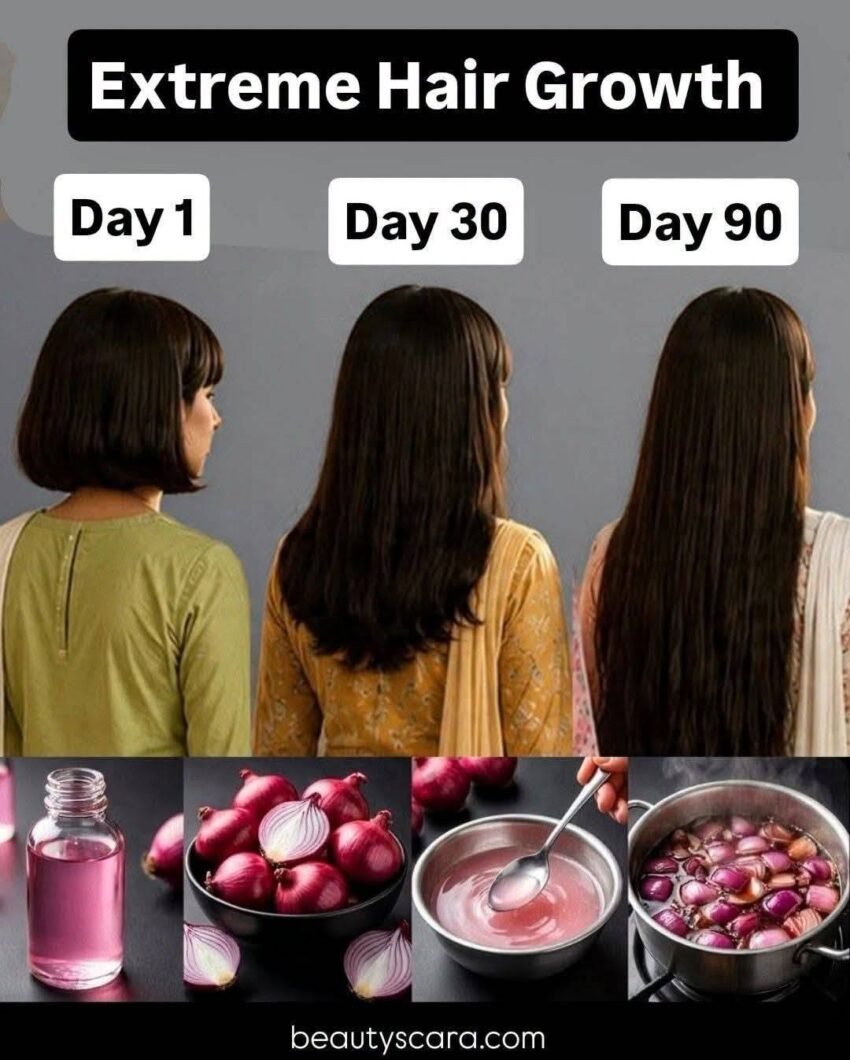
Onion Juice & Onion Hair Oil for Hair Growth: 7 Benefits, the Right Way to Use Them, and What Science Really Says
Discover how onion juice and onion hair oil may support scalp and hair health, how to use them safely, what science says, and when to choose proven treatments.
If you’ve ever watched more hair collect in your shower drain than you expected, you know how quickly a small concern can become an obsession.
You start counting strands. You change your part. You search for “natural hair growth remedies” late at night—and eventually, you find onion juice.
It sounds almost too simple. Blend an onion, squeeze out the juice, put it on your scalp, wait, rinse, and hope.
But there’s a catch: onion juice is one of those hair remedies where the internet has moved faster than the science.
There is legitimate research behind the idea, but it is much narrower than many beauty articles suggest. A small clinical study found promising results for patchy alopecia areata, a specific type of hair loss—not every form of thinning hair. And there is a major difference between fresh onion juice and a commercially formulated “onion hair oil.”
So, should you try it?
Possibly. But the smartest approach is not to treat onion as a miracle cure. It is to understand what onion can realistically do, how to use it without irritating your scalp, and when hair loss deserves a proper diagnosis instead of another DIY treatment.
This guide walks through all three.
What Is Onion Juice for Hair?
Onion juice is simply the liquid extracted from raw onion, usually yellow, white, or red onion, and applied directly to the scalp.
The reason it became popular for hair care is partly nutritional and partly traditional. Onions contain sulfur-containing compounds and various plant compounds, including flavonoids. But the presence of a compound in onion does not automatically mean that rubbing onion on your scalp will produce dramatic hair growth.
That distinction matters.
The strongest human evidence often cited for onion juice comes from a 2002 clinical study involving people with patchy alopecia areata. In that study, 23 participants applied crude onion juice twice daily for two months, while 15 people in the comparison group used tap water. The researchers reported substantially more hair regrowth in the onion-juice group.
That sounds impressive until you look at the details.
The study was small. It focused on a specific autoimmune form of hair loss. It was not a large modern trial demonstrating that onion juice works for male-pattern hair loss, female-pattern hair loss, ordinary shedding, or genetically determined thinning.
In other words, the evidence is interesting—but not broad enough to justify calling onion juice a proven universal hair-growth treatment.
That is probably the most useful thing to know before you begin.
What Are the Potential Benefits of Onion for Hair?
The potential benefits of onion for hair are best divided into two categories: possible scalp-related benefits and cosmetic hair-care benefits.
They are not the same thing.
1. It may support a healthier scalp environment
A healthy scalp provides the foundation for healthy hair. Onion contains sulfur-containing compounds and antioxidants, which is one reason it has attracted interest in traditional hair-care practices.
However, “contains antioxidants” should not be translated into “guarantees new hair growth.”
Your scalp is not a garden where adding one ingredient automatically makes follicles grow faster.
Hair follicles operate through a complex biological cycle influenced by genetics, hormones, inflammation, nutrition, medications, age, and other factors.
Onion may be an interesting addition to a hair-care routine, but it cannot override those factors.
2. Onion juice has limited clinical evidence for patchy alopecia areata
This is where the science gets genuinely interesting.
In the 2002 study, researchers compared crude onion juice with tap water in people with patchy alopecia areata. Hair regrowth became apparent earlier in the onion-juice group, and the researchers reported significantly greater regrowth than in the control group.
But there is a crucial limitation: one small study is not the same as a universally established treatment.
Alopecia areata is different from androgenetic, or pattern, hair loss. It is an immune-mediated condition in which the immune system attacks hair follicles.
That means someone with a widening part caused by female-pattern hair loss should not assume onion juice will work simply because a study involving alopecia areata produced encouraging results.
The American Academy of Dermatology emphasizes that hair loss has many causes and that identifying the cause is central to choosing effective treatment.
3. It may make a hair-care routine feel more nourishing
This is a softer claim, but a practical one.
If you use an onion-based oil blended with a suitable carrier oil, the oil itself may make the hair feel softer, smoother, or less dry.
That is not necessarily evidence of faster follicle growth.
It may simply mean the hair shaft has been lubricated.
And honestly, that distinction can save you from a lot of disappointment.
Hair that looks fuller because it has less frizz and breakage is different from hair that has produced more follicles.
4. Scalp massage may be part of the experience
Many onion hair-oil routines include several minutes of gentle scalp massage.
The massage itself can make the routine feel relaxing and may help distribute the oil evenly. But don’t confuse a pleasant massage with proof that the oil is stimulating dormant follicles.
There is nothing wrong with enjoying the ritual. Just keep the claims realistic.
5. It can encourage consistency with hair care
This sounds less exciting, but consistency often matters more than novelty.
Someone who creates a simple routine—gentle cleansing, conditioning, reduced heat damage, careful detangling, and occasional scalp care—may see better overall hair quality than someone who constantly jumps between aggressive treatments.
Onion can be one small part of that routine if your scalp tolerates it.
Onion Juice vs. Onion Hair Oil: Which Is Better?
This is one of the biggest points of confusion.
Onion juice and onion hair oil are not interchangeable.
| Feature | Onion Juice | Onion Hair Oil |
|---|---|---|
| Main ingredient | Fresh onion extract | Oil infused or formulated with onion-derived ingredients |
| Texture | Watery | Oily |
| Scalp feel | Can feel strong or irritating | Usually more conditioning |
| Smell | Strong | Varies by formulation |
| Evidence for hair regrowth | Limited, including one small alopecia areata study | Much less direct human evidence |
| Best suited for | Short-contact scalp application | Scalp/hair conditioning routine |
| Main drawback | Irritation and odor | Heavy buildup or irritation from fragrance/ingredients |
If your primary goal is to reproduce the preparation used in the well-known clinical study, fresh crude onion juice is closer to what was actually investigated.
If your goal is hair conditioning and a more convenient routine, onion hair oil may be easier to tolerate.
But commercially packaged onion oils should not inherit the clinical claims of onion juice automatically.
A product containing “onion extract” is not necessarily equivalent to fresh onion juice. Concentration, extraction method, carrier oils, preservatives, fragrances, and other ingredients can all differ.
How to Make Onion Juice for Hair
If you want to try fresh onion juice, keep the process simple.
What you need
- 1 small fresh onion
- A clean blender or grater
- A fine strainer or clean cloth
- A small clean container
- Cotton pads or clean fingertips
Step 1: Prepare the onion
Peel and wash the onion.
Cut it into smaller pieces.
Step 2: Extract the juice
Blend or grate the onion until you have a pulp.
Place the pulp in a clean strainer or cloth and squeeze out the liquid.
You only need enough for one application.
Step 3: Patch test first
This step is easy to skip—and is one of the worst steps to skip.
Apply a small amount to a limited area of skin and wait to see whether significant redness, burning, swelling, itching, or another reaction develops.
If your skin reacts, don’t put it all over your scalp.
People can react to cosmetic and topical ingredients, and the FDA has documented adverse reactions associated with some hair-care products, including itching, rash, breakage, and hair loss.
Step 4: Apply sparingly
Use your fingertips or a cotton pad to apply the juice to the scalp rather than soaking the entire length of your hair.
The objective is scalp application, not creating an onion marinade.
Step 5: Avoid broken or irritated skin
Do not apply onion juice to a scratched, sunburned, inflamed, or otherwise damaged scalp.
The fact that something is “natural” does not make irritated skin immune to irritation.
Step 6: Rinse thoroughly
After the contact period, wash your scalp and hair thoroughly with a gentle shampoo.
You may need a second wash if the smell lingers.
And yes, onion smell can be remarkably persistent.
How Often Should You Use Onion Juice?
There is no universally established modern dosing schedule for onion juice as a general hair-growth treatment.
The frequently cited clinical study used crude onion juice twice daily for two months, but that study involved patchy alopecia areata under research conditions.
That does not mean twice-daily application is appropriate for everyone.
For someone experimenting with onion juice as a cosmetic scalp treatment, a more conservative approach is sensible: begin with infrequent use, monitor your scalp, and stop if irritation develops.
More is not automatically better.
If your scalp becomes red, painfully dry, intensely itchy, swollen, or develops a rash, discontinue the treatment rather than trying to “push through” the reaction.
How to Use Onion Hair Oil for Hair Growth
Onion hair oil is generally easier to incorporate into a routine because it behaves like other scalp oils.
A simple method
- Start with a small amount of onion hair oil.
- Apply it to the scalp in sections.
- Massage gently with your fingertips for a few minutes.
- Leave it on for a short period according to the product’s directions.
- Shampoo thoroughly.
- Condition the lengths and ends if needed.
- Monitor your scalp for irritation or buildup.
Avoid aggressive scratching or vigorous massage.
If your hair is already fragile, pulling and friction can work against your goal. The AAD recommends gentle hair care for people experiencing hair loss because thinning hair can be particularly vulnerable to damage and breakage.
Should You Leave Onion Oil Overnight?
Not necessarily.
The idea that an oil must remain on your scalp overnight to “work” is largely a beauty-routine convention rather than a universal scientific rule.
If your scalp tolerates overnight oiling and the product specifically recommends it, you may prefer that routine.
But if you develop itching, greasy buildup, scalp bumps, or irritation, leaving oil on longer is not going to solve the problem.
Shorter contact time may simply be more comfortable.
And if you have seborrheic dermatitis, scalp psoriasis, folliculitis, or another scalp condition, adding heavy oils can sometimes make your routine more complicated rather than better.
Onion Juice for Hair Growth: What Does the Science Actually Say?
This is where responsible hair advice needs to slow down.
The most frequently cited evidence is the 2002 Journal of Dermatology study. The researchers divided 38 people with patchy alopecia areata into an onion-juice group and a tap-water control group. The onion group applied crude onion juice twice a day for two months. The study reported significantly greater hair regrowth in the onion group.
That is a legitimate research finding.
But it does not establish that onion juice:
- reverses male-pattern baldness,
- treats female-pattern hair loss,
- prevents genetic hair loss,
- regrows hair after scarring alopecia,
- replaces minoxidil,
- reverses nutritional deficiencies,
- fixes thyroid-related hair loss,
- or works for everyone experiencing shedding.
That leap is where many online articles go wrong.
The American Academy of Dermatology notes that hair loss can result from hereditary factors, medical conditions, physical or psychological stress, childbirth, medications, and other causes.
The treatment therefore has to match the cause.
Onion Juice and Pattern Hair Loss: A Reality Check
Suppose you’re a 35-year-old man whose temples have gradually receded over several years.
Or you’re a woman who has noticed that her center part is becoming wider.
Those patterns are different from suddenly developing a few smooth bald patches.
If your hair loss follows a classic hereditary pattern, onion juice should not be your only strategy.
The AAD identifies minoxidil as an evidence-based option for several forms of hereditary hair loss and emphasizes early evaluation and treatment.
That doesn’t mean you can’t use onion oil as a cosmetic scalp-care product.
It means you shouldn’t let a home remedy delay a diagnosis.
That distinction can matter enormously.
A Practical 8-Week Onion Hair Routine
If you’re determined to test onion as part of your routine, use a structured experiment rather than changing five things at once.
Weeks 1–2: Establish tolerance
Start conservatively.
Patch test first.
Use a small scalp area before expanding the application.
Take baseline photographs under similar lighting.
Don’t judge progress from memory. Hair looks dramatically different depending on lighting, angle, humidity, and styling.
Weeks 3–4: Build consistency
If your scalp is comfortable, continue your chosen routine consistently.
Keep shampooing and conditioning normally.
Avoid introducing another new growth serum at the same time.
Otherwise, you won’t know what caused an improvement—or an irritation.
Weeks 5–6: Check the scalp, not just the mirror
Look for:
- increased redness,
- flaking,
- itching,
- tenderness,
- new irritation,
- excessive oil buildup,
- increased breakage.
Also examine whether your shedding pattern has changed.
Weeks 7–8: Review objectively
Take another set of photographs.
Compare them with the baseline.
Ask:
- Does the hair look denser?
- Are there fewer broken hairs?
- Has shedding changed?
- Is the scalp healthier?
- Did irritation develop?
- Am I actually seeing new growth, or simply better styling?
This approach is far more reliable than checking your hairline every morning.
Real-World Scenario: When Onion Oil Makes Sense
Imagine Sarah, a 29-year-old in Chicago.
Her hair isn’t disappearing in bald patches. Instead, she has dry ends, frequent heat styling, and noticeable breakage around the front.
She starts using an onion hair oil twice a week, but she also makes two other changes: she reduces high-heat styling and starts using conditioner consistently.
Three months later, her hair looks fuller.
Did onion oil grow new follicles?
Not necessarily.
The improvement could largely reflect less breakage and better hair-shaft conditioning.
That is still a useful result.
Now imagine another person with a rapidly widening part, significant shedding, and a family history of pattern hair loss. Spending six months experimenting exclusively with onion juice could delay an evaluation that might identify a treatable cause.
Same home remedy.
Completely different situation.
Pros and Cons of Onion Juice and Onion Hair Oil
Potential pros
- Inexpensive
- Easy to prepare
- Fits a simple home-care routine
- Has limited clinical evidence worth investigating
- May provide a satisfying scalp-care ritual
- Onion oil can condition hair and reduce the feeling of dryness
Potential cons
- Strong odor
- Possible scalp irritation
- Evidence is limited
- One small study cannot establish universal effectiveness
- Commercial onion oils vary significantly
- May create buildup on some scalps
- Can distract from diagnosing the actual cause of hair loss
- It is not a proven replacement for established medical treatments
The honest verdict?
Onion is interesting. It is not magic.
Common Mistakes—and What to Do Instead
Mistake 1: Leaving onion juice on for hours
Longer exposure does not automatically mean better results.
Better: Start cautiously and rinse if your scalp becomes uncomfortable.
Mistake 2: Applying it every day because “natural” means safe
Your scalp is skin.
Repeated exposure to an irritating ingredient can cause problems even if the ingredient comes straight from your kitchen.
Better: Build tolerance gradually and stop if irritation appears.
Mistake 3: Expecting instant growth
Hair grows slowly.
Visible changes require time, and the timeline depends heavily on the cause of hair loss.
Better: Use standardized photos and evaluate trends rather than daily changes.
Mistake 4: Assuming onion oil and onion juice are scientifically equivalent
They’re not.
Better: Separate the evidence for fresh onion juice from claims made about commercial onion-oil formulas.
Mistake 5: Treating all hair loss as the same condition
A receding hairline, diffuse shedding, broken hair, and smooth bald patches can have completely different causes.
Better: Identify the pattern before deciding on treatment.
Mistake 6: Ignoring scalp symptoms
Pain, severe itching, scaling, inflammation, pustules, or rapidly progressing hair loss deserve more attention than a DIY oil routine.
Better: Get professional evaluation when symptoms are persistent or unusual.
Expert Insight: Your Hair Shaft and Your Hair Follicle Are Different Problems
This is one of the most useful distinctions in hair care.
The hair shaft is the visible strand.
The follicle is the living structure beneath the scalp that produces it.
An oil can make the hair shaft feel smoother and reduce friction. Conditioning can improve manageability. Less heat and mechanical damage can reduce breakage.
But none of those automatically means a dormant or miniaturized follicle has been restored.
This is why a person can say, honestly, “My hair looks better since I started oiling,” without proving that the oil caused new follicular growth.
Both things can be true.
What About Onion Water?
Onion water has also become popular as a lighter alternative to onion juice.
Typically, onions are soaked or boiled in water and the resulting liquid is used as a rinse.
The appeal is obvious: less mess, less oil, and potentially less intense application.
But the same evidence problem remains.
A popular preparation is not automatically a clinically validated treatment.
If you enjoy onion water as a rinse and your scalp tolerates it, there is little reason to treat it as forbidden. Just keep expectations realistic.
What About Red Onion?
Red onions contain various plant pigments and antioxidant compounds, which has helped fuel claims that they are superior for hair growth.
But there is not strong clinical evidence establishing that red onion is dramatically better than yellow or white onion for human hair regrowth.
Choose based on availability and tolerance rather than assuming color determines effectiveness.
Can Onion Juice Stop Hair Fall?
Not reliably for all types of hair loss.
That answer may be less exciting than “yes,” but it is far more useful.
Hair shedding can happen for many reasons. The AAD notes that temporary shedding can occur after major physical stressors such as illness, high fever, surgery, childbirth, or chemotherapy, while hereditary hair loss is another common cause.
If the underlying problem is iron deficiency, thyroid disease, hormonal change, medication-related shedding, traction, autoimmune disease, or hereditary pattern hair loss, onion juice does not address the underlying cause.
That is why persistent shedding deserves investigation.
When You Should See a Dermatologist
Consider professional evaluation if you notice:
- sudden or rapidly increasing hair loss,
- smooth bald patches,
- eyebrow or eyelash loss,
- scalp pain or burning,
- significant scaling or inflammation,
- pus-filled bumps,
- a rapidly receding hairline,
- widening of the part,
- substantial shedding that persists,
- hair loss after starting a medication,
- or hair loss accompanied by other unexplained symptoms.
Early evaluation can matter because some forms of hair loss become harder to reverse after follicles are significantly damaged or scarred. The AAD specifically emphasizes early diagnosis and treatment for several forms of hair loss.
Onion Juice vs. Proven Hair-Loss Treatments
If you’re dealing with diagnosed hereditary hair loss, don’t assume a natural remedy has to compete with medical treatment.
Sometimes the better approach is complementary rather than either/or.
For example, onion oil might be part of a cosmetic hair-care routine while a dermatologist-directed treatment addresses the actual cause.
Topical minoxidil is an established treatment option for several forms of hereditary hair loss, and the AAD identifies it as a commonly recommended treatment for female-pattern hair loss.
For other conditions, treatment can be very different.
Alopecia areata may require anti-inflammatory or immune-directed treatment. Scarring alopecias may require early intervention to prevent permanent follicular destruction. Traction alopecia requires reducing the damaging pulling force, and sometimes additional treatment is necessary.
The lesson is simple:
The best hair-growth treatment is the one that matches the reason your hair is thinning.
What Has Changed by 2026?
Hair care has become increasingly sophisticated, but the marketing has become sophisticated too.
You can now find products combining onion extract with rosemary, caffeine, peptides, botanical oils, vitamins, and other fashionable ingredients.
Some formulas may be excellent cosmetic products.
But a longer ingredient list does not automatically mean a stronger hair-growth effect.
In the United States, claims matter. The FDA explains that products marketed with claims to restore hair growth or affect the structure or function of the body may fall under drug regulations rather than being treated simply as cosmetics.
That is worth remembering when shopping online.
A product that says “supports healthy-looking hair” is making a very different claim from one promising to “reverse baldness.”
The latter deserves considerably more scrutiny.
The broader trend heading forward is likely to be more personalized hair-loss care, not one miracle ingredient for everyone.
Better diagnosis, imaging, individualized treatment plans, and increasingly targeted therapies are gradually changing how clinicians approach hair disorders.
That makes basic scalp care useful—but makes accurate diagnosis even more valuable.
A Safe Onion Hair Routine for Beginners
If you want the simplest possible version, use this framework:
Once you have patch-tested successfully:
- Start with a clean scalp.
- Apply a small amount of onion juice or onion hair oil.
- Massage gently rather than aggressively.
- Keep contact time reasonable.
- Rinse thoroughly.
- Use a gentle shampoo.
- Condition the hair lengths.
- Observe your scalp for irritation.
- Take monthly photographs rather than daily comparison photos.
- Reassess whether the routine is actually helping.
If irritation occurs, stop.
If hair loss continues to worsen, investigate the cause instead of simply increasing the frequency.
The Onion Hair Growth Action Checklist
What to do
- ☐ Patch test before widespread application
- ☐ Start with a conservative routine
- ☐ Apply primarily to the scalp
- ☐ Massage gently
- ☐ Wash thoroughly afterward
- ☐ Use conditioner to reduce breakage
- ☐ Take baseline photographs
- ☐ Track changes over several weeks
- ☐ Keep the rest of your hair routine gentle
- ☐ Investigate persistent or unusual hair loss
- ☐ Consider dermatologist evaluation when the pattern is concerning
What to avoid
- ☐ Don’t assume onion works for every type of hair loss
- ☐ Don’t apply it to broken or irritated skin
- ☐ Don’t keep increasing frequency because results are slow
- ☐ Don’t ignore burning, swelling, or severe itching
- ☐ Don’t confuse reduced breakage with follicle regrowth
- ☐ Don’t assume commercial onion oil has the same evidence as fresh onion juice
- ☐ Don’t replace prescribed treatment without discussing it with your clinician
- ☐ Don’t delay diagnosis when hair loss is sudden or progressing
Frequently Asked Questions
Does onion juice really grow hair?
There is limited human evidence suggesting onion juice may help hair regrowth in patchy alopecia areata, based primarily on a small 2002 clinical study. That evidence does not establish onion juice as a general treatment for all forms of hair loss.
How long should I leave onion juice on my scalp?
There is no universally established timing for general cosmetic use. The commonly cited clinical study used crude onion juice twice daily for two months, but that was a specific research protocol for patchy alopecia areata. For home use, start conservatively and rinse if irritation occurs.
Can I use onion juice every day?
You can physically apply it frequently, but that does not mean you should. More frequent application can increase the chance of irritation. If you experience burning, redness, itching, or a rash, stop using it.
Is onion oil better than onion juice?
They serve somewhat different purposes. Fresh onion juice is the preparation that has been directly studied in the frequently cited clinical trial. Onion hair oil may be more convenient and conditioning, but commercial formulations have not automatically inherited the evidence for fresh onion juice.
Can onion juice regrow a receding hairline?
There is not strong clinical evidence that onion juice reverses a typical hereditary receding hairline. Pattern hair loss has different biology and should be evaluated accordingly. Evidence-based options such as minoxidil may be appropriate for certain types of hereditary hair loss.
Can onion juice stop excessive shedding?
It depends on why the shedding is happening. Onion juice cannot be expected to correct every cause of shedding, especially when the trigger is medical, hormonal, nutritional, medication-related, or hereditary.
Can onion juice damage hair?
The larger concern is usually scalp irritation rather than the onion somehow “burning” the hair itself. Strong irritation, repeated washing, excessive rubbing, or harsh routines can contribute to a poor hair-care environment. Stop if your scalp reacts.
Should I use onion juice before or after shampooing?
Many people prefer applying it to a clean scalp and shampooing afterward because the smell can be strong. The important point is to avoid aggressive cleansing or scrubbing that leaves the scalp irritated.
Can I mix onion juice with coconut oil?
You can create a mixture, but combining ingredients makes it harder to determine what caused an improvement or reaction. If you’re testing onion for the first time, keeping the routine simple makes more sense.
When should I stop using onion juice?
Stop if you develop significant burning, swelling, rash, worsening itching, or other concerning symptoms. Also reconsider the routine if your hair loss continues to progress despite consistent care. Persistent or unusual hair loss deserves a diagnosis rather than endless experimentation.
A Final Word on Natural Hair Growth Remedies
The appeal of onion juice is easy to understand.
It is inexpensive. It is accessible. It doesn’t require a prescription. And unlike many complicated hair-growth routines, you can make it in your kitchen.
There is also a real scientific reason the remedy continues to attract attention: a small clinical study found encouraging regrowth among people with patchy alopecia areata.
But responsible hair care requires stopping there for a moment.
That study does not prove that onion juice can reverse every receding hairline, repair every thinning crown, or restore hair lost to every medical condition.
And that’s actually good news.
It means you don’t have to choose between blindly believing a home remedy and dismissing it completely.
You can try it thoughtfully.
You can patch test.
You can photograph your progress.
You can stop when your scalp tells you something isn’t right.
And most importantly, you can recognize when the problem is bigger than an oil bottle.
If you’re dealing with ordinary dryness or breakage, a gentle hair-care routine—including a conditioning oil if your scalp tolerates it—may be perfectly reasonable. If you’re dealing with progressive thinning or bald patches, finding the cause should move higher up your priority list.
Your hair deserves more than hype.
It deserves a strategy.
Onion juice is a promising but limited home remedy—not a proven cure for general hair loss. If you want to try it, use it cautiously, track your results, and don’t let a DIY routine replace proper evaluation when hair loss is persistent or progressing.
If this guide helped you separate useful hair-care advice from exaggerated claims, leave a comment, share it with someone dealing with hair thinning, and explore more evidence-based hair-care guides.