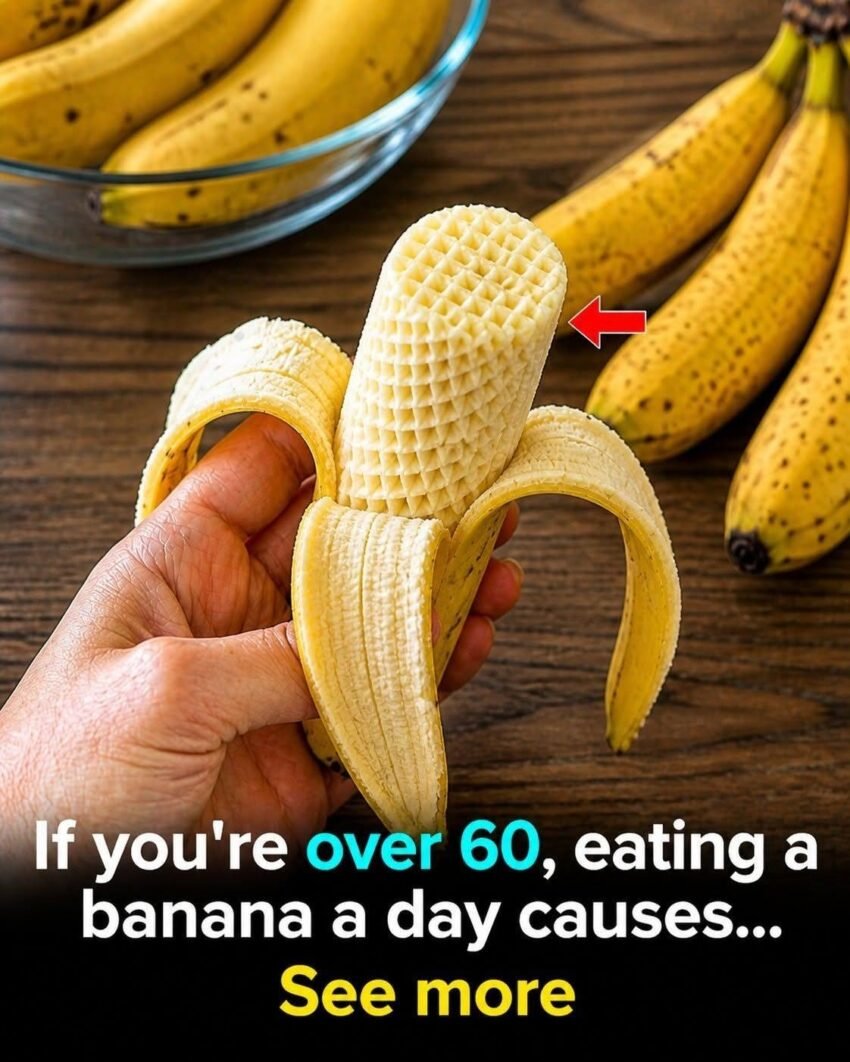
If You’re Over 60, Eating a Banana a Day May Offer These 7 Surprising Health Benefits
Over 60? Discover 7 evidence-based benefits of eating a banana daily, from potassium and fiber to heart, digestive, and bone health.
A banana looks almost too ordinary to deserve much attention.
It’s inexpensive, portable, naturally sweet, requires no preparation, and sits in fruit bowls across millions of American kitchens.
But after 60, the humble banana can be more useful than you might expect.
As we age, nutrition becomes less about chasing individual “superfoods” and more about consistently getting enough fiber, potassium, vitamins, minerals, and satisfying whole foods. Bananas can contribute to several of those goals.
That doesn’t mean a banana is a miracle food—or that everyone over 60 should eat one every day.
It means that a daily banana can be a practical addition to a balanced diet, particularly when it replaces a less nutritious snack.
And there’s an important distinction worth making from the beginning:
The benefit isn’t that bananas magically prevent disease. The benefit is what their nutrients can contribute to an overall healthy eating pattern.
Here are seven reasons a banana may deserve a regular place on your menu after 60, along with the situations in which you may want to be more careful.
1. Bananas provide potassium, an important nutrient for healthy blood pressure
Potassium becomes particularly interesting when we’re talking about heart health.
A medium banana provides roughly 422 milligrams of potassium, according to the U.S. Department of Agriculture’s FoodData Central database. (fdc.nal.usda.gov)
Potassium helps the body maintain normal cell function, nerve signaling, and muscle contraction. It also plays an important role in maintaining normal blood pressure.
The American Heart Association explains that potassium can help lessen the effects of sodium and may help lower blood pressure. It recommends getting potassium primarily through food for most people. (heart.org)
That doesn’t mean eating one banana will suddenly lower your blood pressure.
Think bigger.
If your usual snack is a highly processed food with little potassium and you replace it with fruit, you’ve made a small nutritional upgrade.
Do that consistently, while also eating vegetables, legumes, whole grains, nuts, and other potassium-rich foods, and the overall dietary pattern becomes more meaningful.
One important exception
People with certain kidney conditions may need to limit potassium.
The National Kidney Foundation notes that people with chronic kidney disease may need individualized potassium recommendations depending on their kidney function and blood levels. (kidney.org)
So “more potassium is always better” is not a safe rule for everyone.
2. The fiber can help keep your digestive system moving
Constipation becomes more common with age.
There are many possible reasons: reduced physical activity, changes in diet, medications, inadequate fluid intake, and certain medical conditions.
A banana can contribute fiber to the diet.
A medium banana contains about 3 grams of dietary fiber, according to USDA data. (fdc.nal.usda.gov)
Fiber helps add bulk to stool, while certain types of fiber can also support beneficial bacteria in the gut.
The key, however, is not to treat bananas as a laxative.
They aren’t.
If you’re consistently constipated, eating one banana while otherwise consuming very little fiber probably won’t solve the underlying problem.
Instead, look at your entire day:
- Fruit
- Vegetables
- Beans and lentils
- Whole grains
- Nuts and seeds
- Adequate fluids
- Regular movement
The National Institute on Aging recommends increasing fiber gradually and drinking enough fluids to help fiber work effectively. (nia.nih.gov)
3. Bananas can be an easy energy source
After 60, appetite can change.
Some people simply don’t feel as hungry as they once did.
Others have difficulty preparing elaborate meals.
Dental issues can also make certain foods harder to eat.
A banana solves several practical problems at once.
It’s:
- Soft
- Portable
- Easy to chew
- Naturally sweet
- Inexpensive
- Easy to add to breakfast
- Convenient between meals
A medium banana contains around 105 calories, along with carbohydrates that can provide readily available energy. (fdc.nal.usda.gov)
This can make a banana useful before a walk, as part of breakfast, or as an afternoon snack.
And there’s an underrated advantage here:
A nutritious food that you actually eat is more valuable than a theoretically perfect food that never makes it onto your plate.
Convenience matters.
4. It can make a better snack when paired with protein
Here’s where a banana becomes more useful than simply eating it alone.
Bananas contain carbohydrate but relatively little protein and fat.
That means some people may feel hungry again fairly quickly after eating one by itself.
The solution isn’t necessarily to stop eating bananas.
Instead, pair the banana with a source of protein or healthy fat.
Try:
Banana + plain Greek yogurt
Banana + a small handful of nuts
Banana + natural peanut butter
Banana + cottage cheese
Banana + oatmeal and walnuts
These combinations can be more filling and nutritionally complete than a banana alone.
For older adults, this matters because maintaining adequate protein intake becomes increasingly important for preserving muscle mass and physical function.
The National Institute on Aging emphasizes the importance of adequate protein and nutrient-dense foods as people age. (nia.nih.gov)
The banana supplies carbohydrate, fiber, and micronutrients.
The accompanying food fills some of the nutritional gaps.
5. Bananas contain vitamin B6
Bananas are a source of vitamin B6, a nutrient involved in numerous processes in the body, including protein metabolism and normal nervous-system and immune function.
A medium banana provides approximately 0.4 milligrams of vitamin B6, according to USDA data. (fdc.nal.usda.gov)
That isn’t enough to make bananas a standalone solution for every nutritional need.
But that’s not how nutrition works.
You don’t need one food to provide everything.
You need a varied diet in which different foods contribute different nutrients.
Bananas can be one small but useful piece of that puzzle.
6. Bananas may support a healthier overall diet
This benefit is easy to overlook because it’s not really about the banana itself.
It’s about what the banana replaces.
Imagine two afternoon snacks.
Option A
A banana with a small handful of unsalted almonds.
Option B
A large pastry and a sugar-sweetened beverage.
The difference isn’t simply “banana versus pastry.”
It’s the entire nutritional package.
The first option provides fruit, fiber, potassium, and healthy fats.
The second can provide substantially more added sugar, saturated fat, sodium, and calories depending on the foods and portions involved.
The CDC recommends emphasizing nutrient-dense foods, including fruits and vegetables, while limiting added sugars and highly processed foods as part of healthy eating. (cdc.gov)
So a banana’s value can come from what you choose instead of it.
7. It may be helpful for staying active
Aging well isn’t just about preventing disease.
It’s also about maintaining independence.
Walking to the store.
Climbing stairs.
Gardening.
Playing with grandchildren.
Traveling.
Getting up from a chair without struggling.
Those everyday activities require energy, muscle function, and adequate nutrition.
A banana provides carbohydrate that muscles can use for energy, along with potassium and other nutrients.
That makes it a convenient pre- or post-activity food.
But don’t make the mistake of thinking potassium from bananas alone prevents muscle cramps.
Muscle cramps can have numerous causes, and the evidence linking potassium supplementation or increased potassium intake to prevention of ordinary exercise-associated cramps isn’t straightforward.
If you’re experiencing frequent or severe cramps, it’s better to investigate the cause rather than simply eating more bananas.
The ripeness question: green, yellow, or spotted?
Here’s a fascinating detail.
A banana doesn’t have exactly the same carbohydrate profile throughout its ripening process.
As bananas ripen, some of their starch is converted into sugars.
Less-ripe bananas contain more resistant starch, while ripe bananas tend to taste sweeter because more starch has been converted to simpler sugars.
That means a greenish banana and a heavily spotted banana can produce somewhat different digestive experiences.
This doesn’t make one “good” and the other “bad.”
It simply means ripeness changes the food.
For people who monitor blood glucose, portion size and the rest of the meal matter more than obsessing over whether a banana has one brown spot.
Do bananas spike blood sugar?
They can raise blood glucose because bananas contain carbohydrates.
But that doesn’t make bananas unhealthy.
The size of the glucose response depends on factors including:
- Portion size
- Ripeness
- What else you eat
- Your individual metabolism
- Physical activity
- Whether you have diabetes
- Your medications
The American Diabetes Association includes fruit among foods that can fit into a diabetes-friendly eating pattern, while emphasizing awareness of carbohydrate intake and portions. (diabetes.org)
If you have diabetes, you don’t necessarily need to avoid bananas.
A smaller banana eaten with protein or alongside a balanced meal may work differently for you than a large, very ripe banana eaten alone.
Your own glucose readings, if you’re monitoring them, can provide useful individualized information.
What happens if you eat a banana every morning?
For many people, probably nothing dramatic.
And that’s actually a good thing.
You may simply have:
- A convenient breakfast addition
- A reliable source of potassium
- Some dietary fiber
- A source of vitamin B6
- A naturally sweet alternative to processed snacks
The most meaningful effects of a healthy diet often aren’t dramatic.
They accumulate.
One banana doesn’t transform your health.
But consistently choosing nutrient-dense foods over less nutritious alternatives can contribute to better dietary quality over time.
A better breakfast after 60
A common mistake is eating a banana as the entire breakfast.
A banana is nutritious.
It isn’t a complete meal.
If you’re hungry again an hour later, that’s not surprising.
Instead, combine it with protein, fiber, and other nutrient-rich foods.
For example:
Breakfast idea #1
Plain Greek yogurt + banana + walnuts + cinnamon
Breakfast idea #2
Oatmeal + sliced banana + chia seeds + peanut butter
Breakfast idea #3
Eggs + whole-grain toast + banana
Breakfast idea #4
Cottage cheese + banana + berries + a few nuts
The goal is not to make breakfast complicated.
It’s to give your body more than one nutrient category.
Could eating a banana every day help blood pressure?
Potentially as part of an overall potassium-rich diet.
But we need to be precise.
A banana isn’t a blood-pressure medication.
If you have hypertension, don’t stop taking prescribed medication because you’ve started eating fruit.
Instead, think of bananas as one component of a broader dietary pattern that includes vegetables, fruits, whole grains, legumes, nuts, seeds, and other nutrient-dense foods.
The DASH eating pattern, for example, emphasizes fruits and vegetables and is strongly supported for blood-pressure management. The National Heart, Lung, and Blood Institute identifies potassium-rich foods as part of the DASH approach. (nhlbi.nih.gov)
A banana can fit comfortably into that pattern.
Can bananas help your heart?
Indirectly, they can contribute to a heart-healthy diet.
Potassium is important for cardiovascular function, while replacing highly processed snacks with whole fruit can improve overall dietary quality.
But it’s important not to turn this into:
“Bananas prevent heart attacks.”
That’s not established.
Heart health depends on many factors, including:
- Blood pressure
- Cholesterol
- Smoking
- Physical activity
- Diabetes
- Body weight
- Diet
- Genetics
- Sleep
- Age
A banana is one small part of a much bigger picture.
What about bone health?
Bananas aren’t one of the major calcium-rich foods.
So if you’re eating them specifically for bone strength, don’t stop there.
Bone health depends on adequate calcium, vitamin D, protein, physical activity, and other factors.
Bananas can contribute nutrients to an overall healthy diet, but they aren’t a substitute for calcium-rich foods or appropriate vitamin D intake.
For older adults, maintaining bone health is particularly important because fractures can have a major impact on mobility and independence.
Think of bananas as supporting the broader diet—not carrying the entire job.
The potassium caveat older adults should know
This is perhaps the most important caution in the article.
Potassium is essential.
But more isn’t always better.
People with chronic kidney disease may not be able to remove potassium from the bloodstream efficiently. Certain medications can also raise potassium levels.
The National Kidney Foundation specifically advises people with kidney disease to work with a healthcare professional or dietitian to determine how much potassium they should consume. (kidney.org)
Medications that can affect potassium include certain ACE inhibitors, ARBs, potassium-sparing diuretics, and others.
So if you’re over 60 and taking several medications, don’t assume that eating large amounts of potassium-rich foods is automatically beneficial.
For most healthy people, a banana is simply a normal fruit.
For someone with impaired kidney function or specific medical conditions, dietary advice may need to be individualized.
What if you have diabetes?
A banana can still fit into many diabetes meal plans.
But portion size matters because bananas contain carbohydrates.
A useful strategy is to avoid thinking of fruit as “free food.”
It’s nutritious, but it still contributes carbohydrate.
Pairing fruit with protein or healthy fat may also make a snack more satisfying.
And if you’re taking insulin or medications that can cause low blood sugar, don’t make major carbohydrate changes without understanding how those changes affect your treatment.
The ADA recommends individualized diabetes nutrition rather than a single diet that everyone must follow. (diabetes.org)
Can bananas cause constipation?
This question comes up frequently.
The answer is: it depends.
Bananas contain fiber, but their effect on bowel movements can vary from person to person and may depend on ripeness, overall diet, fluid intake, and individual digestive patterns.
If you’re constipated, don’t automatically assume bananas are the solution.
Look at your total fiber intake and fluid intake.
And if constipation is persistent, severe, painful, or accompanied by blood in the stool, unexplained weight loss, vomiting, or a significant change in bowel habits, talk with a healthcare professional.
Can bananas help you lose weight?
Not by themselves.
No fruit automatically causes weight loss.
But bananas can fit into a weight-management diet because they’re relatively convenient, naturally sweet, and provide fiber and nutrients.
The key is what they contribute to your total calorie intake.
A banana replacing a candy bar may be useful.
A banana added on top of an already excessive calorie intake won’t magically produce weight loss.
That’s an important distinction.
Healthy foods still count toward total energy intake.
Common banana mistakes after 60
Mistake #1: Eating only a banana for breakfast
A banana provides useful nutrients, but it doesn’t provide enough protein for a complete meal.
Fix: Add Greek yogurt, eggs, cottage cheese, nuts, seeds, or another protein-rich food.
Mistake #2: Drinking banana smoothies loaded with extras
A smoothie can become a very calorie-dense drink when you add juice, sweetened yogurt, honey, syrup, and large quantities of nut butter.
Fix: Use whole banana, unsweetened dairy or fortified alternatives, and modest portions of add-ins.
Mistake #3: Assuming bananas are unlimited because they’re healthy
They still contain calories and carbohydrates.
Fix: Choose a portion that fits your nutritional needs.
Mistake #4: Ignoring kidney disease
High-potassium foods may need to be limited in some people with reduced kidney function.
Fix: Follow your clinician’s or renal dietitian’s advice.
Mistake #5: Expecting one food to prevent disease
A banana can’t compensate for smoking, inactivity, uncontrolled blood pressure, poor sleep, or an otherwise nutrient-poor diet.
Fix: Think in terms of patterns.
A simple seven-day banana strategy
If you enjoy bananas and have no medical reason to restrict potassium or carbohydrates, you don’t need a complicated plan.
Monday
Banana + Greek yogurt + walnuts
Tuesday
Banana sliced over oatmeal
Wednesday
Banana + peanut butter as an afternoon snack
Thursday
Banana alongside eggs and whole-grain toast
Friday
Banana + cottage cheese
Saturday
Banana added to plain yogurt with berries
Sunday
Banana blended with unsweetened milk or yogurt, cinnamon, and a small amount of nut butter
Notice what’s missing?
Added sugar.
You don’t need honey or syrup to make a ripe banana sweet.
A useful rule: don’t obsess over the banana
If you’re over 60 and trying to improve your health, there are probably bigger nutritional questions worth answering.
Are you getting enough protein?
Enough vegetables?
Enough fiber?
Are you drinking enough fluids?
Are you eating too much sodium?
Are you getting enough calcium and vitamin D?
Are you eating mostly minimally processed foods?
Are you physically active?
Are your blood pressure and blood glucose under control?
Those questions matter far more than whether you ate a banana at 8 a.m.
The banana is a tool.
It isn’t the strategy.
Frequently Asked Questions
Is eating one banana every day good after 60?
For most healthy older adults, a banana can be a nutritious part of a balanced diet. It provides potassium, fiber, vitamin B6, and carbohydrate for energy. Individual needs vary, particularly for people with kidney disease, diabetes, or certain medication regimens.
What is the best time to eat a banana?
There isn’t a scientifically established “best” time. You can eat one at breakfast, as a snack, before activity, or alongside another meal. What matters more is how it fits into your overall diet.
Can seniors eat bananas every day?
Many older adults can safely eat a banana every day. However, people with certain kidney conditions or other medical issues may need to monitor potassium or carbohydrate intake.
Do bananas lower blood pressure?
Bananas provide potassium, which is associated with healthy blood-pressure regulation. But one banana isn’t a treatment for hypertension. A potassium-rich dietary pattern can support heart health, while people with high blood pressure should follow their healthcare professional’s treatment plan.
Are bananas good for constipation?
They provide dietary fiber and may contribute to healthy digestion. However, individual responses vary. Adequate fluids and a diet containing a variety of fiber-rich foods are also important.
Can bananas raise blood sugar?
Yes. Bananas contain carbohydrates and can raise blood glucose. The effect varies according to portion, ripeness, the rest of the meal, and individual metabolism. People with diabetes can often include bananas in an appropriate eating plan.
Are bananas good for the heart?
They can contribute to a heart-healthy diet by providing potassium and other nutrients. But heart health depends on the overall dietary pattern and many other lifestyle and medical factors.
Can bananas help with muscle cramps?
Bananas provide potassium, but muscle cramps have many possible causes. Eating bananas should not be viewed as a guaranteed treatment or prevention strategy for recurrent cramps.
Should people with kidney disease eat bananas?
Not necessarily. Some people with chronic kidney disease need to limit potassium, depending on kidney function and blood potassium levels. Anyone with kidney disease should follow individualized dietary advice.
Is a banana enough for breakfast?
Usually, it would be better to combine it with protein and other nutrient-dense foods. Try pairing a banana with Greek yogurt, eggs, cottage cheese, nuts, seeds, or oatmeal.
Your Daily Banana Checklist
If bananas fit your diet:
- ☐ Choose a reasonable portion
- ☐ Eat the whole fruit rather than relying on juice
- ☐ Pair it with protein when you want a more filling snack
- ☐ Use it as a naturally sweet addition to oatmeal or yogurt
- ☐ Continue eating a variety of fruits and vegetables
- ☐ Drink adequate fluids
- ☐ Maintain regular physical activity
Be more cautious if you:
- ☐ Have chronic kidney disease
- ☐ Have been told to restrict potassium
- ☐ Take medications that affect potassium
- ☐ Need to closely monitor carbohydrate intake
- ☐ Have diabetes and are making major dietary changes
Don’t expect a banana to:
- ☐ Cure high blood pressure
- ☐ Cure diabetes
- ☐ Guarantee weight loss
- ☐ Prevent heart disease by itself
- ☐ Replace prescribed medication
- ☐ Fix a poor overall diet
If you’re over 60, eating a banana every day can be a genuinely useful habit—but for much more ordinary reasons than social-media headlines suggest.
A medium banana provides potassium, fiber, vitamin B6, and energy, while offering an inexpensive and convenient alternative to many highly processed snacks. (fdc.nal.usda.gov)
Its potassium can contribute to a heart-healthy diet, while its fiber can help support digestive health. (heart.org)
But the real benefit comes from the context.
A banana alongside Greek yogurt and nuts is different from a banana replacing an entire nutritious breakfast. A banana replacing a pastry is different from adding one to an already excessive diet.
And if you have kidney disease, diabetes, or take medications that affect potassium, your ideal intake may be different.
For many adults over 60, one banana a day can be a simple, nutritious habit that supports potassium and fiber intake—but it’s the overall eating pattern, not the banana alone, that matters most.
Medical disclaimer: This article is for general educational purposes and isn’t a substitute for individualized medical advice. If you have kidney disease, diabetes, or take medications that affect potassium or blood glucose, discuss dietary changes with your healthcare professional.
:::