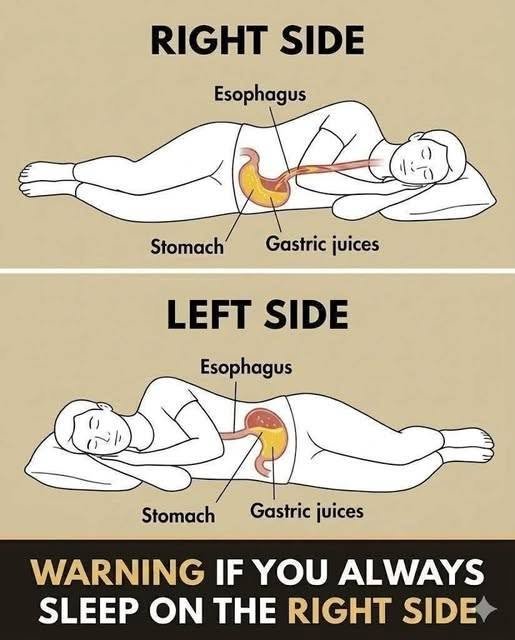
Note That If You Always Sleep on Your Right Side, You Should Have These Sleep Tips in Mind
Your sleeping position may seem like a small detail, but if you spend seven or eight hours in the same position every night, it can affect comfort, pressure points, breathing, and even how well you manage certain nighttime symptoms.
If you’re someone who automatically rolls onto your right side every night, there’s no reason to panic. Side sleeping is a perfectly reasonable position for many people, and there isn’t one “best” sleeping position that works for everyone.
The real question is:
Is your current position comfortable, supportive, and appropriate for your individual health needs?
A few simple adjustments can make right-side sleeping much more comfortable.
1. Start With the Right Pillow
One of the biggest mistakes side sleepers make is using a pillow that is too thin.
When you’re lying on your side, your shoulder creates space between your head and the mattress. If your pillow doesn’t fill that space, your neck can bend downward for hours.
You may wake up with:
- Neck stiffness
- Shoulder discomfort
- Upper-back tension
- Headaches
- A feeling that you “slept wrong”
Your pillow should help keep your head and neck in a relatively neutral position rather than allowing your head to tilt sharply toward the mattress.
A pillow with enough height and support for side sleeping is often more comfortable than a very soft, flat pillow.
But don’t assume that the thickest pillow is automatically best.
Your shoulder width, mattress firmness, and body shape all influence the amount of support you need.
Simple test
Lie on your right side and ask:
Does my nose stay roughly in line with the center of my chest?
If your head is noticeably pushed upward or drops toward the mattress, your pillow setup may need adjustment.
2. Put a Pillow Between Your Knees
This is one of the simplest changes a side sleeper can make.
When you sleep on your side, your upper leg can naturally fall forward.
That can rotate your pelvis and place additional stress on your hips or lower back.
A pillow between your knees can help keep your legs in a more comfortable position.
You don’t necessarily need a special orthopedic pillow.
A regular pillow can work.
For some people, a longer body pillow is even easier because it can support the knees and legs while also giving the upper body something to rest against.
Try this tonight
Lie on your right side.
Bend your knees slightly.
Place a pillow between them.
Notice whether your hips and lower back feel more relaxed.
If they do, you’ve found a simple adjustment worth keeping.
3. Don’t Curl Yourself Into a Tight Ball
The fetal position can feel wonderfully comfortable.
There’s nothing inherently wrong with it.
The problem comes when you curl extremely tightly for hours.
Your hips and knees are pulled toward your chest, your spine rounds, and your neck may bend forward.
If you regularly wake up feeling stiff, experiment with a slightly more open side-sleeping position.
Keep your knees comfortably bent rather than tightly compressed against your chest.
Your goal isn’t to force your body into a perfectly straight line.
It’s simply to avoid spending the entire night in a position that leaves you sore.
4. Support Your Top Arm
Here’s a surprisingly useful trick.
If you sleep on your right side, your left arm may fall forward.
Over several hours, that can leave your shoulder feeling uncomfortable.
Try hugging a pillow or body pillow.
It gives your upper arm somewhere to rest and can make the entire position feel more stable.
This is especially helpful for people who naturally move their arms around while sleeping.
A body pillow can also reduce the feeling that you’re constantly trying to balance yourself on your side.
5. Check Your Mattress
Your pillow isn’t the only thing affecting your sleeping position.
Your mattress matters too.
If the mattress is extremely firm, your shoulder and hip may receive significant pressure.
If it’s extremely soft, your body may sink unevenly, potentially making it harder to maintain a comfortable spinal position.
There isn’t one universally perfect mattress firmness.
The right choice depends on your body, preferred sleeping position, and comfort.
If you consistently wake up with pressure or soreness at the right shoulder or hip, your mattress may be contributing.
A useful experiment
If you’re replacing your mattress, try it before committing when possible.
Lie in your normal right-side position for several minutes.
Don’t judge the mattress while lying on your back for 30 seconds.
Your real sleeping position is the one that matters.
6. Don’t Assume Right-Side Sleeping Is Automatically Bad
This is important because online health advice can become unnecessarily dramatic.
For most healthy adults, sleeping on the right side isn’t inherently dangerous.
People naturally have different preferred positions.
Some sleep on their side.
Some sleep on their backs.
Some switch positions throughout the night.
Others barely move.
If you sleep comfortably on your right side and wake feeling rested without significant symptoms, there’s generally no reason to force yourself into another position simply because someone online says one position is universally “best.”
Your body isn’t a one-size-fits-all diagram.
7. But Certain Health Conditions Can Change the Advice
This is where individual circumstances matter.
For example, people with acid reflux or GERD may find that sleeping on the right side worsens nighttime reflux compared with the left side.
Research has found that left-side sleeping can reduce nighttime acid exposure and improve reflux symptoms in some people. (pubmed.ncbi.nlm.nih.gov)
If you regularly wake with:
- Heartburn
- Acid taste
- Regurgitation
- Burning in your chest or throat
- Nighttime coughing
your sleeping position may be worth discussing with a healthcare professional.
In that situation, trying the left side may be useful.
But don’t automatically assume every nighttime symptom is caused by your sleeping position.
Persistent or severe symptoms deserve proper evaluation.
8. Pregnancy Is Different
During pregnancy, sleep-position advice deserves individual attention.
As pregnancy progresses, many people find side sleeping more comfortable.
The American College of Obstetricians and Gynecologists notes that side sleeping is generally more comfortable later in pregnancy and recommends sleeping on either side rather than becoming overly worried about maintaining one perfectly specific side all night. (acog.org)
A pillow between the knees or beneath the abdomen can make side sleeping substantially more comfortable.
If you’re pregnant and have concerns about sleep position, ask your obstetric clinician for advice tailored to your pregnancy.
9. Keep Your Spine Comfortable—Not Perfect
You’ve probably seen diagrams showing a perfectly straight line from the head through the hips.
Those diagrams are useful, but don’t become obsessed with achieving geometric perfection.
Your body naturally has curves.
You will move during sleep.
You may briefly roll forward or backward.
That’s normal.
The practical goal is simply to avoid a position that consistently causes pain, numbness, or stiffness.
If you wake up feeling good, your sleeping position is probably serving you reasonably well.
If you wake up every morning feeling as though you’ve spent the night wrestling with the mattress, something needs adjusting.
10. Watch Your Shoulder Position
When you sleep on your right side, your right shoulder carries much of your upper-body weight.
If you already have shoulder pain, lying directly on that shoulder for hours may make symptoms worse.
Try moving the shoulder slightly forward or backward rather than forcing it directly underneath your body.
A supportive mattress can also reduce pressure.
If a particular shoulder position causes pain, numbness, weakness, or persistent discomfort, don’t simply keep sleeping through it.
Your body may be telling you something.
11. Don’t Ignore Numbness or Tingling
Occasional pins and needles after sleeping awkwardly aren’t unusual.
But repeated numbness or tingling is worth paying attention to.
If your arm or hand repeatedly becomes numb when you sleep on your right side, experiment with your arm position and pillow support.
Avoid trapping your arm underneath your head or body.
If numbness persists after changing position, occurs frequently during the day, or is accompanied by weakness or other concerning symptoms, seek medical advice.
A sleeping position can compress nerves temporarily, but persistent symptoms may have another cause.
12. Elevate Your Upper Body When Reflux Is the Problem
If nighttime reflux is bothering you, simply adding several soft pillows under your head may not be the best solution.
That can bend the body at the waist rather than creating a consistent incline.
For people with nighttime GERD symptoms, elevating the upper body using an appropriate wedge or bed elevation may be more effective.
The American College of Gastroenterology recommends elevating the head of the bed for nighttime GERD symptoms. (pubmed.ncbi.nlm.nih.gov)
And remember:
Left-side sleeping may help too.
If reflux is your main nighttime problem, right-side sleeping may simply not be your most comfortable position.
13. Give Your Body Permission to Move
You don’t need to stay on your right side all night.
In fact, you probably won’t.
Most people naturally shift positions during sleep.
You may start on your right side, roll onto your back, briefly turn left, and return to the right.
That’s normal.
There’s no prize for remaining perfectly still.
If you wake up on your back or left side, you don’t need to immediately correct yourself unless a healthcare professional has specifically advised you to maintain a certain position.
Comfortable movement is part of normal sleep.
14. Don’t Let Social Media Scare You About Your Heart
One common online claim is that sleeping on the right side is dangerous because of the heart.
For most healthy people, that claim is far too simplistic.
Your heart is positioned somewhat toward the left side of your chest, but that doesn’t mean lying on your right side is inherently harmful.
Some people with certain heart conditions may have specific symptoms or preferences regarding sleep position, but that is a medical issue requiring individualized advice—not a universal rule.
If lying on one side causes shortness of breath, chest discomfort, palpitations, or other concerning symptoms, don’t try to solve the problem by simply changing pillows.
Talk with a healthcare professional.
15. Choose Comfort Over Internet Rules
Here’s a rule worth remembering:
Your sleeping position should support your sleep—not become another source of anxiety.
If you’re comfortable on your right side, wake refreshed, and have no concerning symptoms, you don’t necessarily need to change.
But if you have:
- Persistent neck pain
- Shoulder pain
- Hip pain
- Back stiffness
- Nighttime reflux
- Numbness
- Breathing problems
- Repeated sleep disruption
then your position, pillow, mattress, or another health issue may deserve attention.
The answer isn’t always “sleep on the left.”
Sometimes the answer is simply better support.
A Simple Right-Side Sleeping Setup
If you want to improve your setup tonight, start here.
Your head
Use a pillow that keeps your neck comfortable and supported.
Your shoulders
Don’t force your lower shoulder into an awkward position.
Your arms
Hug a pillow if your upper shoulder feels strained.
Your waist
Make sure your mattress isn’t allowing your body to sink excessively.
Your knees
Place a pillow between them.
Your legs
Keep them slightly bent rather than tightly curled.
Your neck
Avoid sleeping with your head dramatically tilted upward or downward.
That’s it.
You don’t need a bedroom full of expensive sleep gadgets.
Right Side vs. Left Side: Which Is Better?
| Sleeping position | Potential advantages | Possible concerns |
|---|---|---|
| Right side | Comfortable for many people; natural side-sleeping position | May worsen reflux in some people |
| Left side | May help some people with nighttime reflux | Can put pressure on the left shoulder for some |
| Back | Can feel comfortable for some people and support a neutral position | May worsen snoring or obstructive sleep apnea in some people |
| Stomach | Can feel comfortable for certain sleepers | Often places more stress on the neck |
There isn’t one position that wins for every person.
The best position is influenced by your health, comfort, anatomy, and symptoms.
What If You Wake Up With a Sore Neck?
Don’t immediately blame your sleeping position.
Look at the entire setup.
Ask yourself:
Is my pillow too high?
Is it too low?
Am I sleeping with my head rotated?
Is my mattress extremely soft or firm?
Am I putting my arm underneath my head?
Small adjustments can make a surprisingly large difference.
Try changing one thing at a time.
For example, change your pillow height first.
Give your body several nights to adjust.
Then evaluate.
Changing five things simultaneously makes it impossible to know what actually helped.
What If You Can’t Fall Asleep Without Your Right Side?
That’s okay.
Many people develop a preferred sleeping position.
Your brain associates certain physical sensations with bedtime, and changing your position can initially feel strangely uncomfortable.
You don’t have to force a dramatic change overnight.
If you want to experiment with left-side sleeping because of reflux, for example, try spending part of the night there rather than demanding that your body immediately adapt.
Use pillows to support your body.
Make the new position comfortable.
Let the habit develop gradually.
A 5-Minute Sleep-Position Check
Tonight, before getting into bed, take five minutes.
Step 1: Check your pillow
Is your neck comfortably supported?
Step 2: Check your mattress
Does your shoulder feel excessively compressed?
Step 3: Add knee support
Put a pillow between your knees.
Step 4: Support your upper arm
Try hugging a pillow.
Step 5: Notice your symptoms
If right-side sleeping causes reflux, pain, numbness, or breathing problems, don’t ignore that pattern.
Instead, consider discussing it with a healthcare professional.
When Should You Talk to a Doctor?
Sleeping position itself usually isn’t a medical emergency.
But symptoms that happen repeatedly while you’re sleeping deserve attention.
Speak with a healthcare professional if you regularly experience:
- Chest pain
- Significant shortness of breath
- Repeated nighttime choking or gasping
- Severe or persistent heartburn
- Persistent numbness or weakness
- Significant shoulder, hip, neck, or back pain
- Frequent nighttime awakenings
- Loud snoring accompanied by daytime sleepiness
These symptoms may have causes unrelated to your sleeping position.
A change in pillow or mattress shouldn’t be used to postpone medical evaluation.
If you always sleep on your right side, you don’t necessarily need to change your position.
For many people, right-side sleeping is simply a comfortable way to sleep.
The bigger issue is how you sleep on your side.
Use a supportive pillow.
Keep your neck comfortable.
Place a pillow between your knees.
Support your upper arm if necessary.
Avoid curling yourself into an extremely tight position.
And if you regularly experience reflux, pain, numbness, breathing problems, or other symptoms at night, pay attention to the pattern rather than assuming it’s normal.
Most importantly, don’t let internet headlines convince you that one sleeping position is universally dangerous.
The best sleeping position is the one that allows you to breathe comfortably, stay supported, avoid unnecessary pressure, and wake up feeling rested—while taking your individual health needs into account.