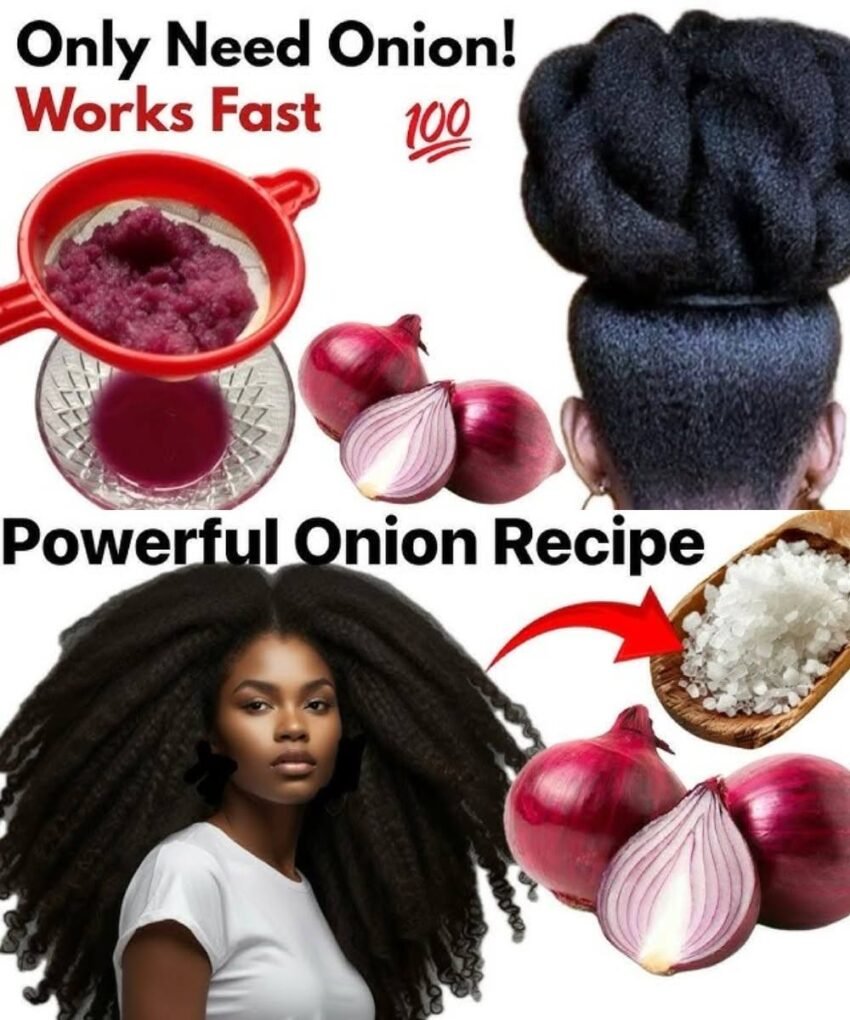
Onion Juice for Hair Growth: How to Make It, How to Use It, and What Really Works
Learn how to make onion juice for hair growth, how to apply it safely, what research suggests, and what results you can realistically expect.
Hair shedding can make you try almost anything.
That’s why onion juice has become such a popular home remedy. The recipe is simple, inexpensive, and easy to make at home. But there’s a big difference between a traditional hair-growth remedy and a proven treatment for hair loss.
So, can onion juice actually help your hair grow?
There is limited clinical evidence suggesting that topical onion juice may help some people with certain types of patchy hair loss, particularly alopecia areata. However, the evidence is small and does not establish onion juice as a cure for common pattern hair loss, severe shedding, or every type of thinning hair.
Still, if you want to try it, you can make onion juice safely at home—and there are a few important details that can make the experience much less irritating.
Here’s what to know before you start.
Why do people use onion juice on their hair?
The idea isn’t completely random.
Onions contain sulfur-containing compounds and various plant compounds. Sulfur is also found in keratin, a protein that makes up much of the hair shaft.
But that fact alone doesn’t prove that putting onion juice on the scalp will cause “extreme” hair growth.
Hair growth is controlled by the biology of the hair follicle, including genetics, hormones, inflammation, nutrition, and the hair-growth cycle.
A substance sitting on the scalp has to do much more than simply contain sulfur to meaningfully change that process.
This is where online claims often go too far.
You may see statements that onion juice “activates dormant follicles,” “stops hair loss permanently,” or “regrows bald spots in days.”
Those claims aren’t supported by strong evidence.
How to Make Fresh Onion Juice for Your Scalp
The simplest recipe requires only an onion and a way to extract and strain the juice.
You’ll need:
- 1 small or medium onion
- A blender, grater, or food processor
- A clean fine-mesh strainer or cheesecloth
- A small clean container
- A cotton pad or clean fingertips for application
Step 1: Peel the onion
Remove the outer skin and rinse the onion under clean running water.
Step 2: Chop it
Cut the onion into smaller pieces.
You don’t need a particular variety. A regular kitchen onion is sufficient if you’re simply testing the home remedy.
Step 3: Blend or grate
Place the chopped onion into a blender and process it into a wet pulp.
If you don’t have a blender, finely grating the onion can work.
Step 4: Strain the pulp
Put the mixture through a clean fine-mesh strainer or cheesecloth.
Press or squeeze the pulp to collect the liquid.
Step 5: Store it briefly
Fresh onion juice is perishable.
Rather than making a large batch and keeping it for weeks, make a small amount and use it promptly. If you need to store it temporarily, keep it refrigerated in a clean, covered container.
When in doubt, throw it out.
A homemade preparation doesn’t contain the preservatives found in commercial cosmetic products.
How to Apply Onion Juice to Your Scalp
Don’t pour half a cup over your head.
More isn’t necessarily better.
Start with a small amount.
1. Patch-test first
Before applying onion juice to your entire scalp, put a small amount on a limited area of skin.
Wait and see how your skin reacts.
If you develop significant burning, swelling, rash, or persistent irritation, wash it off and don’t continue.
2. Apply to the scalp, not just the hair
If your goal is to investigate whether onion juice affects hair growth, applying it to the scalp is more relevant than simply coating the hair shaft.
Use a cotton pad, dropper, or clean fingertips.
3. Massage gently
Lightly spread the juice over the target area.
Don’t aggressively scratch or massage the scalp.
Irritating the skin doesn’t make follicles grow faster.
4. Leave it on briefly at first
If your skin tolerates it, you can leave it on for a short period before washing.
There’s no strong evidence that leaving onion juice on overnight produces dramatically better results.
5. Wash your scalp thoroughly
Use a gentle shampoo to remove the juice and its odor.
If your scalp feels irritated afterward, discontinue use.
How Often Should You Use Onion Juice?
There’s no well-established evidence-based schedule for homemade onion juice as a general hair-growth treatment.
One small clinical study of onion juice for patchy alopecia areata used applications twice daily for two weeks before evaluating the treatment over a longer period, but that study was limited and shouldn’t be interpreted as proof that the same routine works for common hereditary hair loss. (pubmed.ncbi.nlm.nih.gov)
Because homemade onion juice can irritate the scalp, starting conservatively makes more sense than applying it aggressively.
A reasonable approach is to test your skin first and stop if irritation develops.
Does Onion Juice Actually Grow Hair?
This is the question that matters most.
The evidence is limited.
A small randomized clinical study published in the Journal of Dermatology investigated crude onion juice as a treatment for alopecia areata. The researchers reported greater hair regrowth in the onion-juice group than in the tap-water control group.
But the study had a small sample size, and alopecia areata is an autoimmune form of hair loss.
That doesn’t mean onion juice has been proven to treat male-pattern baldness, female-pattern hair loss, postpartum shedding, nutritional hair loss, or every other type of thinning.
In other words:
Interesting evidence? Yes.
Proof of “extreme hair growth”? No.
That’s an important distinction.
Why the Type of Hair Loss Matters
Not all hair loss has the same cause.
Pattern hair loss
This is one of the most common forms of hair loss and is influenced heavily by genetics and hormones.
Hair follicles gradually become smaller, producing thinner hairs.
A home remedy isn’t established as a reliable treatment for this process.
Alopecia areata
This is an autoimmune condition that can cause distinct round or oval patches of hair loss.
The small onion-juice study is relevant here—but it isn’t enough to make onion juice a standard treatment.
Telogen effluvium
This type of shedding can happen after physical or emotional stress, illness, major weight loss, surgery, or other triggers.
In many cases, identifying and addressing the trigger is more important than applying something to the scalp.
Nutritional deficiency
Iron deficiency and inadequate nutrition can contribute to hair problems in some people.
Applying onion juice won’t correct an underlying deficiency.
That’s why unexplained or significant hair loss deserves a proper evaluation.
What Does Onion Juice Do to the Scalp?
One reason people may experience a noticeable sensation after applying onion juice is that raw onion contains compounds that can irritate the skin.
You may feel:
- Tingling
- Warmth
- Stinging
- Mild irritation
But don’t interpret burning as evidence that follicles are being “activated.”
That’s a dangerous skincare myth.
Irritation is irritation.
More irritation doesn’t automatically mean more growth.
If your scalp burns, becomes swollen, develops a rash, or remains painful, wash the product off and stop using it.
Can You Mix Onion Juice With Coconut Oil?
People frequently combine onion juice with coconut oil, olive oil, aloe vera, or other ingredients.
There’s nothing magical about the combination.
Coconut oil can help reduce protein loss from hair and may improve the condition of the hair shaft, but that is different from proving that it stimulates new follicle growth.
If you have a dry scalp or dry hair, a suitable conditioning product may make your hair feel softer.
But don’t confuse improved hair texture with increased hair density.
Those are two different outcomes.
What About Onion Juice and Castor Oil?
Castor oil is another popular ingredient in DIY hair recipes.
It can make hair feel coated and shiny, but strong evidence that castor oil causes significant new hair growth is lacking.
Combining two unproven remedies doesn’t automatically make either one effective.
If you want to experiment, keeping the routine simple is actually useful.
You’ll have a better idea of what your scalp is reacting to.
Should You Leave Onion Juice on Overnight?
There’s no strong evidence that overnight application produces superior hair growth.
And for people with sensitive skin, prolonged exposure could mean more irritation.
If you’re trying onion juice for the first time, a shorter application is more sensible.
You should never feel that you have to tolerate burning because a recipe promises “extreme” results.
How Long Before You Notice Results?
This is where viral videos can create unrealistic expectations.
Hair doesn’t normally grow dramatically overnight.
The hair-growth cycle takes time.
Even established treatments for hair loss generally require months rather than days to judge properly.
So if someone claims that onion juice produced a completely filled-in bald spot after three or five days, be skeptical.
Photographs can also be misleading because lighting, hair length, styling, camera angle, and wet versus dry hair can dramatically change how dense the scalp appears.
A realistic mindset is:
Look for gradual change, not overnight transformation.
What If Your Hair Is Falling Out Suddenly?
Don’t automatically reach for onion juice.
Sudden or substantial shedding can have many causes.
These may include:
- Recent illness
- Major stress
- Significant weight loss
- Certain medications
- Hormonal changes
- Iron deficiency
- Thyroid problems
- Nutritional deficiencies
- Scalp disorders
- Autoimmune conditions
In these situations, treating the underlying cause may be far more effective than experimenting with home remedies.
A dermatologist can examine the scalp and determine whether the problem is shedding, follicle miniaturization, inflammation, infection, or another condition.
What Treatments Have Better Evidence?
If you’re dealing with common pattern hair loss, there are treatments with considerably more clinical evidence than onion juice.
One commonly used over-the-counter option is minoxidil.
The American Academy of Dermatology Association lists minoxidil among treatments that can help some people with hair loss. (aad.org)
Results vary, and treatment generally needs to be continued to maintain benefits.
Prescription options may also be appropriate for some people.
For example, dermatologists may discuss medications such as finasteride for certain men with pattern hair loss, while other treatments may be considered depending on the patient’s sex, age, medical history, pregnancy potential, and type of hair loss.
The right treatment depends on the diagnosis.
The Biggest Mistake: Treating Every Hair Problem the Same
Imagine two people.
One has gradually thinning hair at the crown.
The other develops several smooth bald patches over a few weeks.
They both search for “best natural hair-growth remedy.”
They may end up using the same onion mixture.
But their underlying conditions could be completely different.
That’s why diagnosis comes before treatment.
If your hair loss pattern has changed suddenly, don’t spend months experimenting with recipes before finding out what’s happening.
Can Onion Juice Prevent Hair Loss?
There isn’t enough evidence to say that applying onion juice prevents common hair loss.
It may be interesting as a complementary home remedy, but it shouldn’t be presented as a substitute for established diagnosis or treatment.
And if your hair is thinning because of a medical condition, nutritional deficiency, medication, or hormonal problem, onion juice won’t necessarily address the root cause.
Who Should Be Especially Careful?
Be cautious with DIY scalp treatments if you have:
- Eczema
- Psoriasis
- A very sensitive scalp
- Open sores
- Scratches
- A scalp infection
- Significant inflammation
- A history of allergic reactions to topical products
Putting raw onion juice on already damaged skin can make the irritation worse.
If you have an active scalp condition, it’s better to ask a dermatologist before experimenting.
Can Onion Juice Damage Hair?
The biggest concern is usually the scalp rather than the hair shaft itself.
Raw onion juice can irritate skin.
Repeated irritation can make a scalp uncomfortable and potentially worsen an existing inflammatory condition.
And there’s another practical problem:
The smell.
Raw onion has a strong odor that can linger.
If you have an important event the next morning, this may not be your ideal beauty experiment.
A Safer DIY Routine
If you’re determined to try onion juice, keep the experiment simple.
Step 1
Make a small fresh batch.
Step 2
Patch-test it.
Step 3
Apply a modest amount to the scalp.
Step 4
Avoid broken or irritated skin.
Step 5
Wash it out thoroughly.
Step 6
Stop if you develop significant irritation.
Step 7
Don’t use it as a reason to delay medical evaluation for significant hair loss.
That is a much more sensible approach than covering your entire head with a concentrated mixture and hoping that more equals better.
Onion Juice vs. Minoxidil
| Feature | Onion Juice | Minoxidil |
|---|---|---|
| Evidence for hair growth | Limited | Considerably stronger |
| Best-established use | Limited evidence in patchy alopecia areata | Several forms of common hair loss |
| Availability | Homemade | Widely available over the counter in many formulations |
| Main concern | Scalp irritation | Possible scalp irritation and other side effects |
| Requires consistency | Yes | Yes |
| Guaranteed results | No | No |
This isn’t a competition between “natural” and “chemical.”
It’s about evidence.
A naturally occurring substance can be powerful.
A synthetic medication can be useful.
The important question is whether the treatment has been shown to work for the specific condition you’re trying to treat.
How to Get Better Hair-Growth Results Overall
If you’re serious about healthier hair, don’t focus exclusively on one topical ingredient.
Look at the bigger picture.
Eat enough protein
Hair is largely made of keratin, a protein.
Severely inadequate protein intake can contribute to hair problems.
Avoid crash diets
Rapid weight loss can trigger increased shedding in some people.
Treat documented deficiencies
If blood tests identify an iron or other nutritional deficiency, correcting it can matter.
Don’t take high-dose supplements blindly.
Be gentle with your scalp
Avoid excessive scratching, harsh chemical treatments, and repeated mechanical damage.
Protect your hair from unnecessary damage
Frequent high heat, aggressive chemical processing, and tight hairstyles can contribute to breakage and traction-related hair loss.
Get unexplained hair loss evaluated
This may be the most important step of all.
Frequently Asked Questions
How do I make onion juice for hair growth?
Peel and rinse a small onion, chop it, blend or finely grate it, then strain the pulp through clean cheesecloth or a fine-mesh strainer. Make small batches and keep the preparation clean.
How often should I apply onion juice?
There isn’t a universally established schedule for homemade onion juice as a general hair-growth treatment. A small study of onion juice in alopecia areata used twice-daily application, but that evidence is limited and doesn’t establish the same routine for other types of hair loss. (pubmed.ncbi.nlm.nih.gov)
Can onion juice grow hair on bald spots?
Limited research has investigated onion juice for alopecia areata, a condition that causes patchy hair loss. That research is not enough to conclude that onion juice reliably regrows hair from all types of bald spots.
Can I leave onion juice on overnight?
There’s no strong evidence that overnight use produces better results. Longer exposure may increase irritation, particularly for people with sensitive skin.
Can onion juice stop hair loss permanently?
There isn’t strong evidence that it permanently stops common hair loss. The cause of hair loss matters, and different conditions require different approaches.
Can I mix onion juice with coconut oil?
You can physically combine them, but there is no strong evidence that the combination dramatically improves hair growth. Coconut oil may help condition hair, but that’s different from stimulating new follicle growth.
How long does onion juice take to work?
There is no reliable timeline for onion juice because evidence is limited. Hair growth is a slow process, and dramatic results within a few days should be viewed skeptically.
Does onion juice work better than minoxidil?
There isn’t good evidence establishing onion juice as superior to minoxidil. Minoxidil has substantially more clinical evidence for certain forms of hair loss. (aad.org)
What should I do if onion juice burns my scalp?
Wash it off thoroughly and discontinue use. Persistent burning, swelling, blistering, or severe redness warrants medical evaluation.
When should I see a dermatologist about hair loss?
Consider an evaluation if hair loss is sudden, severe, patchy, accompanied by scalp inflammation, associated with other symptoms, or continues without an obvious explanation.
Your Onion Juice Hair-Growth Checklist
If you want to try it:
- ☐ Make a small fresh batch
- ☐ Strain the juice thoroughly
- ☐ Patch-test before full application
- ☐ Apply gently to the scalp
- ☐ Avoid broken or inflamed skin
- ☐ Wash it out thoroughly
- ☐ Stop if significant irritation develops
Don’t:
- ☐ Assume burning means it’s working
- ☐ Leave it on overnight just to “boost” results
- ☐ Combine numerous irritating ingredients
- ☐ Expect overnight hair growth
- ☐ Use it instead of medical treatment
- ☐ Ignore sudden or severe hair loss
Onion juice is one of those home remedies that sits somewhere between interesting science and internet exaggeration.
There is limited clinical evidence that topical onion juice may help hair regrowth in some people with alopecia areata. But that small body of evidence does not prove that onion juice causes “extreme hair growth,” reverses hereditary baldness, or works for every form of hair loss.
If you want to experiment with it, make a small fresh batch, patch-test your skin, apply it conservatively, and stop if irritation occurs.
More importantly, figure out why your hair is thinning in the first place.
If you’re experiencing pattern hair loss, treatments such as minoxidil have considerably more evidence behind them. If your shedding is sudden or unusual, a dermatologist can help identify the underlying cause.
Onion juice is inexpensive and easy to make, but don’t mistake a promising home remedy for a proven cure. Healthy hair starts with identifying the cause of hair loss and choosing a treatment that actually matches it.
Medical disclaimer: This article is for educational purposes and does not diagnose or treat hair loss. If you have significant, sudden, patchy, painful, or inflamed scalp hair loss, consult a qualified healthcare professional or dermatologist.