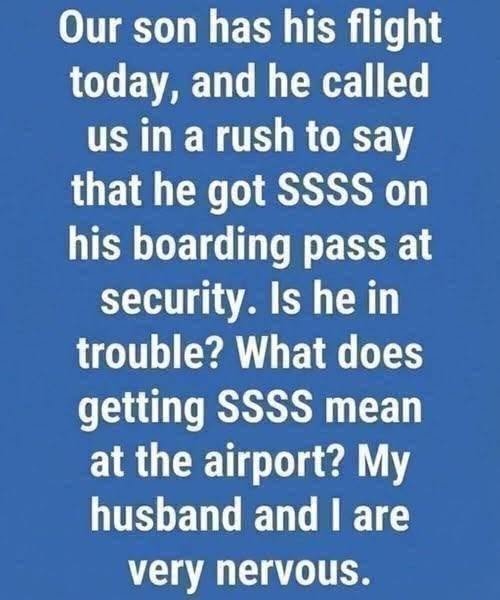
What Does “SSSS” on a Boarding Pass Mean? (And Is Your Son in Trouble?)
Few things cause immediate panic quite like hearing your child call from the airport terminal in a rush, whispering that security printed a mysterious code on their boarding pass: SSSS. For parents sitting miles away, the acronym immediately evokes visions of interrogation rooms, detained flights, and severe trouble.
Take a deep breath. Your son is not necessarily in trouble, and he has not committed a crime. However, seeing those four letters does mean his journey through airport security is going to take a bit longer.
Understanding what SSSS stands for and why it happens can help replace panic with practical clarity.
What Does SSSS Actually Stand For?
SSSS stands for Secondary Security Screening Selection.
It is a designation assigned by the Transportation Security Administration (TSA) or international aviation authorities that flags a passenger for mandatory, enhanced security screening before they are allowed to board their aircraft.
Contrary to popular belief, it is not an automatic mark of criminality or a criminal record check. Rather, it is an extra layer of aviation security designed to catch threats that standard screening might miss.
Why Did Your Son Get Selected?
Travelers often receive the dreaded SSSS code for a variety of routine, non-punitive reasons:
-
Random Selection: The computer algorithms that generate boarding passes select a specific percentage of travelers completely at random on every flight to maintain security unpredictability.
-
One-Way International Bookings: Purchasing a last-minute, one-way international ticket—especially paid in cash or booked close to departure—frequently triggers automated security flags.
-
Name Similarities: If your son shares a name (or a close phonetic spelling) with someone on government watchlist databases, the system will flag the ticket for manual verification.
-
Incomplete Passenger Data: Missing or mismatched Secure Flight data (such as minor errors in date of birth, legal name spelling, or passport numbers) can cause automated vetting flags.
-
Frequent Travel to High-Risk Regions: Traveling extensively to specific countries monitored by international intelligence agencies can increase the likelihood of secondary selection.
What Happens During an SSSS Screening?
When your son hands his boarding pass to the gate agent or security checkpoint officer and the scanner emits a specialized alert tone, he will be directed to secondary screening. Here is what that process typically entails:
-
Enhanced Physical Pat-Down: Security personnel will conduct a thorough, full-body physical pat-down, checking areas that standard metal detectors or body scanners might not fully detail.
-
Luggage Swab for Explosive Residue: Officers will thoroughly unpack his carry-on bags, electronic devices, and personal items, swabbing them with specialized equipment designed to detect microscopic traces of explosive materials.
-
Detailed Documentation Check: Agents will carefully review his physical passport, visa (if applicable), and itinerary details to verify his identity.
-
Baggage Inspection: Checked luggage may also be pulled for secondary manual inspection behind the scenes.
Comparison: Standard Airport Security vs. SSSS Screening
| Security Feature | Standard Screening Process | SSSS Enhanced Screening |
| Selection Method | Universal for all ticketed passengers. | Triggered by random algorithm or security flags. |
| Bag Search | Standard X-ray machine evaluation; occasional manual checks. | Comprehensive manual unpacking and explosive trace swabs. |
| Processing Time | Usually quick (5 to 15 minutes). | Adds an extra 30 to 45 minutes to the boarding process. |
| Boarding Pass Status | Standard barcodes. | Printed with the explicit “SSSS” code, requiring physical clearance stamps. |
What Your Son Should Do Right Now
If your son is currently at the airport and dealing with this, share these quick instructions to keep him calm and cooperative:
-
Comply Calmly: Remind him that arguing, showing frustration, or recording security personnel will only prolong the process. Complete every instruction with a calm, cooperative demeanor.
-
Allow Extra Time: He should head straight to his designated secondary screening area immediately and expect his boarding process to take an extra 30 to 45 minutes.
-
Keep Documents Handy: Ensure his passport, physical boarding pass, and identification are easily accessible in his hands.
Frequently Asked Questions
Does getting SSSS mean he is on a no-fly list?
No. Individuals on the official federal No-Fly List are barred from purchasing tickets or entering the secure boarding area entirely. If your son made it through check-in and received a boarding pass, he is not on that list.
Will he get SSSS every time he flies in the future?
Not necessarily. If the selection was truly random, his next flight will likely process normally. However, if it was triggered by a name match or passport data discrepancy, he may experience repeat flags until the issue is cleared.
Can you apply for a redress number to stop getting SSSS?
Yes. If a passenger experiences repeated secondary screenings due to a name mix-up with someone on a watchlist, they can apply for a Redress Control Number through the Department of Homeland Security (DHS TRIP) to permanently clear their profile.
Action Checklist
-
What to Do: Reassure your son to stay calm and compliant, remind him to give himself extra time before boarding, and advise him to keep his passport ready.
-
What to Avoid: Panicking, assuming legal trouble, arguing with security officers during the screening, or rushing through the secondary check instructions.
While seeing SSSS on a boarding pass is startling and inconvenient, it is a routine aviation security procedure that your son will clear safely as long as he remains calm, cooperative, and gives himself extra time to board his flight.