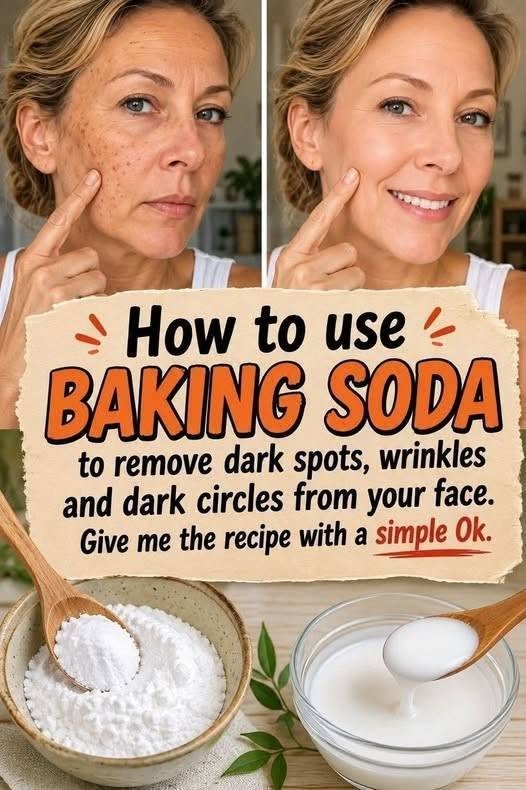
Prepare a Baking Soda Cream and Apply It Before Sleeping: Can It Really Help Wrinkles and Dark Spots?
Introduction
If you’ve spent any time scrolling through social media, you’ve probably come across headlines like, “Apply baking soda before bed and wake up with wrinkle-free skin!” or “This simple kitchen ingredient removes dark spots overnight!” These claims are certainly attention-grabbing, especially when they promise glowing, youthful skin without expensive treatments.
Baking soda is inexpensive, easy to find, and already sitting in most kitchen cupboards. It’s no surprise that many DIY beauty enthusiasts have experimented with it as a facial treatment. But before you start applying baking soda to your skin every night, it’s worth taking a closer look at what science actually says.
The truth is that while baking soda has several useful household and personal care applications, it isn’t a miracle skincare ingredient. In fact, using it incorrectly may do more harm than good, particularly if you have sensitive skin.
In this article, we’ll explore whether baking soda can really reduce wrinkles and dark spots, how it affects your skin, the potential risks, safer alternatives recommended by dermatologists, and the best ways to achieve healthier, younger-looking skin.
Why Baking Soda Became a Popular Beauty Trend
Baking soda, also known as sodium bicarbonate, has been used for generations around the home. It helps clean surfaces, neutralise odours, freshen carpets, and even acts as a gentle abrasive for certain cleaning tasks.
Because of its fine texture and cleansing properties, many people assumed it could also:
- Exfoliate dead skin
- Brighten the complexion
- Lighten pigmentation
- Remove acne scars
- Smooth wrinkles
While there is some truth to its exfoliating ability, this doesn’t automatically mean it’s safe or effective as an overnight facial treatment.
Understanding Your Skin’s Natural Barrier
One of the most important things to understand before using baking soda on your face is that healthy skin has a delicate protective barrier.
This barrier has a slightly acidic pH, typically between 4.5 and 5.5. This acidity helps:
- Keep moisture locked in
- Prevent irritation
- Protect against harmful bacteria
- Support healthy skin cells
Baking soda, however, has a much higher pH of around 9.
Applying something so alkaline to your face can temporarily disrupt your skin’s natural balance.
Over time, repeated use may lead to:
- Dryness
- Tightness
- Flaking
- Redness
- Increased sensitivity
- Irritation
For people with eczema, rosacea, or sensitive skin, these effects can be even more noticeable.
Can Baking Soda Remove Wrinkles?
One of the biggest claims surrounding baking soda is that it reduces wrinkles.
Unfortunately, there is no reliable scientific evidence supporting this claim.
Wrinkles develop due to several natural processes, including:
Ageing
As we grow older, our skin naturally produces less collagen and elastin.
These proteins help keep skin firm and smooth.
Sun Exposure
Ultraviolet (UV) rays gradually damage collagen fibres, leading to premature ageing.
Facial Expressions
Repeated movements like smiling, laughing, and frowning eventually create expression lines.
Lifestyle Factors
Smoking, poor sleep, dehydration, and excessive sun exposure can all contribute to wrinkles.
Baking soda cannot reverse these underlying causes.
Although exfoliation may make skin appear temporarily smoother, this effect is short-lived and does not rebuild collagen.
Can Baking Soda Fade Dark Spots?
Dark spots, also known as hyperpigmentation, occur when excess melanin forms in certain areas of the skin.
Common causes include:
- Sun damage
- Acne marks
- Hormonal changes
- Ageing
- Skin injuries
Some people believe baking soda helps because exfoliation removes surface skin cells.
While gentle exfoliation can improve skin texture over time, baking soda itself does not stop melanin production.
Even worse, if baking soda irritates the skin, the resulting inflammation can actually make pigmentation worse, especially in individuals with medium to dark skin tones.
Is It Safe to Leave Baking Soda on Overnight?
Most dermatologists would advise against it.
Leaving baking soda on your face for several hours increases the chance of:
- Dry patches
- Burning sensations
- Redness
- Itching
- Skin barrier damage
Since everyone’s skin responds differently, some people may notice irritation after just one application.
Are There Any Benefits?
Although baking soda isn’t recommended as an anti-ageing cream, it does have a few limited skincare uses.
For example:
- It can remove excess oil from very oily skin when used sparingly.
- It offers mild exfoliation.
- It may temporarily soften rough patches on areas like elbows or feet.
These benefits are modest and don’t justify frequent overnight facial use.
Who Should Avoid Baking Soda on Their Face?
Avoid using baking soda if you have:
- Sensitive skin
- Rosacea
- Eczema
- Psoriasis
- Active acne breakouts
- Recently exfoliated skin
- Sunburn
- Open cuts or wounds
These conditions already weaken the skin barrier, making irritation more likely.
Better Ingredients for Wrinkles
If reducing wrinkles is your goal, several ingredients have been extensively studied.
Retinol
Retinol encourages skin cell turnover and stimulates collagen production.
With consistent use, it can reduce:
- Fine lines
- Wrinkles
- Uneven texture
Vitamin C
Vitamin C is a powerful antioxidant that helps protect skin from environmental damage while brightening the complexion.
Peptides
Peptides support collagen production and improve skin firmness over time.
Hyaluronic Acid
This ingredient attracts moisture into the skin, making fine lines appear less noticeable.
Sunscreen
No anti-ageing routine is complete without daily SPF.
Preventing UV damage is one of the most effective ways to reduce future wrinkles.
Better Ingredients for Dark Spots
Instead of baking soda, dermatologists often recommend ingredients such as:
- Niacinamide
- Azelaic acid
- Vitamin C
- Alpha arbutin
- Tranexamic acid
- Glycolic acid
- Lactic acid
These ingredients have considerably more evidence supporting their effectiveness.
A Simple Night-Time Skincare Routine
If your goal is healthier, brighter skin, you don’t need complicated DIY recipes.
A simple evening routine might include:
Step 1: Cleanse with a gentle facial cleanser.
Step 2: Apply a treatment containing retinol or niacinamide if suitable for your skin.
Step 3: Finish with a moisturiser containing ceramides or hyaluronic acid.
Consistency matters far more than using harsh ingredients.
Common DIY Mistakes to Avoid
Many people accidentally damage their skin by trying too many home remedies.
Common mistakes include:
- Leaving baking soda on overnight
- Scrubbing too aggressively
- Mixing baking soda with lemon juice
- Skipping moisturiser afterwards
- Forgetting sunscreen the next morning
Even natural or household ingredients can irritate the skin if used incorrectly.
A Real-Life Scenario
Imagine two people hoping to reduce dark spots.
Sarah begins applying baking soda every night because she saw a viral video online.
At first, her skin feels smoother, but after several weeks it becomes dry, irritated, and her pigmentation appears even darker due to inflammation.
Emma chooses a different approach.
She uses sunscreen every morning, applies a vitamin C serum during the day, and uses a gentle retinol cream at night.
After a few months, her skin tone looks more even, her texture improves, and fine lines become less noticeable.
The difference isn’t luck—it’s using treatments supported by scientific research.
Pros and Cons of Using Baking Soda on the Face
Pros
- Inexpensive
- Easy to find
- Mild exfoliating effect
- Removes excess oil temporarily
Cons
- No proven wrinkle-reducing benefits
- Can damage the skin barrier
- May cause irritation
- Can worsen dark spots
- Not suitable for regular overnight use
- Unsuitable for sensitive skin
Frequently Asked Questions
1. Can baking soda remove wrinkles overnight?
No. There is no scientific evidence that baking soda can erase wrinkles overnight or stimulate collagen production.
2. Does baking soda lighten age spots?
Not reliably. It may exfoliate the skin’s surface but does not target the underlying cause of pigmentation.
3. Is baking soda safe for daily facial use?
Daily use is generally not recommended because it can disrupt the skin’s protective barrier.
4. Can baking soda help acne?
Some people find it reduces oil temporarily, but it may also irritate acne-prone skin and worsen inflammation.
5. What should I use instead of baking soda?
Ingredients such as retinol, niacinamide, vitamin C, azelaic acid, and sunscreen have much stronger evidence supporting their benefits.
6. Should I leave baking soda on overnight?
No. Prolonged contact increases the risk of irritation and dryness.
7. Can baking soda make dark spots worse?
Yes. If it causes inflammation, it may contribute to post-inflammatory hyperpigmentation.
8. Is baking soda suitable for sensitive skin?
Generally, no. Sensitive skin is more likely to become irritated.
9. What’s the best way to prevent wrinkles?
Daily sunscreen, moisturising regularly, avoiding smoking, eating a balanced diet, and using proven skincare ingredients are among the most effective strategies.
10. When should I see a dermatologist?
If you have persistent pigmentation, severe acne scars, or rapidly changing skin lesions, seek professional medical advice.
Action Checklist
Do
✔ Wear sunscreen every day.
✔ Keep your skin moisturised.
✔ Choose evidence-based skincare ingredients.
✔ Introduce new products gradually.
✔ Patch-test new products before applying them widely.
Avoid
✘ Leaving baking soda on your face overnight.
✘ Mixing baking soda with lemon juice.
✘ Scrubbing your skin aggressively.
✘ Expecting overnight miracles.
✘ Ignoring persistent skin irritation.
Conclusion
Baking soda may be a useful household cleaner, but it isn’t a proven anti-ageing treatment. While it can provide mild exfoliation, it doesn’t reduce wrinkles, rebuild collagen, or reliably fade dark spots. In fact, frequent or overnight use may damage your skin’s natural barrier, causing dryness, irritation, and, in some cases, worsening pigmentation.
If your goal is healthier, younger-looking skin, focus on habits and ingredients backed by research. A gentle skincare routine, daily sunscreen, proper hydration, and products containing retinol, vitamin C, niacinamide, or hyaluronic acid offer far more reliable results than DIY remedies.
Beautiful skin rarely comes from a single “miracle” ingredient. Instead, it comes from consistency, patience, and choosing treatments that protect your skin rather than putting it at risk.
Baking soda is best left in the kitchen. For smoother skin and a more even complexion, stick with proven skincare ingredients and a routine that supports your skin’s natural health rather than disrupting it.