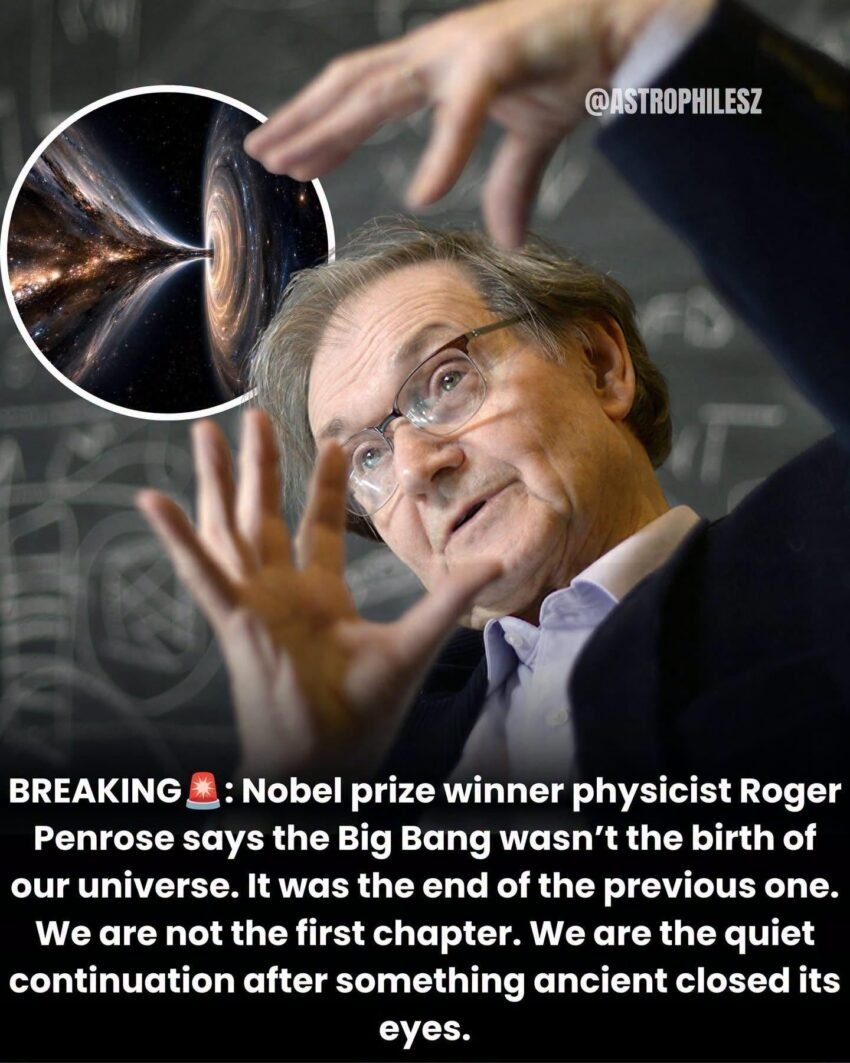
Beyond the Big Bang: Why Roger Penrose Says Time Didn’t Start at Year Zero
Discover how Nobel laureate Roger Penrose’s Conformal Cyclic Cosmology shatters our traditional understanding of the universe’s birth—and why time might actually be infinite.
Explore Roger Penrose’s radical alternative to the Big Bang. Dive into Conformal Cyclic Cosmology, infinite universes, and why time didn’t start at zero.
The Beginning of the End of Beginnings
Picture the moment of creation. For nearly a century, popular science has fed us a neat, tidy image: a single, infinitely dense point—a singularity—suddenly exploding outward in a flash of heat and light to birth space, time, and everything we know. It is an intuitive narrative. Every story needs a beginning, right?
Except reality rarely cares about our narrative preferences.
When you sit down with equations that describe the fabric of spacetime, the standard Big Bang model starts to fray at the edges. It leaves glaring gaps that modern astrophysicists try to patch with mysterious physics like cosmic inflation—a theoretical band-aid that posits the universe expanded faster than light in its earliest micro-moments. But what if the entire premise is flawed? What if the Big Bang wasn’t the absolute creation of the universe, but merely a transition?
Enter Sir Roger Penrose. The Nobel laureate mathematician and theoretical physicist looks at the cosmos and sees something entirely different: a grand, infinite cycle where the distant, cold death of our universe gives birth to the fiery dawn of the next.
If you have ever stared up at the night sky and wondered what came before the beginning, or felt intellectually restless with the “something from nothing” dogma, you are in the right place. We are going to unpack one of the most provocative cosmological models of our time, strip away the dense academic jargon, and look at why Penrose’s ideas might fundamentally change how we understand existence itself.
Why the Standard Big Bang Story Has Cracks
To appreciate why Penrose rocked the scientific boat, we first need to look at why the standard Big Bang narrative leaves theorists tossing and turning at night.
On paper, the Big Bang theory is a triumph. It explains the cosmic microwave background (CMB)—the lingering afterglow of the early universe—and accounts for the abundance of light elements like hydrogen and helium. But dig into the thermodynamics, and you hit a brick wall known as the Second Law of Thermodynamics.
The Second Law states that entropy—disorder, or the unavailability of a system’s thermal energy for conversion into mechanical work—must always increase over time. Universes start ordered and wind down into chaos. Think of a cup of coffee cooling down, or a sandcastle eroding on a beach.
Here is the paradox: our universe started out with an astounding amount of order. The early universe possessed a remarkably low entropy state, allowing gravity to pull matter together into stars, galaxies, and eventually, complex carbon-based life forms that can ponder physics. Why would a chaotic, explosive singularity birth a universe with such exquisite, highly improbable low entropy?
Traditional cosmology basically shrugs and says, “That’s just how the boundary conditions happened to be set at time zero.” For a physicist like Penrose, throwing your hands up at the boundary conditions is intellectual surrender.
The Cultural Weight of “The Beginning”
In Western culture, we are deeply wedded to linear narratives. Genesis, history, personal growth, mortality—we love a clean timeline with a clear alpha and omega. The standard Big Bang fits this psychological blueprint. It gives us a cosmic birth certificate.
When a scientist challenges that framework, it triggers cognitive dissonance. We resist it not necessarily because the math fails, but because it disrupts our deeply ingrained mental models of how beginnings and endings work. But nature does not owe our narrative structures any favors.
Conformal Cyclic Cosmology: The Infinite Wheel
So, what is Roger Penrose’s alternative? It is called Conformal Cyclic Cosmology (CCC). Developed alongside theoretical physicist Gurzadyan and expanded over decades, CCC proposes that the history of the universe is not a finite line, but an endless sequence of epochs called “aeons.”
To understand CCC, you have to stretch your imagination around a mind-bending geometric trick.
The Scale-Free Universe
As our current universe expands, it is accelerating, driven by dark energy. Trillions of years from now, stars will burn out, galaxies will drift so far apart that they can no longer interact, and supermassive black holes will slowly evaporate via Hawking radiation. What remains? A vast, cold, ever-expanding soup of massless particles—mostly photons and gravitons—drifting through an infinite void.
Here is where Penrose introduces his masterstroke of mathematical physics.
In the extreme distant future, when all mass has evaporated into energy, physical scale ceases to have meaning. Without mass, there is no way to measure distance or time. A universe the size of a subatomic particle and a universe stretching across infinite light-years become mathematically indistinguishable when you strip away scale.
Penrose realized that the mathematical geometry of an infinitely large, cold, empty universe at the end of time is structurally identical to the ultra-hot, ultra-dense geometry of the Big Bang at the start of time.
In short: the infinitely large, dead future of our aeon scales down and smoothly transitions to become the infinitely dense, fiery Big Bang of the next aeon. The end of the old world becomes the seed of the new one.
The Evidence: Finding Ghost Circles in the Sky
A brilliant theory is just a poetic bedtime story until you test it against reality. Penrose didn’t just throw mathematical concepts at the wall; he made a concrete prediction.
If previous aeons existed before ours, could they have left scars? Could information—or at least structural anomalies—survive the transition from the end of one universe to the beginning of the next?
Yes. Specifically, Penrose suggested that supermassive black holes colliding in the previous aeon would generate immense bursts of gravitational waves. These waves would spread out across the stretching expanse and leave subtle, circular variations in the cosmic microwave background (CMB) of our own universe.
The Hunt for “Hawking Points”
Collaborating with data scientists, Penrose began combing through high-resolution maps of the CMB gathered by NASA’s WMAP and the European Space Agency’s Planck satellite.
What did they find? Anomalous concentric circles—regions in the sky where the temperature distribution shows statistically significant patterns that standard inflation models struggle to account for. Penrose calls these “Hawking Points”—residual signatures of evaporated supermassive black holes from a universe that existed long before ours drew breath.
Naturally, the astrophysics community has debated these findings fiercely. Skeptics argue these patterns could be statistical noise or artifacts of background radiation processing. Yet, Penrose and his supporters continue to refine their data, standing as a testament to the fact that revolutionary science rarely slides into acceptance without a brawl.
Step-by-Step: How to Conceptualize Cyclical Spacetime
If your brain feels like it’s doing gymnastics, that is entirely normal. Shifting from a linear worldview to a cyclical one requires unlearning years of intuitive conditioning. Use this conceptual framework to anchor your understanding:
-
Step 1: Abandon the “Absolute Zero” Mindset. Stop thinking of the Big Bang as a creation event out of absolute nothingness. Instead, view it as a state change—similar to water turning to steam, but on a cosmic, gravitational scale.
-
Step 2: Follow the Arrow of Entropy. Acknowledge that entropy always increases within an aeon. The universe winds down from order to chaos.
-
Step 3: Recognize the Paradox of Scale. Understand that at the absolute limits of time—both near-zero and infinitely far away—particles lose mass. Without mass, scale disappears. Big and small become the same thing mathematically.
-
Step 4: Bridge the Aeons. Visualize the stretching, cold boundary of a dying universe snapping shut and reshaping itself, via conformal geometry, into the ultra-dense ignition point of a fresh universe.
-
Step 5: Embrace the Infinite Loop. Realize that time does not stop at our future horizon; it crosses a mathematical bridge into a new reality, rendering the cosmos eternal.
Comparative Analysis: Standard Big Bang vs. Conformal Cyclic Cosmology
To clarify how Penrose’s model stacks up against conventional thought, let’s look at a side-by-side comparison of the core pillars of modern cosmology.
| Feature | Standard Big Bang (with Inflation) | Conformal Cyclic Cosmology (Penrose) |
| Origin of Universe | Absolute beginning from a spacetime singularity at $t = 0$. | A continuous transition from the remote future of a previous aeon. |
| Fate of Universe | Eternal expansion into cold heat death (the “Big Freeze”) with no return. | The ultimate cold heat death mathematically morphs into the Big Bang of the next aeon. |
| Entropy Problem | Requires an unexplained, highly fine-tuned low entropy state at the start. | Low entropy at the start is a natural consequence of scaling down a vast, smooth, empty prior universe. |
| Time Paradigm | Linear and finite in the past (has a definitive birth date). | Infinite and cyclical across endless historical aeons. |
| Observable Evidence | Cosmic Microwave Background, Hubble expansion, primordial element abundances. | CMB anomalies, concentric rings, and proposed “Hawking Points.” |
Pros and Balances of the Cyclic Model
No scientific model is bulletproof, and intellectual honesty requires looking at both the brilliance and the vulnerabilities of CCC.
The Pros
-
Solves the Entropy Puzzle: It provides an elegant, physical mechanism for why our universe started with such low entropy without relying on improbable cosmic coincidences.
-
Eliminates the Initial Singularity: Standard physics breaks down at actual mathematical singularities (where density becomes infinite). CCC bypasses this by using conformal geometry to bridge states without requiring an unphysical infinite density point.
-
Testable Predictions: Unlike many multiverse theories that remain permanently tucked away behind impenetrable horizons, CCC makes specific, testable claims about anomalies in the cosmic microwave background.
The Challenges and Criticisms
-
Particle Physics Hurdles: For CCC to work in its strictest sense, all massive particles must eventually decay or lose their mass in the distant future (including electrons). While some grand unified theories suggest protons can decay, it remains unproven.
-
Mainstream Inertia: The cosmological community is deeply anchored in the standard inflation paradigm. Shifting decades of textbook consensus takes an immense mountain of empirical data.
-
Mathematical Complexity: The conformal scaling techniques Penrose uses require advanced differential geometry, making it difficult for non-specialists to evaluate intuitively.
Common Pitfalls When Studying Modern Cosmology
When diving into complex topics like theoretical physics, it is easy to fall into mental traps. Here is how to keep your footing:
-
Pitfall 1: Confusing “Cyclic” with “Reversing.”
-
The Mistake: Assuming the universe expands, stops, reverses, and collapses back into a “Big Crunch” (the old oscillating universe model).
-
The Fix: Remember that Penrose’s universe keeps expanding forever. The transition happens through scale invariance at the end of time, not by bouncing backward through a physical contraction.
-
-
Pitfall 2: Treating Metaphors as Literal Mechanics.
-
The Mistake: Visualizing a universe physically squeezing through a tiny cosmic hourglass.
-
The Fix: Understand that space and time are geometric constructs. The “bridge” between aeons is a mathematical transformation of scale, not a physical funnel.
-
-
Pitfall 3: Dismissing Consensus Too Easily.
-
The Mistake: Assuming the standard Big Bang is completely “wrong” because a brilliant alternative exists.
-
The Fix: View CCC not as a refutation of observational data, but as a deeper interpretation of what that data means for the boundaries of time.
-
Expert Insights: What This Means for the Future of Physics
If Roger Penrose is right—or even partially right—it forces a dramatic reevaluation of humanity’s place in the cosmic timeline. We are not living in a one-shot creation story that began abruptly 13.8 billion years ago and will fade into sterile nothingness. Instead, we are participants in an infinite, self-renewing tapestry.
In the broader context of 2026 physics research, the intersection of quantum gravity, information preservation, and cosmology is yielding fascinating tensions. As next-generation telescopes and orbital observatories map the CMB with even greater fidelity, the debate over pre-Big Bang signatures is moving from the fringes to the center of theoretical astrophysics.
The takeaway for curious minds is clear: science is never finished. The textbook version of reality is always a work-in-progress, waiting for a visionary to look at the same equations everyone else is staring at and see an entirely different door.
Mini Case Scenario: The Paradigm Shift in Real Time
Consider Dr. Elena Vance, a computational astrophysicist working at a prominent research institute in the United States. For years, Elena trained within the orthodox framework of cosmic inflation, building simulations based on standard Big Bang parameters.
When she first encountered Conformal Cyclic Cosmology, she dismissed it as mathematical philosophy—clever, but untestable. However, as she began analyzing anomalous temperature spikes in public Planck data datasets for an independent side project, she noticed recurring structural alignments that matched Penrose’s predicted low-variance circles.
Her experience mirrors the quiet revolution happening across labs worldwide: ideas that once sounded like science fiction are increasingly being stress-tested against hard data. Elena didn’t throw away her textbook, but she stopped viewing the universe’s history as a closed book with a single introduction. She learned the value of holding two competing frameworks in her mind until the data forced a verdict.
Frequently Asked Questions
1. Does Roger Penrose’s theory mean time goes on forever?
Yes. In Conformal Cyclic Cosmology, time is infinite. When one aeon reaches its thermal death and transitions into the Big Bang of the next, time continues across the boundary through conformal rescaling. There is no final end.
2. How does CCC explain the beginning of the universe if there is no Big Bang singularity?
It replaces the traditional “singularity” (where physics breaks down at infinite density) with a smooth geometric transition. The infinitely sparse, cold future of the old universe maps mathematically onto the ultra-dense, hot start of the new one.
3. Has Penrose’s theory been proven correct?
It has not been definitively proven. While Penrose and his collaborators have published papers pointing to concentric circles and “Hawking Points” in the cosmic microwave background, the broader scientific community treats these findings with cautious skepticism, awaiting independent replication and higher-resolution data.
4. What happens to black holes in a cyclical universe?
In Penrose’s model, supermassive black holes evaporate over trillions of years via Hawking radiation. The immense gravitational waves generated by their past interactions and mergers leave subtle structural fingerprints that survive the transition into the next aeon.
5. Is Conformal Cyclic Cosmology compatible with string theory or quantum mechanics?
CCC is primarily a classical general relativity and conformal geometry framework. Integrating it fully with the probabilistic rules of quantum mechanics remains one of the major theoretical challenges for physicists working on quantum gravity.
6. Does this theory suggest that history repeats itself identically in every aeon?
No. The matter and energy distribution in each aeon is entirely randomized by quantum fluctuations during the transition. While the physical laws remain consistent, the specific events, galaxies, and life forms within each aeon are completely unique.
7. Why hasn’t this replaced the standard Big Bang model in high school textbooks yet?
Textbooks prioritize established, consensus models that have decades of widespread observational backing. Paradigm shifts in cosmology take generations to move from cutting-edge theoretical papers to foundational classroom curricula.
8. How does dark energy fit into Penrose’s cyclical model?
Dark energy plays a central role. Because dark energy causes the universe’s expansion to accelerate, it ensures that matter eventually becomes so dispersed that particles lose mass, enabling the scale-free transition required for the next aeon to begin.
Action Checklist
What to Do:
-
Read up on foundational thermodynamics, specifically entropy and the arrow of time, to grasp why cosmic boundary conditions puzzle physicists.
-
Explore public data sets from the Planck and WMAP space telescopes to see how astrophysicists map the cosmic microwave background.
-
Keep an open, analytical mind when evaluating fringe scientific theories against mainstream consensus.
What to Avoid:
-
Confusing Penrose’s cyclic universe with the old “Big Crunch” oscillating universe model.
-
Accepting complex physics claims without checking how researchers test them empirically.
-
Assuming current scientific models are permanent dogma rather than evolving descriptions of reality.
Roger Penrose’s Conformal Cyclic Cosmology challenges us to abandon our comfort with linear timelines, offering a breathtaking vision of an infinite cosmos where every ending is simply a new ignition.