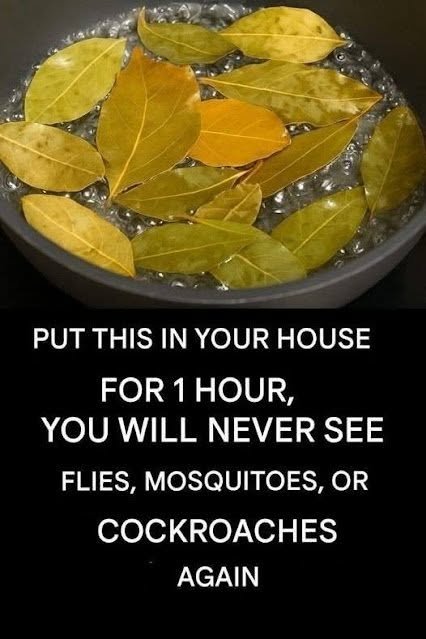
Simple Bay Leaf Trick Can Help Keep Insects Out of Your Home—But Does It Really Work?
Do bay leaves really repel insects? Learn what the evidence says about this popular home trick, which pests it may affect, and better ways to keep bugs out.
You place a few dried bay leaves inside the kitchen cabinet, pantry, or near the windows.
The idea is simple: insects supposedly dislike the strong scent and will stay away.
It sounds almost too easy—and that’s exactly why the trick keeps coming back.
But does it actually work?
Sometimes, the idea has a scientific basis. The problem is that the evidence does not support treating a few bay leaves as a reliable insect-control system for your home.
Bay leaves contain aromatic compounds, and plant-derived chemicals can have insect-repelling or insecticidal properties under certain conditions. But there’s a major difference between finding insect activity against a concentrated plant extract in a controlled experiment and proving that a handful of dried leaves sitting in your pantry will keep household pests away.
That distinction is easy to miss.
So if you’ve been wondering whether bay leaves can really help with ants, cockroaches, pantry moths, flies, or other unwanted visitors, here’s what you need to know—and what to do instead when the bugs don’t get the memo.
Why the bay leaf trick became so popular
The appeal is obvious.
You don’t need to spray anything.
You don’t need an elaborate trap.
You don’t need to empty your cabinets.
And you probably already have bay leaves in the kitchen.
The traditional trick usually involves placing several dried bay leaves:
- Inside kitchen cabinets
- Near flour and cereal
- In pantry corners
- Around garbage areas
- Near windows and doors
- Inside drawers
- Near suspected insect entry points
The theory is that the leaves release a scent that insects find unpleasant.
There is some biological plausibility behind that idea. Plants produce volatile compounds as part of their chemistry, and certain plant oils and their constituents can affect insects.
The U.S. Environmental Protection Agency recognizes that naturally derived substances can have pesticidal uses, including repellent effects. But EPA also makes an important distinction: a product intended to repel a pest is a pesticide, and registered repellent products are evaluated for safety and effectiveness according to their intended use.
That doesn’t mean your bay leaves are secretly an EPA-approved cockroach treatment.
It means the general concept of plant-based insect repellency is real.
The question is whether the particular home remedy is strong enough, long-lasting enough, and reliable enough to matter.
And that’s where the answer becomes much less certain.
Do bay leaves actually repel insects?
The short answer: they may affect some insects, but ordinary bay leaves are not a proven all-purpose household repellent.
This distinction is important.
There is research into the insecticidal and repellent properties of plants and their essential oils. Some plant-derived compounds can repel, disrupt, or kill insects at sufficient concentrations.
But that doesn’t automatically mean the intact dried leaf sitting on your shelf produces enough active compounds to have the same effect.
Think about peppermint oil versus a few mint leaves.
They’re related.
They’re not equivalent.
The oil is a concentrated preparation containing volatile compounds at much higher concentrations than the intact plant material.
The same principle can apply to bay leaves.
A laboratory experiment using an extract or essential oil is not necessarily evidence that placing three dried leaves beside your cereal will produce the same result.
That’s one of the biggest problems with viral natural-pest-control claims.
The ingredient may have some insect-related activity. The household method may still be ineffective.
Why bay leaves might affect insects in the first place
Bay leaves commonly sold for cooking come from aromatic plants in the laurel family, particularly Laurus nobilis.
Like many aromatic plants, the leaves contain volatile compounds responsible for their characteristic smell.
Insects navigate their environments partly through chemical cues.
Odors can influence whether an insect approaches, avoids, feeds, or settles in a particular location.
That makes the basic idea of an aromatic plant acting as a deterrent scientifically plausible.
But “plausible” isn’t the same as “proven.”
To reliably repel a household pest, you need several things to happen at once:
- The active compounds must be present.
- They must reach the insect at an effective concentration.
- The insect must respond to those compounds.
- The effect must last long enough to matter.
- The concentration must remain effective as the leaves age.
- The placement must actually intersect with the insect’s behavior.
A dried bay leaf sitting six feet from a cockroach hiding behind an appliance may not accomplish much.
The insect doesn’t have to cooperate with the experiment.
Which insects are people trying to repel with bay leaves?
The trick is most commonly promoted for kitchen and pantry pests.
That includes:
- Cockroaches
- Ants
- Pantry moths
- Weevils
- Flies
- Silverfish
- Small beetles
But these insects don’t all behave alike.
And that’s critical.
A pantry beetle searching for food is dealing with a completely different environment from a cockroach looking for moisture and shelter.
A fly responding to odors isn’t behaving like an ant following a pheromone trail.
So the phrase “bay leaves repel insects” is already too broad.
A better question is:
“Does bay leaf have a demonstrated effect against this particular pest under these particular conditions?”
That is the question a good pest-control strategy should start with.
What about cockroaches?
Cockroaches are probably the pest most strongly associated with the bay-leaf trick.
You’ll often see advice suggesting that placing bay leaves in cabinets and corners will make cockroaches disappear.
There’s no good reason to treat that as a dependable solution.
Cockroaches are remarkably adaptable.
They seek food, water, warmth, and shelter. EPA recommends addressing those fundamentals when controlling household pests: remove accessible food, reduce moisture, eliminate hiding places, seal entry points, and use appropriate control measures when needed.
That’s a much more reliable framework than relying on scent alone.
Even if a strong aromatic odor makes an insect avoid a particular spot temporarily, the pest may simply find another route.
And if a cockroach infestation provides abundant food, water, and hiding places, a few leaves aren’t addressing the conditions that allow the population to persist.
There’s another reason not to underestimate the problem.
EPA notes that cockroaches can contribute to asthma and allergy problems in homes.
So if you’re seeing cockroaches regularly, especially during daylight hours or in multiple rooms, it’s better to treat that as a pest-management problem rather than a kitchen-spice problem.
Can bay leaves keep ants away?
This one is also complicated.
Ants rely heavily on chemical communication, including scent trails that help workers navigate toward food and back to the colony.
A strong odor may interfere with insect behavior in some circumstances.
But putting bay leaves beside an ant trail isn’t guaranteed to eliminate the trail.
You may simply see the ants reroute.
And that’s a common failure with home remedies:
People interpret temporary relocation as successful control.
Suppose ants were entering through a crack beside your kitchen window.
You place bay leaves nearby.
The ants disappear.
Success?
Maybe not.
If they later appear from another crack three feet away, you’ve learned that the original route was disrupted—not that the colony is gone.
The real solution is to identify where they’re entering, eliminate food and moisture sources, and use an appropriate bait or other pest-management method when necessary.
What about pantry moths and weevils?
This is where the bay-leaf trick sounds especially attractive.
Nobody wants to open a bag of flour and discover tiny insects inside.
So the idea of placing bay leaves in the pantry feels like a harmless layer of protection.
But pantry pests are often already associated with contaminated or infested food packages.
A bay leaf sitting on the shelf doesn’t necessarily solve the underlying problem.
If you find insects in flour, cereal, rice, pasta, nuts, pet food, or other dry goods, the first step is to identify and isolate the affected products.
Then inspect nearby packages.
Why?
Because pantry pests can spread from one food package to another.
The EPA’s basic pest-control guidance emphasizes removing food sources and storing food in sealed containers.
That’s the strategy with the biggest practical advantage:
Don’t just try to make your pantry smell unpleasant to insects. Make it difficult for them to find and access food.
The scent problem nobody talks about
Bay leaves smell strong to us.
That doesn’t automatically mean insects experience the smell as intolerable.
In fact, one of the most common mistakes in natural pest-control advice is assuming:
“If I can smell it strongly, the insect must hate it.”
That’s not necessarily true.
Humans and insects perceive chemicals differently.
A scent that fills your kitchen may have little effect on a particular pest—or may affect it only briefly.
Even when an odor does have repellent properties, the effect can weaken as volatile compounds dissipate.
Freshly crushed aromatic material and an old dried leaf sitting behind a cereal box are not equivalent exposures.
Fresh bay leaves vs. dried bay leaves
This matters more than many home-remedy articles suggest.
The bay leaves you use for cooking are generally dried.
Drying changes the plant material and reduces some volatile compounds over time.
The leaves still have aroma, of course.
But the intensity can decline with storage.
That means a bag of bay leaves that has been sitting in your cabinet for two years is unlikely to produce exactly the same odor profile as recently dried or freshly processed leaves.
Even then, stronger aroma still wouldn’t guarantee effective pest control.
It’s another reason not to confuse smell with proven repellency.
What if you crush the bay leaves?
You may see advice suggesting that crushing or breaking the leaves makes the trick more effective because it releases more aromatic compounds.
There’s a logical basis for that.
Breaking plant tissue can release volatile compounds.
But it doesn’t turn bay leaves into a validated insecticide.
At best, you’re changing the amount and speed at which aromatic compounds are released.
You’re still missing a reliable answer to the most important question:
Is the concentration high enough, for long enough, to control the pest?
Without evidence for that specific use, you shouldn’t assume the answer is yes.
The biggest mistake: treating “natural” as “effective”
This is worth remembering because it applies far beyond bay leaves.
Natural substances can absolutely affect insects.
Some are extremely potent.
Others are weak.
Some repel.
Some attract.
Some kill.
Some do almost nothing at the concentration found in a kitchen.
EPA classifies certain naturally derived materials as biopesticides, demonstrating that “natural” and “pesticide” are not mutually exclusive concepts.
But natural does not mean:
- Automatically effective
- Automatically safe
- Automatically appropriate for every pest
- Automatically stronger than conventional products
And “chemical-free” is an especially misleading concept.
Bay leaves contain chemicals.
So does water.
So does vinegar.
So does every plant.
The useful question isn’t whether something is natural.
It’s whether it works for the specific problem without creating unnecessary risk.
Bay leaves vs. proven pest-control strategies
| Method | Main purpose | Reliability |
|---|---|---|
| Bay leaves | Odor-based folk deterrent | Uncertain |
| Cleaning crumbs and spills | Removes food sources | High practical value |
| Sealed food containers | Blocks access to food | High practical value |
| Sealing cracks and gaps | Reduces entry points | High practical value |
| Reducing standing water/moisture | Removes resources | High practical value |
| Sticky traps/monitoring traps | Detects activity | Useful for monitoring |
| EPA-registered pesticide | Targeted pest control | Evidence-based when used as labeled |
| Professional pest management | Identification + control | Useful for persistent infestations |
The lesson isn’t that bay leaves are useless.
It’s that they’re nowhere near the top of the list when you have a genuine infestation.
A better way to test the bay-leaf trick at home
If you’re curious, you can perform a simple observation without pretending it’s a scientific proof.
Step 1: Identify the insect
Don’t start with the remedy.
Start with the pest.
An ant problem, pantry beetle problem, and cockroach problem require different strategies.
Step 2: Identify the attraction
Look for:
- Food crumbs
- Open containers
- Pet food
- Standing water
- Leaks
- Trash
- Damp areas
- Clutter
- Entry cracks
Step 3: Remove the attraction
Clean the area and store food securely.
EPA recommends sealing food, cleaning spills and crumbs promptly, keeping dishes clean, managing trash, and reducing hiding places as basic pest-prevention measures.
Step 4: Add bay leaves if you want
Put a few in the area as a low-effort experiment.
But don’t count this as your primary pest-control measure.
Step 5: Monitor what happens
Don’t judge success after an hour.
Watch the area over several days.
Are insects actually decreasing?
Or did they simply move somewhere else?
Step 6: Escalate when necessary
If activity continues, use an evidence-based method appropriate for the pest or contact a qualified pest professional.
A simple pantry strategy that beats the bay-leaf trick
Imagine you discover tiny beetles around your flour.
Instead of putting bay leaves around the shelf and hoping for the best, try this:
First: Inspect every dry-food package.
Second: Remove visibly infested products.
Third: Clean the shelf thoroughly.
Fourth: Transfer susceptible foods into tightly sealed containers.
Fifth: Monitor the pantry.
Sixth: If the insects continue appearing, identify the species and determine the appropriate treatment.
The key difference is that you’re attacking the pest’s food supply and access, not simply trying to make the environment smell unpleasant.
That aligns with EPA’s “starve them out, dry them out, keep them out” approach to household pest prevention.
What about placing bay leaves near doors and windows?
This is another popular version of the hack.
The idea is that insects approaching the house will detect the odor and turn around.
But outdoor conditions make this even less predictable.
Air movement disperses odors.
Temperature changes affect volatility.
Rain and humidity can alter plant material.
And insects can approach from multiple directions.
If you’re trying to prevent insects from entering through windows or doors, physical exclusion is generally a more dependable strategy.
Repair damaged screens.
Seal obvious gaps.
Check door sweeps.
Keep doors closed when practical.
Those interventions don’t depend on an insect deciding that your bay leaf smells unpleasant.
Could bay leaves work better in a small enclosed space?
Potentially, the concentration of an odor can be greater in an enclosed space.
But that still doesn’t give you a guaranteed pest-control effect.
A small pantry may hold the scent longer than an open patio.
Yet the insect species, concentration, exposure time, temperature, and behavior all matter.
So if someone says:
“Bay leaves work in a sealed cabinet because the smell becomes stronger.”
the appropriate response is:
Possibly more odor, but not necessarily reliable pest control.
Those are different claims.
What the EPA’s guidance tells us about “repellent” claims
There is a useful regulatory lesson here.
EPA explains that products intended to prevent, destroy, repel, or mitigate pests fall under the broad definition of pesticides.
For products marketed as repellents, effectiveness matters.
EPA says registered repellent products have supporting data reviewed as part of the registration process, while certain exempt products have not necessarily been evaluated for effectiveness.
That doesn’t mean you need an EPA registration number for every bay leaf sitting in your kitchen.
It does mean that when a commercial product makes a strong pest-control claim, consumers should distinguish between:
“This has a pleasant insect-unfriendly smell”
and
“This product has demonstrated effectiveness against a specific pest.”
Those aren’t interchangeable claims.
Can bay leaves hurt insects?
The answer depends on what you’re talking about.
Certain concentrated plant extracts and essential oils can have insecticidal activity.
But that does not mean a whole dried bay leaf will kill insects.
Again, concentration is crucial.
This is similar to the difference between drinking a cup of mint tea and applying concentrated peppermint oil.
Same plant family of compounds.
Very different exposure.
You should therefore be skeptical of claims that a few leaves will “kill” a cockroach infestation.
Repelling, disrupting behavior, and killing are three different effects.
Should you use bay-leaf essential oil instead?
This is where caution becomes more important.
Essential oils are concentrated.
Concentrated does not mean automatically safe.
You shouldn’t assume that because bay leaves are used as food seasoning, concentrated bay oil can be sprayed indiscriminately around your home, on surfaces, or near pets.
EPA advises consumers to follow product labels for pesticide use, including application instructions and safety precautions.
And don’t apply homemade concentrated oils to pets unless a veterinarian or appropriate product labeling specifically supports that use.
A kitchen herb and a concentrated essential oil are not the same product.
What if you have children or pets?
This is another reason not to become overly enthusiastic about DIY pest remedies.
A few intact bay leaves stored out of reach are one thing.
A home filled with homemade sprays, concentrated essential oils, powders, or improvised pesticides is another.
EPA recommends keeping pesticide products safely away from children and following label directions carefully.
If you’re dealing with an actual infestation, use a product specifically labeled for the pest and location, and follow the directions.
“Natural” is not a substitute for safe handling.
The mini case study: Lisa’s kitchen
Lisa notices a few ants near the kitchen counter.
She places bay leaves around the area.
The next morning, there are no ants.
She assumes the bay leaves worked.
Three days later, she finds ants around the sink.
Then another trail appears near the pantry.
What happened?
The bay leaves may have influenced where the ants traveled.
Or the ants may have simply shifted routes.
Or the original food source disappeared.
Or the colony’s activity naturally fluctuated.
There isn’t enough information to know.
Lisa’s next move should not be adding twenty more bay leaves.
She should inspect for crumbs, leaks, food residue, and entry points.
She should clean the area, seal food, and monitor the trail.
If the infestation persists, she should move to a more reliable control strategy.
That’s what separates a household experiment from a pest-control plan.
Common mistakes people make with the bay-leaf trick
Mistake 1: Using bay leaves instead of cleaning
If food remains accessible, you’re giving insects a reason to stay.
Fix: Remove the food source first.
Mistake 2: Assuming fewer insects means they’re gone
Pests can move.
Fix: Monitor activity over time.
Mistake 3: Using the same remedy for every insect
Different pests behave differently.
Fix: Identify the pest before choosing a control method.
Mistake 4: Leaving old leaves in place indefinitely
A forgotten bay leaf eventually becomes part of the clutter.
Fix: Replace or remove them periodically if you’re using them for scent.
Mistake 5: Escalating to homemade essential-oil mixtures
More concentrated does not automatically mean better.
Fix: Use appropriately labeled products when chemical control is necessary.
Mistake 6: Ignoring moisture
Cockroaches and many other pests benefit from accessible water.
Fix: Repair leaks and reduce unnecessary moisture.
Mistake 7: Ignoring entry points
If insects can walk through a gap, scent may not stop them.
Fix: Seal cracks, repair screens, and improve door and window barriers.
A five-minute insect prevention routine
You don’t need to spend your entire Saturday deep-cleaning the house.
Start with these five actions:
1. Wipe food surfaces
Remove crumbs and sticky residue.
2. Seal dry goods
Use tight containers for cereal, flour, sugar, rice, pasta, and similar foods.
3. Check moisture
Look under sinks and around appliances for leaks.
4. Inspect entry points
Look at screens, doors, window frames, and cracks.
5. Empty trash regularly
Don’t give insects a reliable food source.
EPA specifically recommends these kinds of food-access, moisture, clutter, and entry-point controls as foundational pest prevention.
That’s not as glamorous as putting bay leaves in a cabinet.
It’s considerably more useful.
Pros and cons of the bay-leaf trick
Potential advantages
- Inexpensive
- Easy to try
- Doesn’t require spraying chemicals
- Produces a strong natural aroma
- May have some insect-repellent potential based on plant chemistry
- Can be used as a supplemental household experiment
Limitations
- No reliable guarantee of household pest control
- Effectiveness may vary by insect species
- Aroma fades
- Dried leaves aren’t equivalent to concentrated extracts
- May simply redirect insects
- Doesn’t eliminate food, water, or shelter
- Doesn’t address an established infestation
- Stronger plant extracts require more careful handling
The important word here is supplemental.
Bay leaves can be an extra step.
They shouldn’t be your only step when insects are actually multiplying inside your home.
Does the trick work better with more bay leaves?
Not necessarily.
This is another assumption that sounds logical:
More leaves = more scent = more repellent effect.
The first part may be true.
The second does not automatically follow.
A stronger odor doesn’t guarantee that a pest will respond in a meaningful way.
And adding more leaves can create clutter without solving the source of the infestation.
If your kitchen needs twenty bay leaves to keep insects away, you probably have a pest-management problem that requires a different solution.
What about putting bay leaves inside flour containers?
It’s a common suggestion.
But if your goal is protecting dry food, the container itself is doing much more important work.
A properly sealed food container prevents insects from reaching the food.
That is physical exclusion.
The bay leaf is relying on behavioral avoidance.
When you can choose between physically blocking an insect and hoping it dislikes an odor, the physical barrier is the stronger strategy.
This is why EPA recommends storing food in sealed containers as part of household pest prevention.
The 2026 perspective: integrated pest management beats viral hacks
The modern approach to household pest control is less about finding one magical ingredient and more about combining several practical controls.
That approach is often called integrated pest management, or IPM.
The basic idea is straightforward:
Identify the pest.
Understand what attracts it.
Remove food and water sources.
Block entry.
Monitor activity.
Use targeted control when necessary.
That framework is far more robust than relying on a single smell.
And it has another advantage:
You don’t have to choose between “all-natural” and “chemical.”
You can start with prevention and physical controls, then use an appropriate registered product if the problem warrants it.
EPA’s consumer guidance specifically recommends preventive actions before turning immediately to pesticides.
Frequently Asked Questions
Do bay leaves really keep insects away?
They may have some insect-repellent potential because bay leaves contain aromatic compounds, but there isn’t enough evidence to treat ordinary dried bay leaves as a reliable all-purpose household insect repellent.
Will bay leaves get rid of cockroaches?
You should not rely on them to eliminate cockroaches. If you have an infestation, address food, water, shelter, and entry points and use an appropriate pest-control strategy.
Do bay leaves repel ants?
They may affect insect behavior through their aroma, but placing bay leaves near an ant trail is not a dependable way to eliminate an ant colony.
Can bay leaves prevent pantry moths?
There is not enough evidence to consider bay leaves a reliable protective barrier. Inspect dry foods, remove infested products, clean storage areas, and use sealed containers.
Should I crush bay leaves to make them work better?
Crushing leaves can release more aromatic compounds, but that doesn’t establish that the resulting odor concentration will control household insects.
How long do bay leaves repel insects?
There isn’t a reliable household duration because effectiveness itself has not been established as a general bay-leaf treatment. Aroma can also diminish as dried leaves age.
Are bay leaves safer than insecticides?
A food herb and a pesticide are not directly comparable. Concentrated plant extracts can behave differently from culinary quantities. For any pesticide product, follow the label and safety instructions.
Can I put bay leaves around my pet’s food?
It is better not to rely on bay leaves as pest control around pet food. Store pet food securely, clean spills promptly, and use pest-control products only according to their labeling and intended use.
What is more effective than bay leaves for household insects?
Removing food and water sources, sealing entry points, reducing clutter, using appropriate monitoring traps, and selecting pest-specific control methods are generally more reliable approaches.
Should I stop using bay leaves if I like the trick?
Not necessarily. If you enjoy using them for their scent, there is little reason to stop simply because they aren’t a proven universal insect repellent. Just don’t mistake them for a dependable treatment when you have a genuine infestation.
Your Bay Leaf Insect Checklist
If you want to try bay leaves
- Use ordinary culinary bay leaves.
- Place them in dry, accessible areas where appropriate.
- Treat them as a supplemental measure, not a guaranteed solution.
- Replace stale leaves if you’re using them primarily for their aroma.
- Monitor insect activity rather than assuming success.
If you actually have insects
- Identify the pest.
- Remove crumbs and food residue.
- Seal dry foods.
- Clean spills promptly.
- Reduce moisture and fix leaks.
- Empty trash regularly.
- Seal cracks and gaps.
- Repair window and door screens.
- Monitor activity.
- Use an appropriate labeled pest-control product if needed.
- Consider professional pest management for persistent infestations.
Don’t
- Assume a strong smell guarantees repellency.
- Assume fewer insects means the infestation is gone.
- Use bay leaves as the sole treatment for cockroaches.
- Treat concentrated essential oils as interchangeable with dried leaves.
- Spray homemade mixtures around food without understanding their safety.
- Ignore an expanding infestation because a natural remedy seems convenient.
The bay-leaf trick isn’t completely disconnected from science.
Bay leaves contain aromatic compounds, and plant-derived chemicals can have genuine effects on insects. But that does not establish that placing a few dried leaves around your kitchen will reliably keep household insects away.
The evidence is simply not strong enough to make that promise.
If you want to try the trick, think of it as a low-effort experiment or supplemental measure, not a proven pest-control system.
For lasting results, focus on the things insects actually need: food, water, shelter, and access.
Seal the cereal.
Clean the crumbs.
Fix the leak.
Close the gap under the door.
Store food properly.
And if the insects keep coming, identify the pest and use a control method designed for that particular problem.
Bay leaves may influence some insects because of their aromatic compounds, but the common home trick is not reliable enough to replace proper pest prevention or treatment.
If you’ve tried the bay-leaf trick, share this with someone who swears by it, leave a comment about which insect you’re dealing with, and explore more evidence-based household tips before spending money—or relying on a viral hack.
This article is for general educational purposes. For significant or persistent pest infestations, follow product labels and consider advice from a qualified pest-management professional.