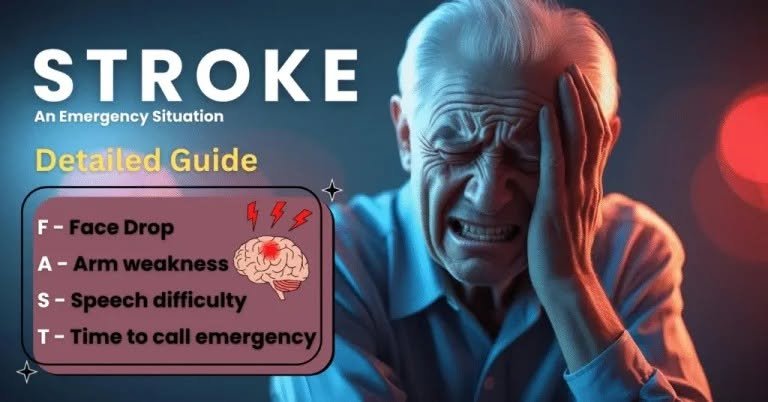
The Complete Clinical Guide to Stroke: Causes, Recognition, Diagnosis, and Advanced Treatment
A stroke is a medical emergency that occurs when blood flow to a region of the brain is interrupted or reduced, depriving brain tissue of oxygen and vital nutrients. Within minutes, brain cells begin to die. Understanding the underlying mechanisms, recognizing early warning signs, and securing immediate medical intervention are critical for minimizing long-term disability and saving lives.
Types and Core Causes of Stroke
Strokes are broadly categorized into three primary types, each driven by distinct pathological causes:
-
Ischemic Stroke (87% of all cases): Caused by a blocked or narrowed artery leading to the brain. This can result from a thrombosis (a blood clot forming in a cerebral artery narrowed by plaque buildup/atherosclerosis) or an embolism (a clot or piece of debris that travels from elsewhere in the body, commonly the heart, and lodges in a narrow brain vessel).
-
Intracerebral Hemorrhage: Occurs when a blood vessel inside the brain bursts, spilling blood into surrounding tissue. Chronic high blood pressure (hypertension) and cerebral amyloid angiopathy are leading triggers.
-
Subarachnoid Hemorrhage: Involves bleeding in the area between the brain and the thin tissues covering it (subarachnoid space), typically caused by a ruptured aneurysm or arteriovenous malformation (AVM).
-
Transient Ischemic Attack (TIA): Often called a “mini-stroke,” this is a temporary blockage of blood flow causing stroke-like symptoms that resolve within minutes to 24 hours. A TIA serves as an urgent warning sign of an impending major stroke.
Recognizing Symptoms: The FAST Acronym
Time is brain. Every minute a stroke goes untreated, the average patient loses roughly 1.9 million brain cells. The FAST framework is the global gold standard for identifying acute warning signs:
-
F – Face Drooping: Does one side of the face droop, or is it numb? Ask the person to smile.
-
A – Arm Weakness: Is one arm weak or numb? Ask the person to raise both arms. Does one drift downward?
-
S – Speech Difficulty: Is speech slurred, are they unable to speak, or are they hard to understand? Ask them to repeat a simple sentence.
-
T – Time to Call 911: If you observe any of these signs—even if they go away—call emergency services immediately and note the exact time symptoms first appeared.
Additional acute symptoms include sudden confusion, trouble walking, loss of balance or coordination, severe headache with no known cause, and sudden trouble seeing in one or both eyes.
Diagnostic Workup and Evaluation
Upon arrival at a medical facility, rapid diagnostic imaging and neurological assessments determine the precise type of stroke to guide treatment:
-
Computed Tomography (CT) Scan: A non-contrast head CT is typically the first imaging test performed to rapidly differentiate between an ischemic stroke and an intracranial hemorrhage.
-
Magnetic Resonance Imaging (MRI): Uses powerful magnets and radio waves to create detailed images of brain tissue, highly sensitive for detecting small or early-stage ischemic damage.
-
Angiography (CTA or MRA): Visualizes blood vessels in the neck and brain to locate blockages, aneurysms, or malformations.
-
Cardiac Evaluations: An electrocardiogram (ECG) and echocardiogram are routinely performed to check for arrhythmias (such as atrial fibrillation) that may have triggered a cardioembolic stroke.
Acute Medical and Surgical Treatments
Intervention strategies depend entirely on whether the stroke is ischemic or hemorrhagic:
| Stroke Type | Primary Acute Interventions | Recovery & Long-Term Management |
| Ischemic Stroke | Administration of IV alteplase or tPA (tissue plasminogen activator) within a strict 3-to-4.5-hour window to dissolve clots; Endovascular Thrombectomy (EVT) to mechanically retrieve large clots from major brain arteries. | Antiplatelet medications (aspirin, clopidogrel), statins for cholesterol management, blood pressure control, and targeted rehabilitation therapies. |
| Hemorrhagic Stroke | Emergency surgery to clip aneurysms, evacuate pooled blood, or relieve intracranial pressure; strict blood pressure reduction medications. | Long-term neurological rehabilitation, vascular monitoring, management of underlying hypertension, and lifestyle modifications. |
Prevention and Long-Term Outlook
Controlling modifiable risk factors drastically reduces stroke incidence. Key preventative measures include managing hypertension, treating atrial fibrillation with anticoagulants, maintaining healthy cholesterol and blood glucose levels, quitting smoking, exercising regularly, and adopting a heart-healthy diet rich in fruits, vegetables, and whole grains. Modern advancements in neurovascular intervention continue to improve survival rates and functional recovery, turning what was once a devastating event into a manageable medical emergency with effective post-stroke rehabilitation.