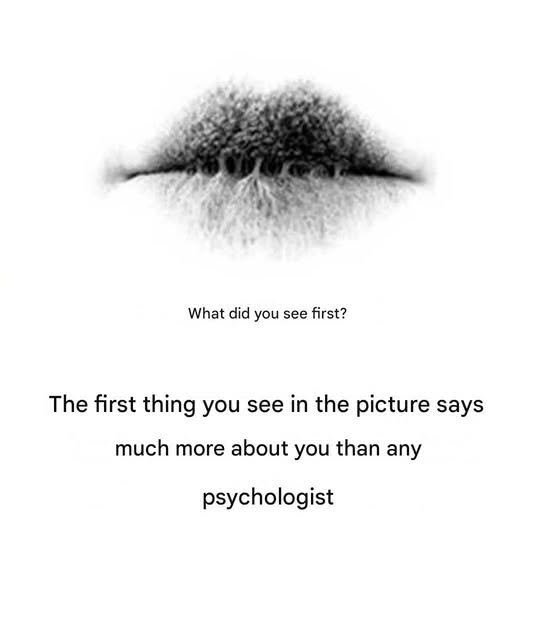
The Illusion of Choice: What the First Thing You See in an Image Reveals About Your Brain
You scroll through your social media feed, and suddenly a swirling optical illusion stops your thumb. The caption flashes a bold promise: “The first thing you see will reveal your deepest, darkest subconscious traits.” Within seconds, millions of shares later, we willingly hand our psychological blueprints over to a geometric graphic designed in Photoshop.
The Psychology of Pareidolia
Human beings are hardwired meaning-making machines. Long before we developed complex written language, survival depended on our brain’s ability to instantly spot patterns, danger, and hidden shapes in ambiguous environments—a neurological phenomenon known as pareidolia.
When you look at a classic ambiguity test (like the famous Rorschach inkblots or modern digital optical illusions), your brain does not consult a secret vault of your inner psyche. Instead, it relies on immediate, highly practical cognitive shortcuts:
-
Visual Processing Speed: How quickly your occipital lobe registers primary contrast, lines, and shading.
-
Contextual Priming: What you were thinking about three seconds before looking at the image (e.g., if you are hungry, you are far more likely to see a food shape in an abstract blob).
-
Neurological Bias: Whether your brain naturally prioritizes the whole picture (global processing) or zooms into microscopic details (local processing).
Why We Love Pseudo-Psychology
These viral personality quizzes exploit a well-documented cognitive bias called the Forer Effect (or Barnum Effect). Psychologist Bertram R. Forer discovered in 1948 that individuals will give high accuracy ratings to descriptions of their personality that supposedly were tailored specifically for them, but which are actually vague and universally applicable.
When a test tells you, “You are fiercely independent on the outside, but sensitive and caring on the inside,” your brain instantly finds supporting evidence from your life while ignoring all the times you were fiercely dependent or emotionally thick-skinned. It feels profound because our egos desperately want to believe we are complex, fathomable mysteries easily unlocked by a clever jpeg.
The Real Mirror
The true psychological revelation isn’t found in whether you saw a tiger or a tree first. The real insight lies in why you needed the validation of a digital test in that exact moment. Are you seeking certainty in a chaotic week? Are you bored at your desk? Or are you simply looking for a quick, low-stakes way to understand your own identity?
Your mind is shaped by your lived experiences, traumas, joys, and daily habits—none of which can be reduced to a binary visual split.
What is the most convincing personality test or quiz you’ve ever taken that actually turned out to be completely accurate?