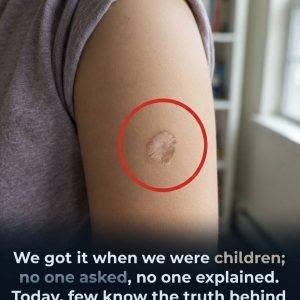
The Tiny Scar on Your Arm May Hold a Powerful Story About Humanity’s Greatest Victory Over Disease
Look closely at that circular mark on your shoulder. That tiny scar holds a profound story about humanity’s greatest victory over a devastating disease.
Roll up your sleeve and catch the light just right. Near your shoulder, most people born before the 1980s carry a distinct, faint circular mark—a slightly faded, puckered impression in the skin no larger than a pencil eraser. In a world obsessed with flawless skin and cosmetic perfection, this minor imperfection is easily ignored or forgotten.
Yet, that tiny indentation is far more than a simple mark left behind by childhood healthcare. It is a quiet, permanent badge of honor from one of the most remarkable scientific crusades in human history. It is the signature of smallpox eradication—a testament to a time when global cooperation, brilliant science, and profound courage allowed humanity to entirely wipe out a microscopic executioner that had plagued our species for thousands of years.
Understanding the origin of that mark changes how you view public health, modern medicine, and the quiet resilience embedded in everyday human history.
Understanding Smallpox and the Genesis of Vaccination
To appreciate the weight of that scar, you have to understand the terror that smallpox (Variola virus) once inflicted upon civilization. For millennia, smallpox was one of the most feared scourges on earth. It killed roughly thirty percent of everyone it infected and left survivors permanently scarred, blinded, or disfigured. Mummies dating back to ancient Egypt, including Pharaoh Ramses V, bear the unmistakable pockmark lesions of the virus, proving its ancient reign of terror.
The turning point began in 1796 when an English country doctor named Edward Jenner made a pivotal observation. Milkmaids who contracted cowpox—a mild, non-fatal disease caught from the udders of cows—seemed entirely immune to smallpox. In an audacious medical experiment, Jenner inoculated a young boy with cowpox matter, then later exposed him to smallpox. The boy never developed the disease.
Thus, the word vaccination was born, derived from vacca, the Latin word for cow. That initial discovery unlocked a biological key: by training the human immune system using a safe, weakened, or related agent, we could outsmart deadly pathogens before they ever took hold.
Why That Tiny Scar Looks Different: The Bifurcated Needle
If you examine your arm scar closely, you might notice it has a faint grid-like or stippled pattern rather than a solid oval shape. That specific visual texture tells a fascinating story of mid-20th-century engineering and global public health logistics.
For generations, smallpox vaccination was administered using a traditional multi-puncture lancet or jet injector gun, which often left a larger, more prominent scar. However, in the late 1960s, as the World Health Organization (WHO) launched its historic intensified eradication campaign, a brilliant medical engineer named Benjamin Rubin invented the bifurcated needle.
This tiny, two-pronged stainless-steel fork could hold a microscopic droplet of vaccine between its prongs by capillary action. Instead of driving a deep needle into the muscle, a healthcare worker would dab the skin multiple times rapidly—about fifteen pricks in a few seconds—just breaking the surface layer. This intradermal technique used a fraction of the vaccine liquid, required zero electricity, and could be easily taught to local volunteers in remote villages from the Brazilian rainforests to the mountains of India.
That unique grid pattern on your arm is the fingerprint of the bifurcated needle—an ingenious piece of technology that helped vaccinate hundreds of millions of people with maximum efficiency.
Why the Smallpox Eradication Matters Today
It is easy to take the eradication of smallpox for granted in the twenty-first century. When a disease is completely gone, people naturally forget the absolute devastation it once caused. However, looking at smallpox eradication through a modern lens provides vital lessons in global scientific solidarity.
Smallpox remains the only human infectious disease to be completely eradicated through deliberate public health intervention. In 1980, the World Health Assembly officially declared: “Smallpox is dead.”
Ignoring the historical effort required to achieve that victory creates a dangerous historical amnesia. Eradicating smallpox required unprecedented cooperation between geopolitical rivals during the height of the Cold War. The United States and the Soviet Union pooled resources, shared surveillance data, and co-funded vaccine distribution to corners of the earth torn apart by poverty and conflict. It proved that when humanity unites around a common scientific goal, even our most terrifying biological enemies can be permanently defeated.
Step-by-Step Actionable Guide to Exploring Medical History
Uncovering the historical context of medical milestones like the smallpox eradication can be an enriching educational pursuit. Follow these steps to dive deeper into medical history.
-
Examine Family Archives: Talk to older family members, parents, or grandparents about their memories of receiving the smallpox vaccine or witnessing the eradication campaigns of the 1960s and 70s.
-
Consult Archival Records: Visit digital museum archives, such as the Wellcome Collection or the Centers for Disease Control and Prevention (CDC) museum exhibits, to view historical photographs of the WHO eradication teams.
-
Study Epidemiological Principles: Read introductory literature on herd immunity, viral mutation, and the mechanics of attenuated live-virus vaccines to understand why eradication is so biologically difficult to achieve.
-
Preserve Oral Histories: If you know someone who worked on the front lines of global health during the mid-20th century, document their stories before those firsthand accounts are lost to time.
Strategic Comparison: Smallpox Eradication vs. Modern Disease Management
| Feature | Smallpox Eradication Campaign (1966–1980) | Modern Infectious Disease Control (e.g., Influenza/COVID) |
| Pathogen Stability | Extremely stable DNA virus with no animal reservoirs | Rapidly mutating RNA viruses that continuously evolve |
| Intervention Goal | Complete global eradication and zero transmission | Ongoing management, seasonal updates, and mitigation |
| Vaccine Permanence | Single lifetime administration provided long-term immunity | Frequent booster requirements needed to match new variants |
| Global Cooperation | Unprecedented Cold War-era superpower alignment | Fragmented international coordination and logistical friction |
Pros and Cons of Vaccine-Preventable Disease Eradication
-
Pros:
-
Completely eliminates human suffering, death, and disability caused by the pathogen.
-
Eliminates the long-term financial and medical costs of treating the disease.
-
Secures a safer, healthier future for all subsequent generations.
-
Validates the power of global scientific collaboration and innovation.
-
-
Cons:
-
Requires immense, sustained political will and international funding.
-
Logistics can be exceedingly difficult in war zones or remote, infrastructure-poor regions.
-
Public complacency can set in once a disease is no longer visible in daily life.
-
Maintaining secure laboratory samples for scientific research requires strict biosecurity protocols.
-
Common Mistakes and How to Fix Them
-
Mistake: Confusing the smallpox vaccination scar with the modern BCG tuberculosis vaccine scar.
-
Fix: While both leave marks on the upper arm, the smallpox scar typically features the distinct stippled pattern from the bifurcated needle, whereas the BCG scar is often smoother or keloid-raised. Check vaccination records if you are uncertain of your medical history.
-
-
Mistake: Assuming all viral diseases can be eradicated as easily as smallpox.
-
Fix: Understand that smallpox was biologically unique—it had no animal hosts, displayed obvious symptoms that made tracing easy, and left survivors immune for life. Viruses like influenza or rabies circulate in animal populations, making complete eradication practically impossible.
-
-
Mistake: Downplaying the rigorous historical effort required to achieve global health milestones.
-
Fix: Read primary accounts of WHO field workers who walked miles through impassable terrain to ring bells and vaccinate remote households.
-
Expert Insights: The Legacy of Eradication in Modern Virology
Historians of science and epidemiologists frequently emphasize that the eradication of smallpox laid the foundational blueprint for modern global health security. The surveillance-containment strategy—identifying an outbreak, isolating infected individuals, and ring-vaccinating their immediate contacts—was perfected during the smallpox campaign.
Medical researchers note that the scientific techniques developed during decades of studying poxviruses directly accelerated the foundational mRNA and viral-vector research platforms used today. The ghost of smallpox lives on not in disease, but in the advanced tools we use to protect human life from emerging pathogens.
Frequently Asked Questions
-
Why don’t children get the smallpox vaccine anymore?
Because smallpox was completely eradicated in the wild by 1980, routine vaccination was halted globally since the risk of the vaccine outweighed the non-existent risk of catching the disease.
-
Is the smallpox scar permanent?
Yes. The skin reaction caused by the vaccine creates localized tissue remodeling and a mild scar that typically remains visible for a lifetime.
-
Can smallpox return from nature?
No natural reservoirs of the smallpox virus exist anywhere on earth anymore. The only known official samples are kept under maximum security in approved research laboratories in the United States and Russia.
-
Did everyone get the same size scar?
No. Scar size varied based on the specific administration method used, individual skin healing responses, and whether it was a primary vaccination or a revaccination.
-
What does the vaccine actually contain?
Unlike early historical methods that used actual smallpox, modern-era smallpox vaccines use vaccinia virus, a harmless poxvirus related to smallpox and cowpox that stimulates the immune system safely.
-
Why is smallpox the only human disease eradicated so far?
Smallpox had no animal carriers (zoonotic reservoirs), caused obvious visible symptoms that made tracking simple, and provided lifelong immunity after infection or vaccination.
-
Who invented the bifurcated needle?
Dr. Benjamin Rubin invented it in 1965 while working for Wyeth Laboratories, and it became the primary delivery tool for the WHO’s global eradication push.
-
Are there people alive today who still have active smallpox immunity?
Individuals vaccinated before 1980 may retain some baseline T-cell or antibody memory, but experts believe immunity has waned significantly over the decades.
Action Checklist for Exploring Medical History
-
What to do:
-
Examine personal immunization records and family health histories.
-
Explore digital exhibits hosted by the WHO or CDC regarding disease eradication.
-
Read historical literature documenting the life and work of Edward Jenner and global health workers.
-
Share the history of the bifurcated needle to educate others about public health triumphs.
-
-
What to avoid:
-
Assuming historical medical advancements happened easily without immense human sacrifice and labor.
-
Confusing different types of vaccination scars found on the human arm.
-
Overlooking the vital importance of international scientific cooperation.
-
That tiny, unassuming circular mark on your arm is a quiet monument to human ingenuity—a permanent reminder that when science, courage, and global unity intersect, even our most devastating diseases can be permanently banished from the earth.