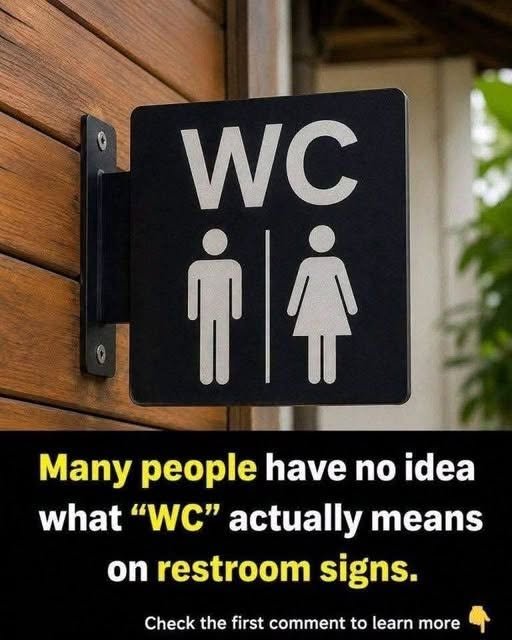
The Surprising History and Global Meaning Behind “WC” on Restroom Doors
Discover the fascinating linguistic roots of the two-letter abbreviation seen on washroom doors across the globe and why it remains an international travel staple.
Stepping off a plane in Europe, navigating a historic railway station in the UK, or checking out a boutique hotel in Asia, you are bound to encounter a familiar two-letter abbreviation on doors down the hall: WC.
For American travelers or those unfamiliar with international signage, it can occasionally prompt a moment of hesitation. Is it a utility closet? Does it stand for something technical? Yet, within seconds, the familiar universal symbol of a washroom underneath removes all doubt.
Despite how common the acronym is worldwide, few people stop to ask what those letters actually stand for or how a piece of nineteenth-century indoor plumbing terminology became an international standard. This quick exploration uncovers the surprising history, linguistic evolution, and modern relevance of “WC.”
The Translation: What “WC” Stands For
The letters “WC” stand for Water Closet.
While today the term sounds slightly formal or clinical, it was originally coined in Victorian Britain to describe a revolutionary technological upgrade: a toilet connected to running water that could flush waste away through a drainage pipe.
Before indoor plumbing became standard, most homes and public spaces relied on outdoor privies, chamber pots, or earth closets. When elite homes and hotels began installing the first indoor flushing toilets inside small, dedicated rooms or partitioned chambers, they needed a way to distinguish these modern marvels from ordinary storage spaces or washing rooms. Thus, the “water closet” was born.
Why Did It Become Standard on International Signs?
If the term originated in the English-speaking world, why is “WC” far more common on European and Asian restroom doors than it is in the United States?
1. Linguistic Neutrality and Brevity
As international travel and tourism surged in the mid-twentieth century, airports, train stations, and hotels needed signage that could be understood across multiple languages without requiring long translations. While “Restroom,” “Bathroom,” “Ladies/Gentlemen,” or “Toilet” carried different cultural nuances or language barriers, “WC” became a universally recognized shorthand.
2. European Standardization
Many European countries adopted “WC” directly into their local languages. In German, French, Dutch, Italian, and Spanish-speaking tourism sectors, the abbreviation became so embedded that locals often pronounce the letters using their native phonetic sounds (such as Vee-Ceh in German or Double-Vez in French) rather than translating the English words.
Comparative Overview: Global Restroom Terminology
| Region / Country | Common Signage / Terminology | Literal Meaning or Context |
| United Kingdom & Europe | WC or Toilets | Water Closet (historic indoor plumbing) |
| United States | Restroom, Bathroom, Men/Women | Focused on comfort or facility features |
| France | Les Toilettes or WC | Washing/cleansing room |
| Germany | WC or Toilette | Water Closet or cleaning facility |
| Australia & New Zealand | Toilets, Bathroom, Amenities | Practical municipal terminology |
Common Misconceptions About Restroom Signs
Misconception 1: “WC” Stands for “Wheelchair Accessible”
A surprisingly common mix-up for travelers is confusing “WC” with the international wheelchair accessibility symbol, leading to awkward moments.
-
The Reality: Wheelchair accessibility is designated by the universal ISA (International Symbol of Access) stick-figure icon in a wheelchair, whereas “WC” strictly denotes a water closet/toilet facility.
Misconception 2: “WC” Is a Modern Corporate Acronym
Some assume the abbreviation was invented recently by international airport architects.
-
The Reality: The term dates back to the 1870s and 1880s during the height of the Victorian plumbing boom in Great Britain.
Action Checklist
-
Look for the Letters: Spot “WC” on your next international trip to instantly locate essential facilities without translation hurdles.
-
Share the History: Impress your travel companions by explaining how Victorian plumbing terminology conquered the globe.
-
Check Accessibility: Remember that “WC” indicates a toilet, but look for the separate wheelchair icon if you need ADA-compliant facilities.
Language travels in strange ways. What started as a nineteenth-century Victorian engineering term for an indoor flushing toilet has survived the test of time, transforming into a globally understood linguistic shortcut that helps travelers find what they need, no matter what language is spoken outside the door.