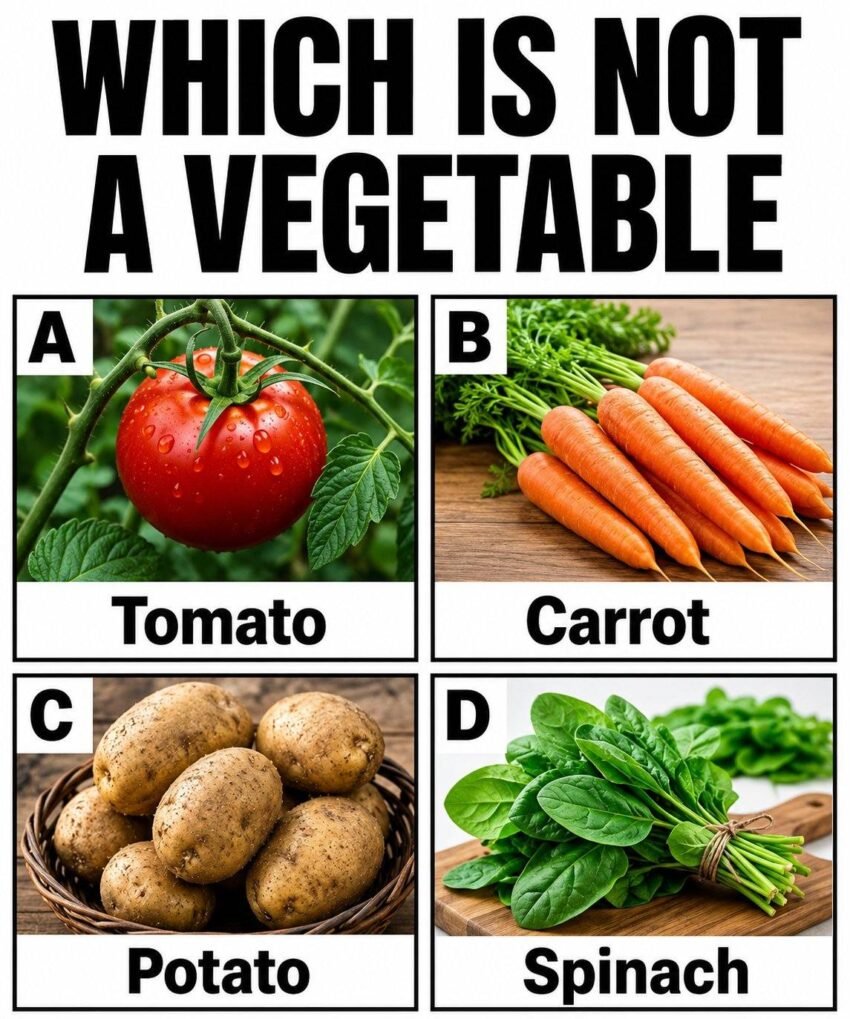
Which Is Not a Vegetable? Tomato, Carrot, Potato, or Spinach — The Answer Might Surprise You
Learn which option is not a vegetable among tomato, carrot, potato, and spinach. Simple explanation with nutrition facts and everyday examples.
At first glance, this question feels almost too easy:
Which is not a vegetable?
A) Tomato
B) Carrot
C) Potato
D) Spinach
Most people answer it quickly—sometimes confidently, sometimes incorrectly.
That’s because everyday language and botanical science don’t always agree. What we call a “vegetable” in the kitchen is often very different from how plants are classified in biology.
So let’s clear up the confusion once and for all.
The Correct Answer
👉 The scientifically correct answer is: Tomato
But there’s an important twist.
Tomato is botanically a fruit, even though it is used as a vegetable in cooking.
Why Tomato Is Not a Vegetable (Scientifically)
In botanical terms, fruits are defined as:
The seed-bearing part of a plant that develops from the flower.
A tomato develops from the flowering part of the plant and contains seeds inside.
That places it in the fruit category scientifically.
So even though we treat it like a vegetable in meals, salads, and sauces, biology class says otherwise.
Why the Other Options Are Vegetables
Let’s break down the rest:
🥕 Carrot
Carrot is a root vegetable.
We eat the taproot of the plant, which stores nutrients for growth.
It is firmly classified as a vegetable in both culinary and botanical terms.
🥔 Potato
Potato is also a vegetable—but specifically a tuber.
It grows underground and stores energy in the form of starch.
Even though it grows differently from leafy greens, it is still considered a vegetable.
🥬 Spinach
Spinach is a leafy green vegetable.
We consume its leaves, which are rich in vitamins and minerals.
It fits perfectly into the vegetable category.
Why People Get Confused
The confusion comes from the difference between two systems:
1. Culinary Classification
Used in cooking and everyday language.
- Vegetables = savory foods (spinach, carrot, potato, etc.)
- Fruits = sweet or sour foods (apple, mango, banana, etc.)
By this system, tomato is treated as a vegetable.
2. Botanical Classification
Used in science and biology.
- Fruits = seed-bearing structures
- Vegetables = roots, stems, leaves, and other plant parts
By this system, tomato is a fruit.
A Fun Fact That Surprises Most People
In 1893, the U.S. Supreme Court actually ruled that tomatoes should be legally classified as vegetables for taxation purposes.
Why?
Because they were commonly used in savory meals, not desserts.
So depending on context, tomato can be both:
- A fruit (science)
- A vegetable (law and cooking)
Simple Memory Trick
If you ever see a question like this again, remember:
- If it has seeds and grows from a flower → fruit
- If it is a root, leaf, or stem → vegetable
So:
- Tomato → Fruit 🍅
- Carrot → Vegetable 🥕
- Potato → Vegetable 🥔
- Spinach → Vegetable 🥬
Why This Question Matters More Than You Think
It may seem like a simple trivia question, but it teaches an important lesson:
Not everything is what it looks like on the surface.
In nutrition, science, and even daily life, categories often depend on perspective.
Understanding these differences helps you:
- Think more critically
- Understand food better
- Avoid common misconceptions
- Improve basic nutrition knowledge
Frequently Asked Questions
Is tomato a fruit or vegetable?
Botanically, tomato is a fruit. In cooking, it is treated as a vegetable.
Why is potato considered a vegetable?
Because it is an underground storage stem (tuber) used as a savory food.
Is carrot a fruit or vegetable?
Carrot is a vegetable. It is the root of the plant.
Is spinach a fruit?
No. Spinach is a leafy green vegetable.
Why do we treat fruits as vegetables in cooking?
Because culinary classification is based on taste and usage, not plant biology.
Are there other “vegetables” that are actually fruits?
Yes, examples include cucumber, bell pepper, eggplant, and zucchini.
Quick Answer Summary
- Tomato → Not a vegetable (fruit in science)
- Carrot → Vegetable
- Potato → Vegetable
- Spinach → Vegetable
Conclusion
So, which is not a vegetable—tomato, carrot, potato, or spinach?
The scientifically correct answer is tomato, because it is classified as a fruit. However, in everyday cooking, it is still commonly treated as a vegetable.
This simple question highlights how language and science can describe the same food in very different ways.
Tomato is the odd one out because it is a fruit botanically, even though we often use it like a vegetable in meals.