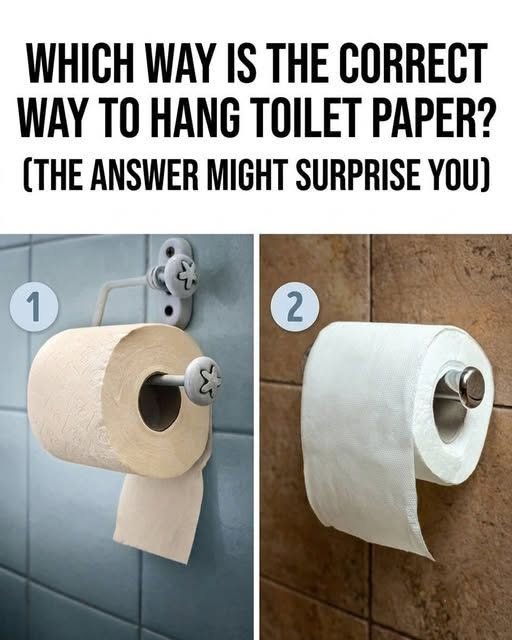
Which Way Is the Correct Way to Hang Toilet Paper? The Answer Might Surprise You
Over or under? Discover the history, practical benefits, hygiene debate, and surprising truth about the “correct” way to hang toilet paper.
There are some household debates that never seem to disappear.
Pineapple on pizza.
Toilet seat up or down.
And then there’s the surprisingly heated question:
Should toilet paper hang over the roll—or under it?
If you’ve ever walked into someone’s bathroom and immediately noticed the roll was hanging the “wrong” way, you’re definitely not alone.
For decades, people have argued that there is only one correct answer. Some insist the loose end should hang over the front of the roll. Others prefer it tucked underneath, closer to the wall.
And then there’s the famous historical claim that supposedly settles the argument once and for all.
An 1891 U.S. patent for a toilet-paper roll contains an illustration showing the paper hanging over the top.
Case closed, right?
Not quite.
The patent is real. The illustration is real. But the story that it definitively proves the inventor intended toilet paper to hang “over” is more complicated than viral posts often suggest.
So what’s actually the best way to hang your toilet paper?
Let’s settle the debate—with history, practicality, hygiene, and a little common sense.
Over or Under: What Are We Actually Talking About?
Before getting into the history, let’s define the two options.
The “over” method
The loose end hangs toward you and comes over the top of the roll.
      _______
    /         \
   |   ROLL    |
    \_________/
         \
          \
This is the orientation you’ll see in many hotels, restaurants, offices, and homes.
The “under” method
The loose end comes from behind the roll and hangs underneath, closer to the wall.
      _______
    /         \
   |   ROLL    |
    \_________/
          /
         /
Both methods dispense toilet paper perfectly well.
The disagreement is largely about convenience, cleanliness, appearance, and personal preference.
But there’s a fascinating historical reason the “over” side has such a strong case.
The 1891 Patent That Started the Modern Argument
In 1891, inventor Seth Wheeler of Albany, New York, received a U.S. patent for an improved toilet-paper roll.
The patent is U.S. Patent No. 465,588, issued on December 22, 1891.
And here’s where things get interesting.
The patent’s illustration shows a roll with the loose paper extending over the top.
That image eventually became famous online because people interpreted it as the inventor essentially saying:
“This is how toilet paper is supposed to hang.”
The image certainly makes a compelling argument for the “over” camp.
But there’s a catch.
The patent wasn’t actually about the orientation of the roll
The patent focused on the construction of the toilet-paper roll and, specifically, a perforation design intended to make individual sheets easier to separate.
A legal analysis of the patent points out that the illustration was meant to demonstrate features of the paper itself—not necessarily to establish an official hanging instruction.
In other words:
The inventor’s drawing shows “over,” but that doesn’t prove he declared “over” to be the only correct way.
There’s an even more interesting detail.
Another Wheeler patent from around the same period has been interpreted as showing the opposite orientation.
So if you’re looking for an absolutely definitive historical ruling from Seth Wheeler, the evidence isn’t as conclusive as internet memes suggest.
So… Is Over Actually Better?
Here’s where the argument becomes practical rather than historical.
For everyday use, over has several advantages.
1. It’s easier to see and grab
When the loose end hangs toward you, you can immediately see where the next sheet begins.
You don’t have to reach behind the roll to find the paper.
That can make changing the roll and tearing off individual sheets easier.
2. It’s easier to control the amount you use
The exposed sheet makes it easier to identify the perforation and tear off a specific number of squares.
That can be useful if you’re trying to avoid unnecessarily pulling off a long strip.
3. It looks more visually obvious
This may sound trivial, but there’s a reason hotels and many professionally maintained bathrooms commonly use the over position.
The loose end is visible.
The roll looks finished and ready to use.
It’s also easier for a guest to immediately understand where to pull.
What About Hygiene?
This is where the answer becomes surprisingly complicated.
You might assume that one orientation has been scientifically proven to be much more hygienic.
There isn’t strong evidence establishing that simply choosing “over” or “under” dramatically changes household infection risk.
However, there are reasonable arguments on both sides.
The argument for “over”
With the paper hanging over the roll, the loose end generally hangs away from the wall.
That can reduce the chance that the exposed edge repeatedly brushes against the wall behind the dispenser.
A bathroom wall isn’t necessarily sterile.
So keeping the loose paper away from surfaces can make intuitive sense.
The argument for “under”
There’s another side to the hygiene debate.
Depending on how you pull and tear the paper, the under position may allow some people to use one hand to hold the paper against the wall while tearing it.
That could reduce contact between a person’s hand and the rest of the roll.
A 2025 discussion involving microbiology experts highlighted this exact disagreement: one argument favored “under” because of reduced hand-to-roll contact, while another favored “over” because the paper is less likely to contact the wall.
So there isn’t a simple scientific verdict that says:
“Over is hygienic; under is unhygienic.”
The bigger hygiene factors are much less controversial.
What Matters More Than Over vs. Under?
If you’re genuinely concerned about bathroom hygiene, don’t spend all your energy fighting over the toilet-paper orientation.
Focus on the things that matter more.
Wash your hands properly
Hand hygiene is one of the most important ways to reduce the spread of infectious organisms.
After using the bathroom, wash your hands thoroughly with soap and water.
Keep the bathroom clean
Regularly clean frequently touched surfaces such as:
- Toilet handles
- Faucet handles
- Door handles
- Light switches
- Countertops
- Toilet surfaces
- Toilet-paper holders
Don’t touch the roll unnecessarily
Regardless of orientation, repeatedly handling the entire roll isn’t ideal.
Pull what you need, tear it off, and move on.
Keep the toilet-paper holder reasonably clean
Dust and residue can accumulate around holders over time.
A quick wipe during routine bathroom cleaning is easy.
The bigger lesson
The difference between over and under is probably much smaller than the difference between good and poor bathroom hygiene habits.
The Case for Hanging Toilet Paper “Over”
If we ignore tradition and look at everyday practicality, there are several reasons to prefer the over position.
Easier to find
The loose end is visible.
Easier to tear
The perforation is generally easier to access.
Easier for guests
A visitor doesn’t have to figure out where the paper is hiding.
Less contact with the wall
The hanging paper tends to sit away from the wall.
Easier to monitor
You can immediately see how much paper remains.
More convenient for children and older adults
For someone with limited dexterity or mobility, a clearly exposed loose end may be easier to grasp.
The Case for Hanging Toilet Paper “Under”
The under position isn’t irrational either.
There are legitimate practical reasons some people prefer it.
It looks tidier
The loose end is tucked behind the roll.
For people who prefer a minimalist bathroom, this can look cleaner.
It can discourage pets
Anyone who has lived with a curious cat knows that a toilet-paper roll can become an entertainment device.
An exposed roll can be incredibly tempting.
With the paper hanging underneath, some pets may have a harder time getting a good grip.
Of course, a determined cat may consider that a challenge rather than a deterrent.
It can reduce accidental unrolling
Children and pets can sometimes pull a surprising amount of paper from an exposed roll.
The under position can make that slightly less convenient.
It may feel more secure
Some people simply prefer the way the roll feels when the loose end is tucked closer to the wall.
There’s nothing medically wrong with that preference.
Over vs. Under: A Quick Comparison
| Feature | Over | Under |
|---|---|---|
| Easy to find loose end | Excellent | Good |
| Easy to tear | Excellent | Good |
| Paper away from wall | Usually | Less so |
| Looks minimalist | Good | Excellent |
| Pet-resistant | Less effective | Often better |
| Guest-friendly | Excellent | Good |
| Historical patent illustration | Yes | No |
| Proven dramatically more hygienic | No | No |
So if you’re asking which one is more convenient for most people, over has a strong argument.
But if you’re asking whether science has established one as universally correct, the answer is no.
What the Original Patent Actually Shows
The patent is worth examining because it’s at the heart of this debate.
Seth Wheeler’s 1891 patent describes an improved toilet-paper roll with a particular way of separating individual sheets. The design used shaped cuts and connections intended to make sheets easier to tear away cleanly.
The accompanying drawing depicts the roll with the paper coming over the top.
That historical image is real.
But interpreting it as a direct instruction—“always hang your toilet paper this way”—goes further than the patent itself does.
A legal analysis of the patent notes that the drawing was intended to illustrate the invention’s perforation and separation features, not necessarily the orientation of a bathroom dispenser.
That’s an important distinction.
So here’s the honest historical verdict:
The 1891 patent gives the “over” position a fascinating historical association, but it doesn’t conclusively settle the over-versus-under debate.
Why the Toilet Paper Debate Became So Emotional
It seems ridiculous that people can become genuinely annoyed about toilet paper orientation.
But there’s a psychological reason everyday household habits can become surprisingly personal.
We learn routines from our families.
Maybe your parents always installed toilet paper over.
Maybe your grandparents used under.
Maybe you grew up thinking the “correct” method was obvious.
Then you move in with a partner.
Suddenly, you discover that the other person has been doing it differently their entire life.
Neither person necessarily sees their method as a preference.
They see it as the normal way.
That’s how a tiny household habit can become a surprisingly passionate debate.
The Hotel Test
Want to know which orientation many people instinctively consider more polished?
Look at hotel bathrooms.
You’ll frequently find toilet paper hanging over the roll, sometimes with the loose end folded into a small point.
There’s a practical reason for this.
Hotels need bathrooms to be:
- Easy for guests to understand
- Visually tidy
- Quick to service
- Consistent from room to room
An overhanging roll checks those boxes.
It doesn’t prove that over is medically superior.
But it does make a good argument for its practicality.
What About the “Hotel Fold”?
You’ve probably seen toilet paper folded into a triangle or point in a hotel bathroom.
Some people interpret it as a hygiene measure.
It’s more accurately understood as a presentation and housekeeping convention.
The fold tells guests that the bathroom has been cleaned or serviced.
But don’t mistake a decorative fold for sterilization.
The important hygiene practices remain ordinary cleaning and good handwashing.
Is There a Right Way for Families With Kids or Pets?
This is where the “under” method can actually win.
If you have a toddler who enjoys pulling an entire toilet-paper roll onto the floor, you may develop a completely different definition of “correct.”
Likewise, cat owners have learned that some pets view toilet paper as a free-access entertainment system.
For those households, keeping the loose end underneath may reduce temptation.
So perhaps the real answer is:
The correct way is the way that works best for your household.
If you’re in a hotel, over is probably the easiest orientation for guests.
If you’re trying to keep a mischievous cat from turning your bathroom into a paper confetti machine, under may be the more practical choice.
Does Toilet Paper Direction Affect How Much You Use?
Possibly, but don’t expect a dramatic difference.
With the paper hanging over, the perforations are easy to see and the roll is easy to control.
That can make it easier to tear off a specific amount.
But there isn’t good evidence that simply changing the orientation will dramatically reduce household toilet-paper consumption.
If you want to use less paper, habits probably matter more:
- Pull deliberately.
- Avoid automatically taking a huge strip.
- Teach children not to unroll the roll unnecessarily.
- Don’t use toilet paper for cleaning tasks better suited to a reusable cloth or appropriate cleaning product.
Common Toilet Paper Mistakes
The over-versus-under debate gets all the attention, but there are other habits worth reconsidering.
Mistake #1: Treating the bathroom as a sterile environment
It isn’t.
Bathrooms contain many surfaces that can collect microorganisms.
Better approach: Clean regularly and wash your hands properly.
Mistake #2: Touching the entire roll
There’s no need to handle more of the roll than necessary.
Better approach: Pull the amount you need and tear it cleanly.
Mistake #3: Assuming a hotel-style fold makes the roll hygienic
A folded edge is mostly presentation.
Better approach: Judge cleanliness by actual cleaning practices.
Mistake #4: Using excessive toilet paper
More isn’t necessarily better.
Better approach: Use enough for the task without automatically pulling off a large amount.
Mistake #5: Starting a household war over the direction
Life is short.
Better approach: If your partner insists on the opposite orientation, consider agreeing on a compromise—or simply let the person who changes the roll choose.
The Surprisingly Important Part: Handwashing
If you want to improve bathroom hygiene, this is where your attention belongs.
The toilet-paper debate is entertaining.
Hand hygiene is much more consequential.
Wash your hands with soap and water after using the bathroom.
Make sure you clean all parts of your hands rather than quickly touching your palms together and calling it done.
And don’t forget commonly missed areas such as between the fingers and around the thumbs.
A perfectly positioned toilet-paper roll can’t compensate for poor hand hygiene.
So, Which Way Should You Hang Toilet Paper?
After looking at the history, practicality, and hygiene arguments, here’s the most reasonable conclusion:
For everyday convenience, hang it over.
The loose end is easier to see, easier to grab, easier to tear, and generally sits away from the wall.
There’s also a famous 1891 patent illustration showing the paper in that orientation.
But there’s an important asterisk.
It isn’t an objectively proven universal rule.
The patent wasn’t specifically declaring an official bathroom orientation, and arguments about hygiene exist on both sides.
So if you prefer under, you aren’t committing some terrible bathroom offense.
You’re simply choosing a different way to use the roll.
And if you live with someone who strongly disagrees?
You may have discovered that toilet paper is less about engineering and more about diplomacy.
Frequently Asked Questions
Is toilet paper supposed to go over or under?
For convenience, many people prefer the paper hanging over the top because the loose end is easier to see and grab. A famous 1891 patent illustration also depicts the paper coming over the roll. However, the patent does not explicitly establish “over” as the only correct orientation.
Did the inventor of toilet paper say it should hang over?
Not exactly. Seth Wheeler’s 1891 patent illustration shows the paper coming over the roll, but the patent concerned the design and perforation of the roll rather than establishing a universal hanging instruction.
Is hanging toilet paper over more hygienic?
There is no strong basis for saying that “over” is universally more hygienic. One argument is that the loose paper stays farther from the wall, while another argues that under can make one-handed tearing easier. Good bathroom cleaning and handwashing matter much more.
Why do hotels usually hang toilet paper over?
The over position makes the loose end easy for guests to find and creates a neat, recognizable presentation. Hotels also sometimes fold the end as part of housekeeping presentation.
Is hanging toilet paper under wrong?
No. There is no universal rule requiring toilet paper to hang under or over. Under may actually be convenient in households with pets or young children who like pulling the roll.
Does toilet paper direction save paper?
Possibly in small ways because over can make the perforations easier to see and the amount easier to control, but there isn’t strong evidence that orientation alone dramatically changes household toilet-paper consumption.
Why does everyone argue about toilet paper orientation?
It’s a familiar household habit, and people often learn it from their families. Because the habit becomes automatic, discovering that someone does it differently can feel surprisingly “wrong.”
What is the best way to keep toilet paper hygienic?
Keep the bathroom and toilet-paper holder clean, avoid unnecessary handling of the roll, and wash your hands thoroughly after using the bathroom. The orientation itself is a relatively minor part of overall bathroom hygiene.
What if my cat keeps unrolling the toilet paper?
Try hanging the roll under, keeping the bathroom door closed when appropriate, or using a holder designed to make unrolling more difficult. In a cat household, practicality may be more important than historical tradition.
Does the 1891 patent prove the debate is over?
No. The patent drawing strongly associates Wheeler’s invention with the over orientation, but the patent itself was about the construction and perforation of the roll. A historical analysis also points out that the drawing shouldn’t necessarily be interpreted as an official instruction about dispenser orientation.
Final Verdict: Over Wins—But Not Because the Law Says So
After more than a century of debate, the toilet-paper question still doesn’t have the absolute scientific or legal answer that viral posts sometimes promise.
The famous 1891 patent is real.
The drawing shows the paper coming over the roll.
But that doesn’t mean Seth Wheeler officially declared war on everyone who prefers the under position.
For most households, over is probably the more convenient choice. It’s easy to grab, easy to tear, and keeps the loose paper visible.
But if you prefer under, your bathroom isn’t breaking any rules.
And if someone in your household insists otherwise, you now have the perfect response:
“The patent shows over—but technically, it doesn’t settle the argument.”
Then quietly change the roll and walk away.
Some debates are best left unresolved.
What do you use—over or under? Share this article with the person in your household who always changes the roll the “wrong” way and let the debate begin.