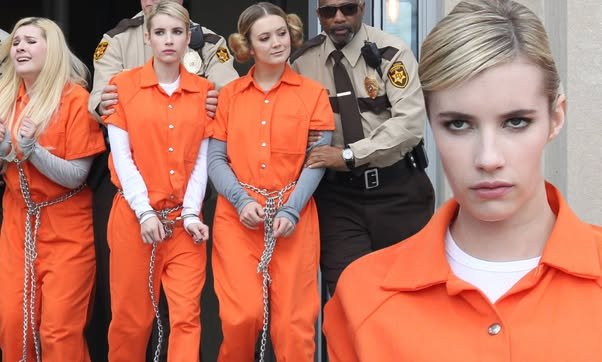
The High-Vis History: Why American Prisoners Wear Orange Jumpsuits
Drive past a county jail or watch any American news broadcast covering a high-profile transfer, and you will see the same visual uniform: the bright, unmistakable orange jumpsuit. It has become an inescapable pop-culture trope, shorthand for incarceration across movies, television, and true-crime documentaries.
Yet, this sartorial choice is a relatively modern invention. For decades, American penal institutions relied on traditional black-and-white stripes, classic denim, or gray cotton duck uniforms. The nationwide shift to high-visibility orange was driven by a mix of public safety, psychological deterrence, and administrative practicality.
The Catalyst: The Alcatraz and Prison Escapes of the Past
Historically, American prisons used striped uniforms specifically to make runaway inmates instantly recognizable to the public and law enforcement. The iconic black-and-white stripes were introduced in the 19th century because they stood out sharply against natural landscapes.
However, by the mid-20th century, correctional systems phased out stripes, viewing them as archaic and overly punitive, transitioning instead toward more muted, utilitarian work-clothing colors like khaki, gray, and dark blue.
The widespread adoption of bright orange began in the 1970s and 1980s, catalyzed by high-profile prison escapes and a growing focus on facility management. County jails and maximum-security lockups needed a color so violently bright that it would be impossible for an escaped inmate to blend into a civilian crowd, even from a distance.
The Four Reasons Corrections Departments Chose Orange
The standardization of orange jumpsuits wasn’t arbitrary; it serves specific operational functions within the modern American penal system:
-
Instant Visual Identification: In the event of an escape, a prison yard riot, or an unauthorized movement within a facility, correctional officers and local law enforcement can spot an orange-clad individual instantly against concrete, asphalt, and natural foliage.
-
Psychological Disorientation: Clinical studies on color psychology suggest that hyper-saturated, synthetic bright colors can induce subtle psychological fatigue and lower morale. While debated, uniform codes often utilize standardized colors to strip away individuality and reinforce institutional control.
-
Standardized Inventory Control: Jumpsuits are cheap to manufacture, easy to launder in industrial facilities, and difficult to alter or conceal weapons beneath. A one-piece garment eliminates belts, extra pockets, and layered clothing where contraband could be hidden.
-
Media and Public Safety Signaling: For county jails holding pretrial detainees or inmates awaiting transport, orange visually separates them from the general public, warning citizens to maintain distance during hospital visits or courthouse transfers.
Variations Behind Bars: It’s Not All Orange
Outside of popular media, not every American inmate wears orange. Correctional institutions actually use a sophisticated color-coding hierarchy to manage populations and assess security risks:
-
Orange: Typically reserved for county jail inmates, pretrial detainees, or high-risk transport situations where maximum visibility is required.
-
Khaki or Beige: Frequently used in federal penitentiaries and state prisons for general population inmates who have demonstrated stable behavior.
-
White or Light Gray: Often assigned to inmates in protective custody, administrative segregation, or death row, signifying restricted movement.
-
Green or Blue: Frequently utilized for trusties, work-release inmates, or those assigned to institutional jobs (such as kitchen or laundry details) who have earned lower-security status.
-
Red or Yellow: Commonly deployed to identify maximum-security inmates, disciplinary segregation cases, or specific protective separation needs (such as keeping rival gang members apart).
The Modern Debate Over Prison Attire
In recent years, the use of standard prison uniforms—particularly bright orange—has faced growing criticism from civil rights advocates, criminal justice reformers, and even some correctional administrators.
Critics argue that parading pretrial detainees through media cameras in bright orange jumpsuits violates the foundational legal principle of the presumption of innocence. When a defendant appears in court or on the evening news wearing high-visibility orange shackles, it creates an unavoidable cognitive bias in the minds of the public and potential jurors, framing them as guilty before a trial even begins.
Additionally, some progressive municipal jails have begun experimenting with civilian-style clothing for low-risk or pretrial populations, noting that returning to normal attire helps preserve human dignity, reduces institutional dehumanization, and lowers recidivism rates upon reentry.
The orange jumpsuit remains a defining symbol of the American justice system, born out of a practical need for security, visibility, and control. While its future may shift as public attitudes toward pre-trial detention and rehabilitation evolve, it stands as a stark visual reminder of how institutions manage populations under lock and key.
What are your thoughts on the use of standard prison uniforms—should pre-trial detainees wear civilian clothes to protect the presumption of innocence? Share your perspective in the comments below.