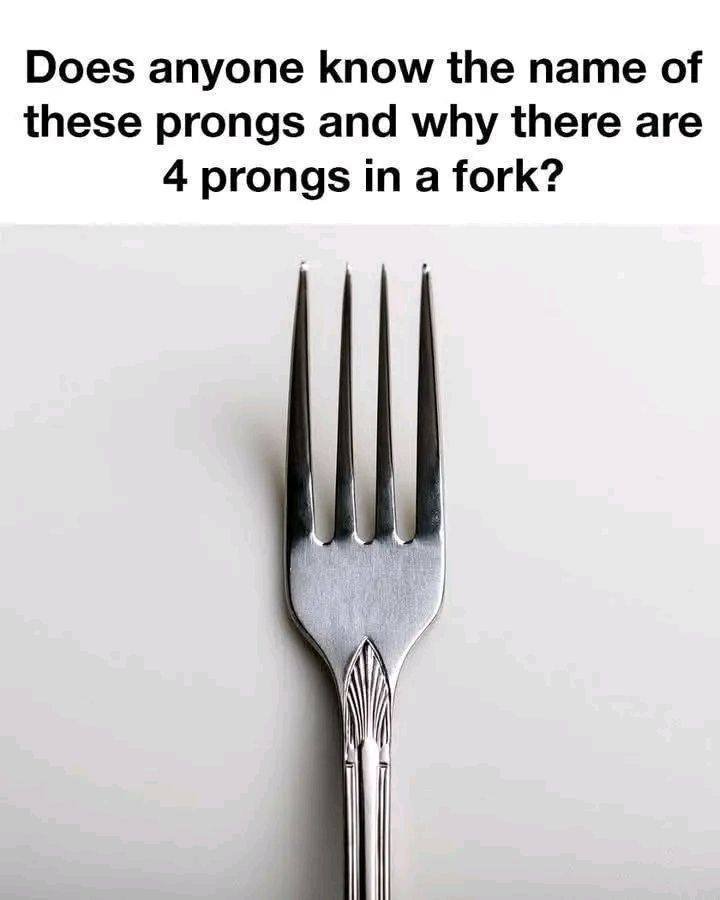
Why Do Forks Have Four Prongs? The Surprising Reason Will Make You Look at Your Utensils Differently
Ever wondered why forks have four prongs? Discover the fascinating history, design logic, and practical reasons behind this everyday utensil.
A Simple Question That Stumps Most Adults
It’s funny how kids ask the questions we’ve never really thought about.
You’re sitting at the dinner table, and suddenly:
“Why does a fork have four prongs?”
You pause… and realize you don’t actually know.
It’s one of those everyday objects we use without thinking—but behind that simple design is centuries of evolution, practicality, and clever engineering.
Let’s break it down in a way that finally makes sense.
The Short Answer
Forks typically have four prongs (or tines) because it’s the perfect balance between:
- Stability
- Functionality
- Ease of use
But that’s just the surface.
The real story goes much deeper.
A Quick Look at History
Forks weren’t always part of everyday dining.
In fact:
- Early forks in Europe (around the 11th century) had two prongs
- They were mainly used for serving food, not eating
- Many people preferred using hands, knives, or spoons
By the 18th century, forks became more common in places like Italy, France, and eventually the United States.
And during that time, designers experimented with:
- 2 prongs
- 3 prongs
- 4 prongs
- Even more in some cases
Over time, one design clearly stood out.
Why Four Prongs Became the Standard
1. Better Grip on Food
Two prongs weren’t enough.
They could spear food, but:
- Soft foods slipped off
- Small items were hard to pick up
Adding more prongs gave better control.
Four prongs = a secure grip without damaging food.
2. Perfect Balance Between Spacing and Strength
If you add too many prongs:
- They become too thin
- Food gets squished instead of held
- Cleaning becomes harder
If you use too few:
- Food slips through
Four prongs hit the sweet spot:
- Strong enough
- Spaced well
- Easy to use
3. Works for Multiple Food Types
Think about what you eat daily:
- Pasta
- Salad
- Meat
- Vegetables
A four-pronged fork can:
- Twirl pasta
- Hold salad leaves
- Pierce meat
- Scoop small items
Few designs are this versatile.
4. Comfort and Control
The design also fits naturally in your hand.
With four prongs:
- Pressure is evenly distributed
- Less force is needed
- It feels intuitive to use
That’s why even children quickly learn how to use a fork.
Why Not 3 or 5 Prongs?
Three-Pronged Forks
These still exist—especially for:
- Seafood
- Desserts
But they’re less versatile for everyday meals.
Five or More Prongs
Sounds useful, but in practice:
- They’re harder to manufacture
- Less durable
- Not significantly more effective
So they never became mainstream.
Fun Fact: Different Forks Still Exist
Even today, not all forks are the same.
You’ll find variations like:
- Salad forks (often shorter with slightly wider spacing)
- Dessert forks (sometimes 3 prongs)
- Serving forks (larger and stronger)
But the standard dinner fork?
Still four prongs—because it works.
Real-Life Scenario: Why This Matters
Imagine trying to eat spaghetti with a two-pronged fork.
- It slips
- It’s messy
- It takes longer
Now switch to a four-pronged fork:
- Smooth twirling
- Better grip
- Less frustration
That small design difference changes the entire eating experience.
Pros and Cons of the Four-Prong Design
| Pros | Cons |
|---|---|
| Excellent grip | Not specialized for every food |
| Versatile | Slightly harder to clean than 2-prong |
| Comfortable to use | Can bend if low-quality |
| Balanced design | Limited innovation due to standardization |
Common Misconceptions
“It’s just tradition”
Not true. The design survived because it’s functional, not just historical.
“More prongs would be better”
In reality, more prongs reduce efficiency and durability.
“All forks are the same”
Different forks serve different purposes—but four prongs dominate for a reason.
Expert Insight: Design Simplicity Wins
There’s a principle in design:
The best tools are the ones you don’t have to think about.
Forks are a perfect example.
The four-prong design is:
- Simple
- Efficient
- Time-tested
That’s why it hasn’t changed much in hundreds of years.
2026 Perspective: Why This Still Matters
In a world full of innovation, some designs remain unchanged because they’ve already reached optimal efficiency.
Like:
- The wheel
- The paperclip
- The fork
Sometimes, evolution doesn’t mean change—it means getting it right once and keeping it that way.
FAQs
1. What are fork prongs actually called?
They’re called tines.
2. Who invented the four-prong fork?
No single inventor—it evolved over time in Europe.
3. Are there cultures that use different forks?
Yes, but the four-prong design is widely adopted globally.
4. Why do some forks have uneven prongs?
Specialized forks (like salad forks) may have a wider tine for cutting or scooping.
5. Is a four-prong fork the most efficient design?
For general use—yes, it’s considered the best balance of function and simplicity.
6. Can fork design still improve?
Possibly, but major changes are unlikely because the current design works extremely well.
Quick Action Checklist (Try This Yourself)
- Compare different forks in your kitchen
- Notice how each handles different foods
- Try eating with fewer prongs (for fun!)
- Observe how design affects ease of use
That simple fork on your table?
It’s the result of hundreds of years of trial, error, and refinement.
Four prongs aren’t random—they’re the perfect balance of function, comfort, and efficiency.
Next time you sit down for a meal and pick up your fork, take a second to appreciate it.
A small design.
A big impact.
And thanks to your kid’s question—you now know the answer most adults don’t.
Got more “why does this exist?” questions? Drop them below. Those simple curiosities often lead to the most fascinating discoveries.